Mastering Kinematics Equations
📋 In this guide
Kinematics equations are the cornerstone of understanding motion in physics. These equations describe the motion of objects without considering the forces that cause the motion. Despite their fundamental nature, students often struggle with kinematics equations due to the complexity of integrating multiple variables like velocity, acceleration, displacement, and time. This article will break down these equations into understandable parts, helping you gain confidence in tackling kinematics problems.
Students often find kinematics equations challenging because they involve abstract concepts that require a solid grasp of algebra and physics. With multiple variables that can change simultaneously, it's easy to feel overwhelmed. However, by mastering these equations, you'll be able to solve problems involving everything from a falling apple to a speeding car.
By the end of this article, you'll have a comprehensive understanding of kinematics equations, including their key formulas, step-by-step problem-solving techniques, and real-world applications. Whether you're tackling physics kinematics equations for the first time or looking to refine your skills, this guide will provide the clarity you need to excel.
Step-by-Step: How to Solve Kinematics Equations
Step 1: Identify the Known Variables
When solving problems using kinematics equations, start by identifying what information is provided. Typically, you'll be given values for some variables, such as initial velocity, time, or acceleration. Write these down clearly, and determine which variable you need to find. This step is crucial as it helps you choose the right equation.
Step 2: Choose the Appropriate Equation
Based on the known variables, select the most suitable kinematics equation. For example, if you have initial velocity, acceleration, and time, and need to find the final velocity, you would use the equation v = u + at. This decision-making process is key to solving the problem efficiently.
Step 3: Substitute the Known Values
Once you've chosen the correct equation, substitute the known values into it. This step involves basic algebra, where you'll input the numerical values for the variables you know. Ensure your units are consistent (e.g., using meters for distance and seconds for time) to avoid errors.
Step 4: Solve for the Unknown Variable
With the equation set up, solve for the unknown variable. This may involve rearranging the equation if necessary. Double-check your calculations to ensure accuracy. After finding the answer, consider whether it makes sense contextually to verify your solution's validity.
🤖 Stuck on a math problem?
Take a screenshot and let our AI solve it step-by-step in seconds
⚡ Try MathSolver Free →Worked Examples
Example 1
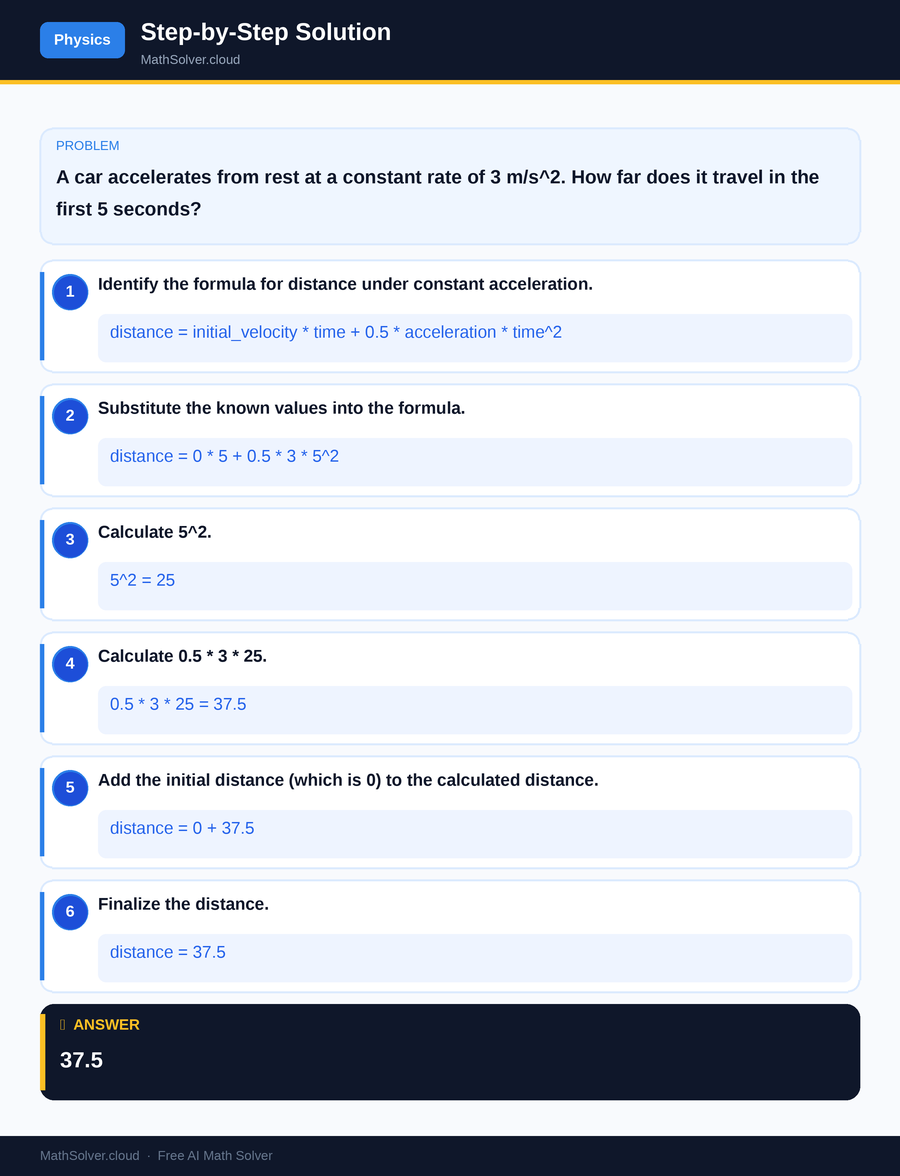
MathSolver Chrome extension solving this problem step-by-step
Example 2
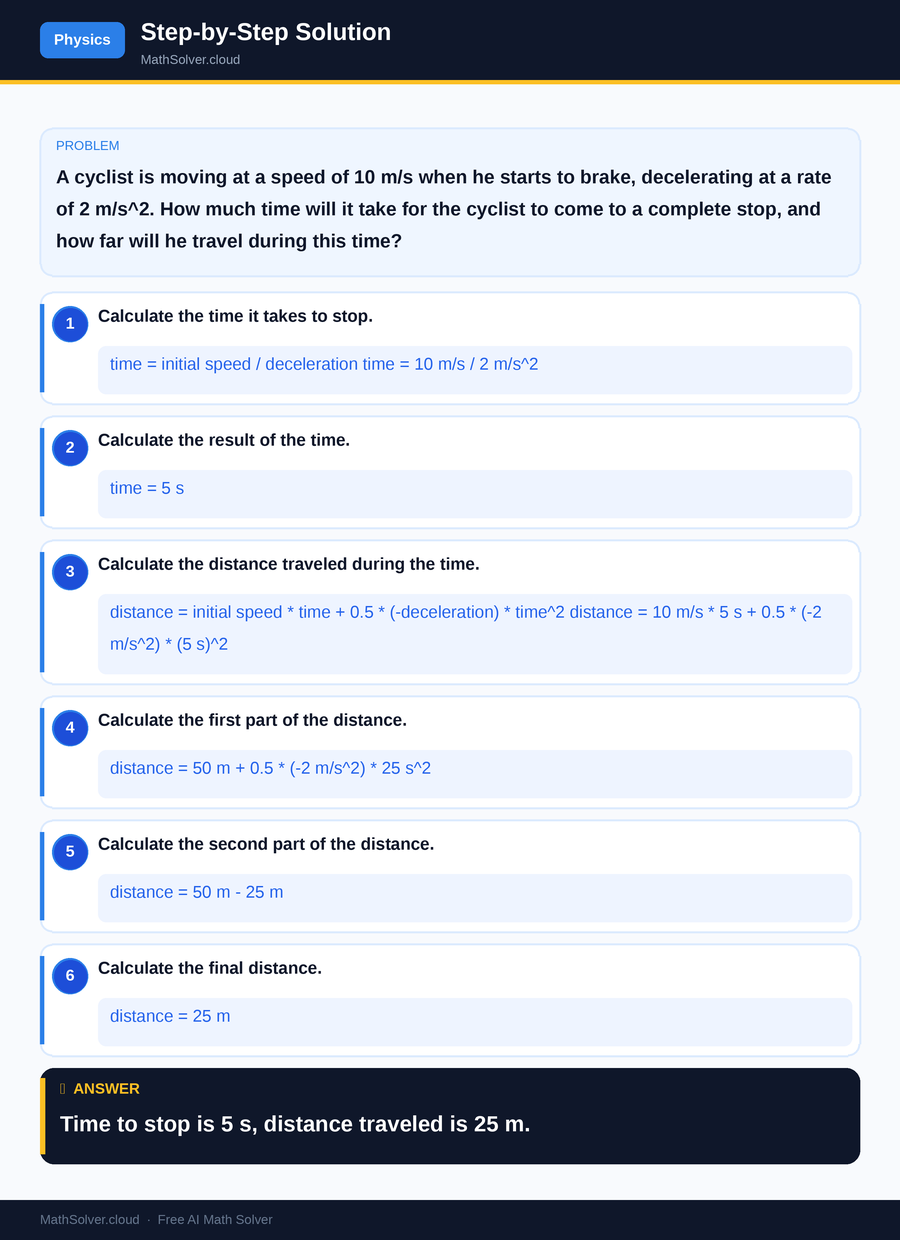
MathSolver Chrome extension solving this problem step-by-step
Common Mistakes to Avoid
One common mistake students make with kinematics equations is confusing the variables, especially initial and final velocities. To prevent this, always clearly label your variables and double-check which velocity is initial and which is final. Another frequent error is inconsistent units; remember to convert all measurements to compatible units before solving to avoid incorrect answers.
Another pitfall involves misidentifying which equation to use for a given problem. This can be avoided by carefully analyzing the known and unknown variables and matching them with the equation that aligns with your needs. Practice and familiarity with the equations will reduce this error over time.
Real-World Applications
Kinematics equations are crucial in various real-world applications, from engineering to video game design. Engineers use these equations to design vehicles and predict their motion under various conditions, ensuring safety and efficiency. Similarly, kinematics is essential in sports science for analyzing athletes' movements to enhance performance and reduce injury risks.
In the entertainment industry, animators use kinematics equations to create realistic motion in films and video games. By understanding how objects move, they can simulate lifelike animations that enhance the user experience. These examples highlight the broad applicability of kinematics in practical scenarios.
Frequently Asked Questions
❓ What are kinematics equations?
❓ Why do students struggle with kinematics equations?
❓ How can AI help with kinematics equations?
❓ What is the difference between linear and rotational kinematics equations?
❓ How are kinematics equations used in sports?
🚀 Solve any math problem instantly
2,000+ students use MathSolver every day — join them for free
📥 Add to Chrome — It's Free