Mastering Kinematic Equations in Physics
📋 In this guide
Kinematic equations are a fundamental tool used in physics to describe the motion of objects. These equations relate the variables of motion, such as displacement, velocity, acceleration, and time, enabling students to solve a wide range of problems involving moving objects. Many students find kinematic equations challenging because they require a solid understanding of algebra and a clear grasp of the physical concepts involved. In this article, we'll break down the kinematic equations, discuss their applications, and provide step-by-step guidance to help students master them.
Understanding kinematic equations is crucial for anyone studying physics, as they form the basis for analyzing motion in one or more dimensions. Students often struggle with these equations because they involve multiple variables and can be applied in various ways depending on the problem. However, with practice and a structured approach, anyone can learn to apply kinematic equations effectively. By the end of this article, you'll have a clear understanding of these equations and be able to solve typical physics problems involving motion.
In addition to linear motion, kinematic equations can also be extended to rotational motion, where they are known as angular kinematic equations. These are used to describe the motion of rotating objects and are essential for understanding phenomena such as spinning wheels and rotating planets. As we delve into the details of kinematic equations, you'll also learn about their broader applications in physics and how they are essential for solving real-world problems.
Step-by-Step: How to Solve Kinematic Equations
Step 1: Identifying the Given Variables
The first step in solving problems with kinematic equations is to carefully identify the known variables in the problem. Look for information about the initial velocity, final velocity, acceleration, time, and displacement. It's crucial to understand which values are provided and which variable you need to solve for. This will guide you in selecting the appropriate kinematic equation to use.
Step 2: Choosing the Right Equation
Once you have identified the known variables, the next step is to choose the right kinematic equation that relates these variables. For example, if you have the values for initial velocity, acceleration, and time, and you need to find the final velocity, you would use the equation v = u + at. Understanding the relationships between the variables is key to selecting the correct equation for your problem.
Step 3: Solving the Equation
With the appropriate kinematic equation selected, substitute the known values into the equation. Make sure to keep track of units, as they need to be consistent throughout the calculation. Solve for the unknown variable by performing the necessary algebraic manipulations. This might involve isolating the variable on one side of the equation or rearranging terms to simplify the calculations.
Step 4: Checking Your Work
After finding the solution, it's important to check your work. Verify that the solution makes sense in the context of the problem. Double-check your calculations and ensure that all units are consistent. If the result seems unreasonable, revisit your steps to identify any errors. This practice will help you develop a deeper understanding of kinematic equations and build confidence in your problem-solving skills.
🤖 Stuck on a math problem?
Take a screenshot and let our AI solve it step-by-step in seconds
⚡ Try MathSolver Free →Worked Examples
Example 1
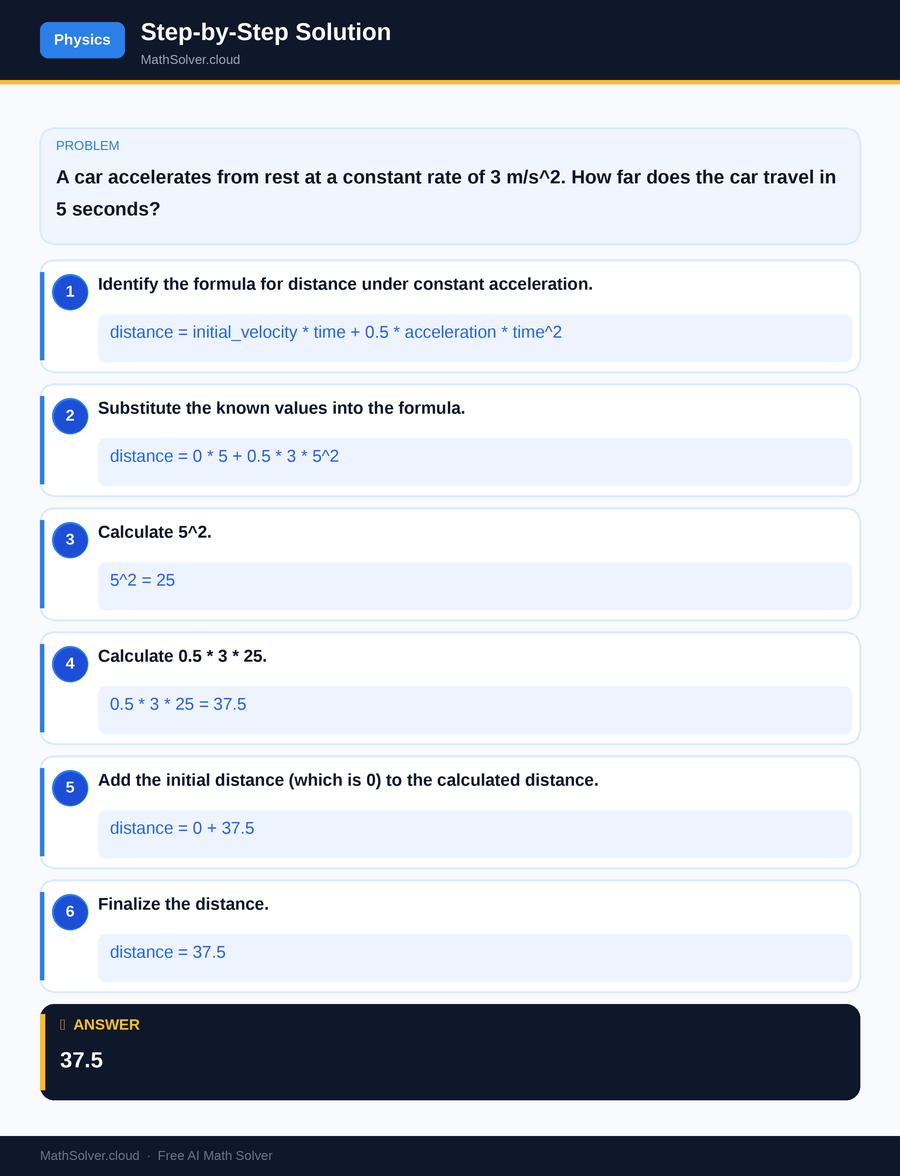
MathSolver Chrome extension solving this problem step-by-step
Example 2
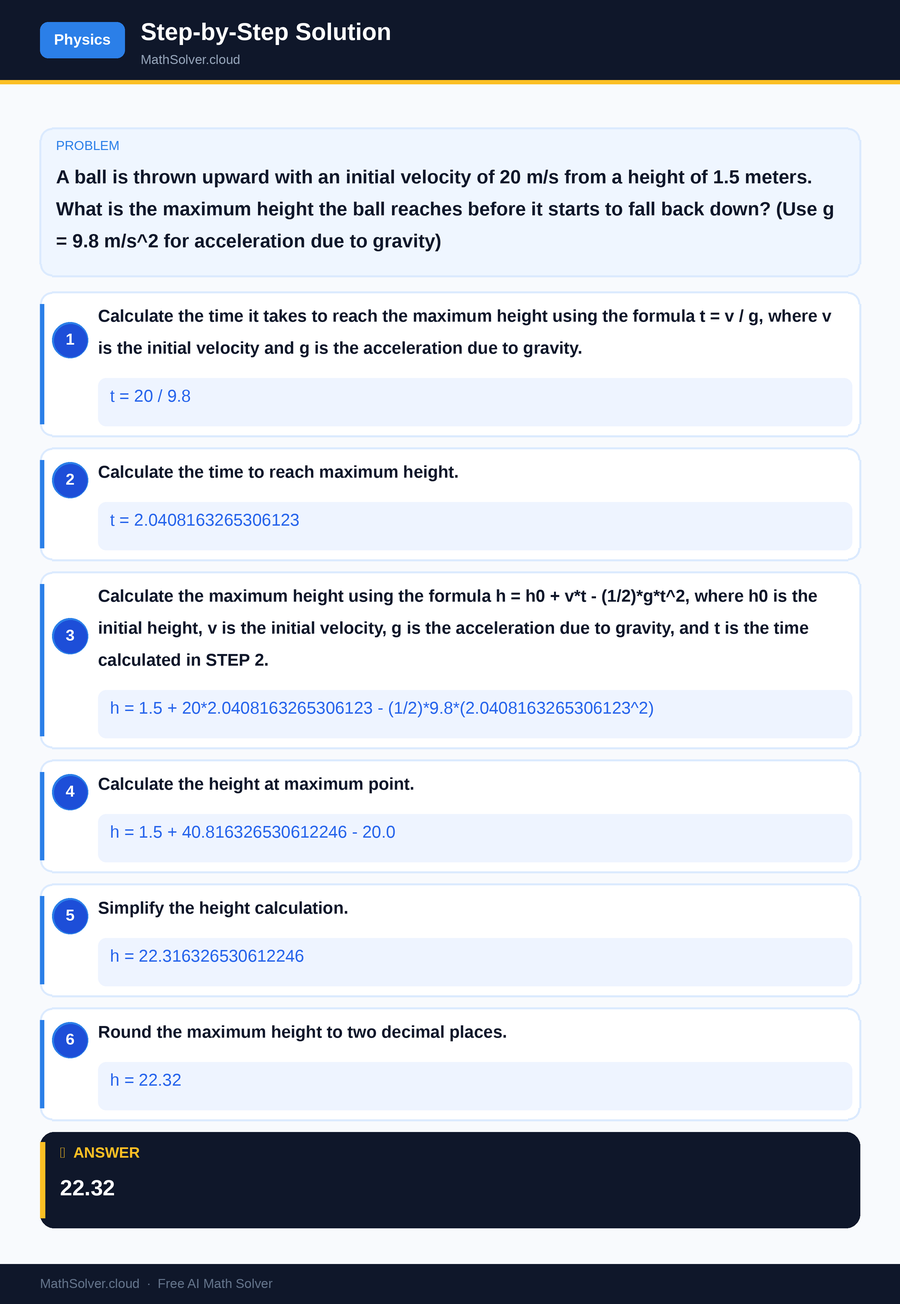
MathSolver Chrome extension solving this problem step-by-step
Common Mistakes to Avoid
One common mistake students make when using kinematic equations is confusing the variables, such as mixing up initial and final velocities. To avoid this, always clearly label each variable and keep track of what each one represents in the context of the problem. Another frequent error is neglecting the direction of motion, which can lead to incorrect signs for velocity and acceleration. Remember that direction matters, especially in problems involving gravity or any form of deceleration.
Another pitfall is failing to use consistent units, which can lead to incorrect results. Always ensure that all measurements are in compatible units (e.g., meters, seconds) before performing calculations. If necessary, convert units before substituting values into the equations. By paying attention to these details, you'll be better equipped to solve problems accurately and efficiently.
Real-World Applications
Kinematic equations have numerous real-world applications. For instance, they are used in designing transportation systems, such as calculating the stopping distance required for vehicles or determining the optimal launch parameters for rockets. Engineers also use these equations to analyze the motion of machinery parts, ensuring that they operate efficiently within specified limits.
In sports, kinematic equations help athletes improve their performance by analyzing their motion. For example, coaches can use these equations to optimize a sprinter's acceleration and velocity to achieve the best possible race times. Understanding the principles of motion through these equations provides valuable insights that can be applied in various fields, from automotive design to athletics.
Frequently Asked Questions
❓ What are kinematic equations used for?
❓ Why are kinematic equations important in physics?
❓ How can AI help with kinematic equations?
❓ What is the difference between linear and angular kinematic equations?
❓ How do kinematic equations relate to real-world problem-solving?
🚀 Solve any math problem instantly
2,000+ students use MathSolver every day — join them for free
📥 Add to Chrome — It's Free