Exploring the Kinematic Equation in Physics
📋 In this guide
The kinematic equation is a fundamental tool in physics that describes the motion of objects. These equations are essential for solving problems related to the motion of objects, whether it's a car accelerating down a road, a ball being thrown into the air, or any other scenario involving motion. Many students find kinematic equations challenging due to their mathematical nature and the requirement to understand physical concepts such as velocity, acceleration, and displacement. In this article, we'll explore the kinematic equation in detail, breaking it down step by step to make it more approachable and understandable.
Kinematic equations are crucial because they help predict and analyze motion, a core concept in physics. Students often struggle with these equations because they involve multiple variables and require a solid understanding of basic physics principles. Additionally, the application of these equations often involves interpreting complex word problems, which can be daunting. However, by the end of this article, you'll have a solid grasp of the kinematic equation and feel more confident in tackling related problems.
Throughout this article, we'll explore the key kinematic equations and how they are used in physics to describe an object's motion. We'll provide a step-by-step guide to help you understand how to apply these equations in different scenarios. Additionally, we'll work through some example problems to illustrate how these equations are used in practice. Finally, we'll discuss common mistakes to avoid, real-world applications, and answer some frequently asked questions. Whether you're a student studying physics or just someone interested in understanding motion better, this article will provide valuable insights into the kinematic equation.
Step-by-Step: How to Solve Kinematic Equation
Step 1: Understand the Variables
The first step in using kinematic equations is to understand the variables involved. Each equation contains variables such as initial velocity (u), final velocity (v), acceleration (a), time (t), and displacement (s). It's crucial to identify these variables in the problem you're solving. For example, if a problem states that a car starts from rest, this implies that the initial velocity (u) is 0. Understanding these variables will help you choose the right kinematic equation to use.
Step 2: Choose the Appropriate Equation
Once you've identified the variables, the next step is to choose the appropriate kinematic equation. The choice depends on the information given and the quantity you need to find. For example, if you know the initial velocity, acceleration, and time, and you need to find the final velocity, you would use the equation v = u + at. It's essential to match the equation to the known quantities and the quantity you need to solve for.
Step 3: Substitute the Values
After selecting the correct equation, substitute the known values into it. Pay attention to the units of each quantity to ensure consistency. For example, if the time is given in seconds and the velocity in meters per second, make sure all other units are compatible. Substituting the values correctly is critical to getting the right answer, so double-check your work before proceeding.
Step 4: Solve for the Unknown
Finally, solve the equation for the unknown variable. This may involve algebraic manipulation, such as rearranging the equation to isolate the unknown. After solving, check your answer to ensure it makes sense in the context of the problem. For instance, if you're solving for time and get a negative value, this suggests a mistake since time cannot be negative. Always verify your solution by considering whether it logically fits the problem description.
🤖 Stuck on a math problem?
Take a screenshot and let our AI solve it step-by-step in seconds
⚡ Try MathSolver Free →Worked Examples
Example 1
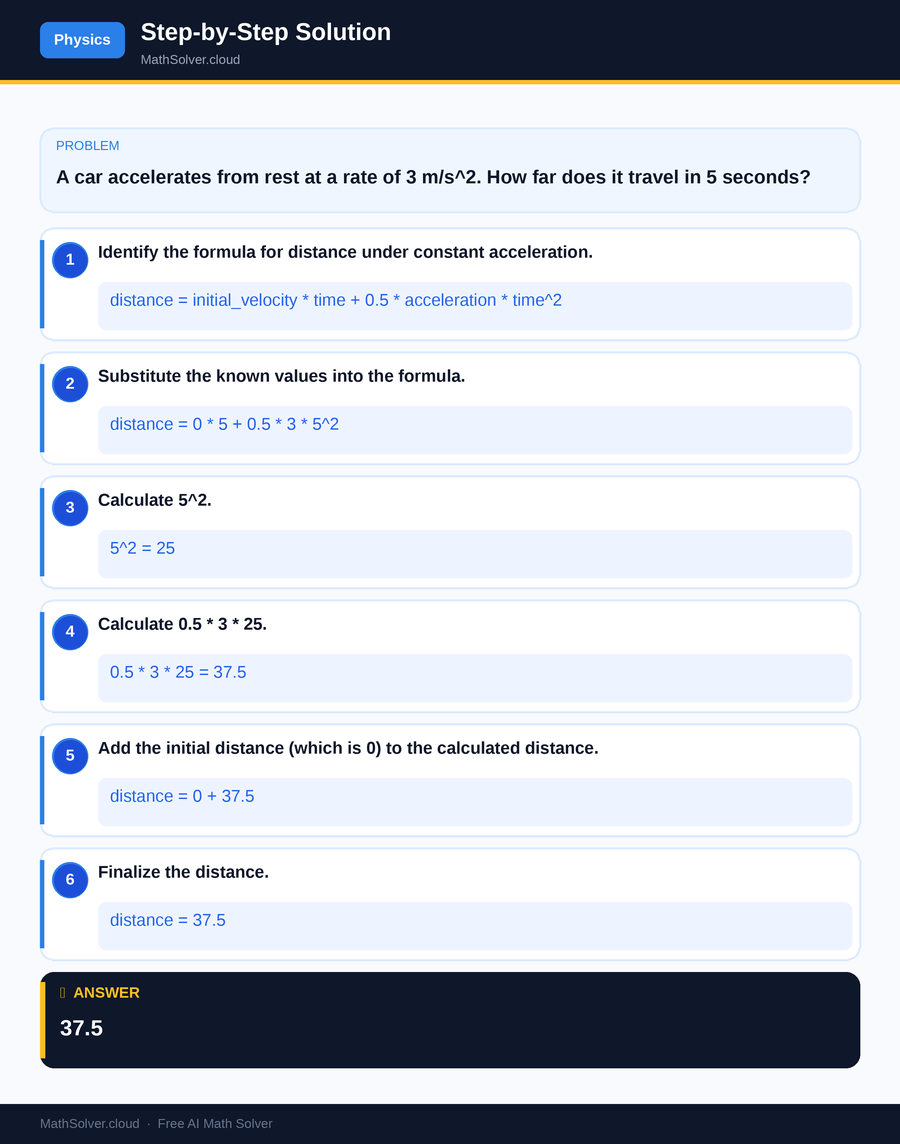
MathSolver Chrome extension solving this problem step-by-step
Example 2
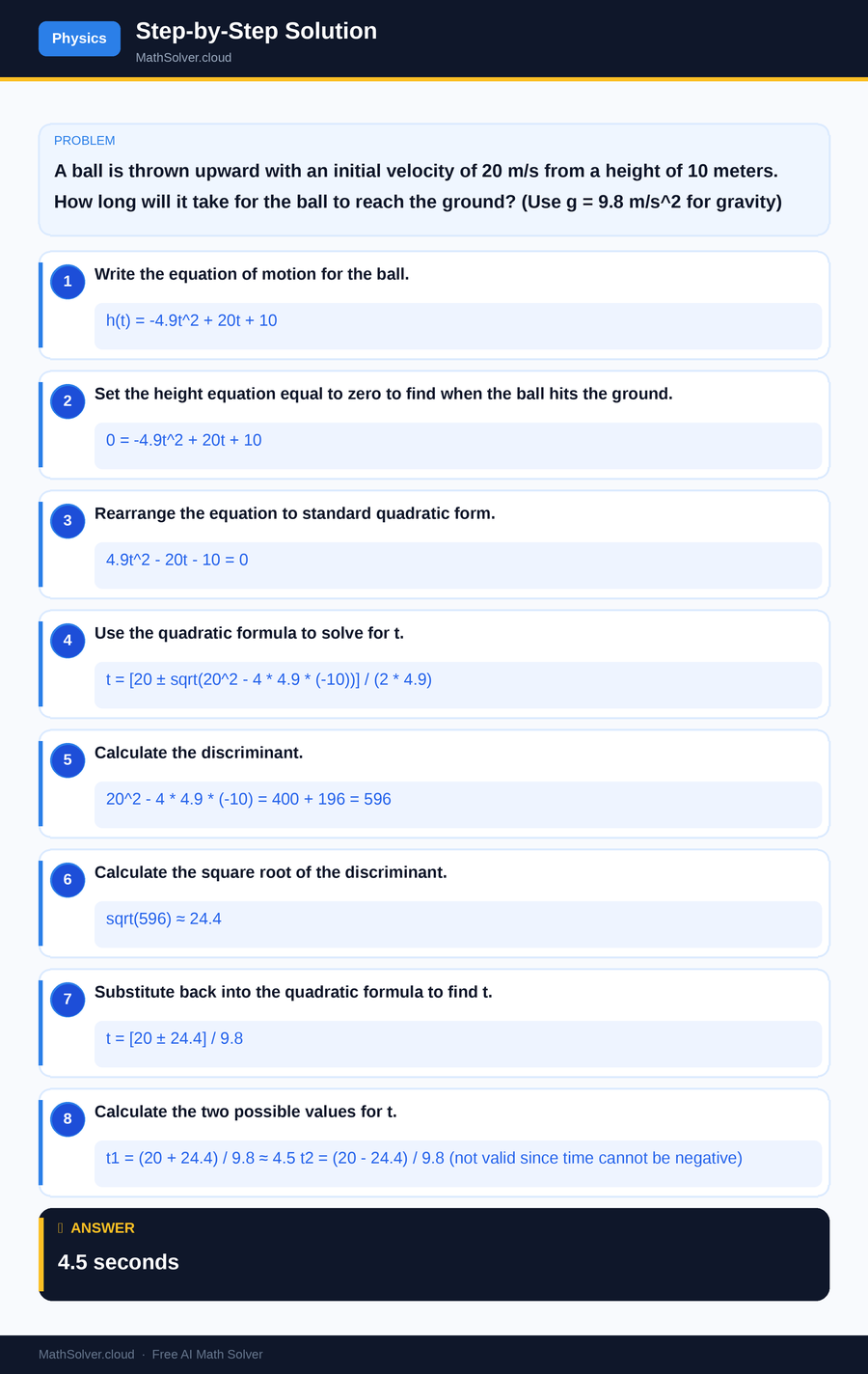
MathSolver Chrome extension solving this problem step-by-step
Common Mistakes to Avoid
One common mistake students make when working with kinematic equations is not paying attention to the signs of the variables, especially acceleration. Since acceleration due to gravity is often negative in these equations, forgetting to include the negative sign can lead to incorrect results. Always double-check the direction of the acceleration and ensure it's consistent with the problem's description.
Another frequent error is confusion between velocity and speed. Velocity is a vector quantity, meaning it has both magnitude and direction, while speed is only the magnitude. When solving kinematic problems, ensure you understand whether the question refers to velocity or speed to avoid incorrect answers. Carefully interpreting the problem and identifying the correct quantities to use is crucial for success.
Real-World Applications
Kinematic equations have numerous real-world applications, making them an essential part of physics education. One common application is in the design and analysis of vehicles, where engineers use these equations to predict and optimize the motion of cars, bicycles, and other transportation modes. This ensures vehicles perform efficiently and safely under various conditions.
Another significant application is in sports science, where kinematic equations help analyze athletes' movements. By understanding motion mechanics, coaches and trainers can improve athletic performance, design more effective training programs, and reduce injury risks. These equations are also used in fields like robotics, where precise motion control is essential for the successful operation of robotic systems.
Frequently Asked Questions
❓ What is the purpose of the kinematic equation?
❓ Why do students often find kinematic equations challenging?
❓ How can AI help with kinematic equations?
❓ How are kinematic equations used in angular motion?
❓ What resources can help students learn kinematic equations more effectively?
🚀 Solve any math problem instantly
2,000+ students use MathSolver every day — join them for free
📥 Add to Chrome — It's Free