Mastering the Integration Math Formula
📋 In this guide
The integration math formula is a fundamental concept in calculus that allows us to find the area under a curve, among other applications. Many students find integration challenging because it involves understanding abstract mathematical concepts and applying them to solve complex problems. This article will guide you through the basic principles of integration, provide step-by-step instructions, and offer examples to help you master this essential math skill. By the end of this guide, you'll have a solid grasp of the integration math formula and be able to tackle problems with confidence.
Understanding the integration math formula is crucial for anyone studying calculus or related fields. Students often struggle with integration because it requires a different way of thinking compared to other areas of math. It's not just about finding the right answer; it's about understanding the process and the logic behind it. In this article, we'll demystify the integration process, breaking it down into manageable steps and providing clear examples to illustrate each point.
Whether you're preparing for an exam, trying to complete your homework, or simply want to improve your math skills, this guide will be a valuable resource. We'll cover the integration math formula in detail, explain common pitfalls to avoid, and show you real-world applications of this powerful tool. By integrating these concepts into your study routine, you'll find that integration becomes less of a mystery and more of a skill you can confidently apply.
Step-by-Step: How to Solve Integration Math Formula
Step 1: Understanding the Function
Before diving into the integration math formula, you need to understand the function you are working with. Identify the function f(x) that you will integrate. Determine the limits of integration, which are the values of x where you will start and stop calculating the area under the curve. This step sets the foundation for your entire integration process.
Step 2: Setting Up the Integral
Once you have the function and limits, set up the integral. Write the integral symbol, followed by the function f(x), and then the differential dx. Specify the limits of integration by placing them at the bottom and top of the integral symbol. This setup is crucial as it defines the problem you are solving and gives you a clear path to follow.
Step 3: Finding the Antiderivative
The next step involves finding the antiderivative, also known as the indefinite integral, of the function f(x). The antiderivative is a function F(x) whose derivative is equal to f(x). Apply integration rules and techniques, such as power rule or substitution, to find F(x). This step is where most of the mathematical work occurs, so take your time to ensure accuracy.
Step 4: Evaluating the Integral
Finally, evaluate the integral by applying the limits to the antiderivative. Substitute the upper limit into F(x) and then subtract the result of substituting the lower limit. This calculation gives you the definite integral, representing the area under the curve from a to b. Double-check your work to ensure that all calculations are correct and that you have applied the integration math formula accurately.
🤖 Stuck on a math problem?
Take a screenshot and let our AI solve it step-by-step in seconds
⚡ Try MathSolver Free →Worked Examples
Example 1
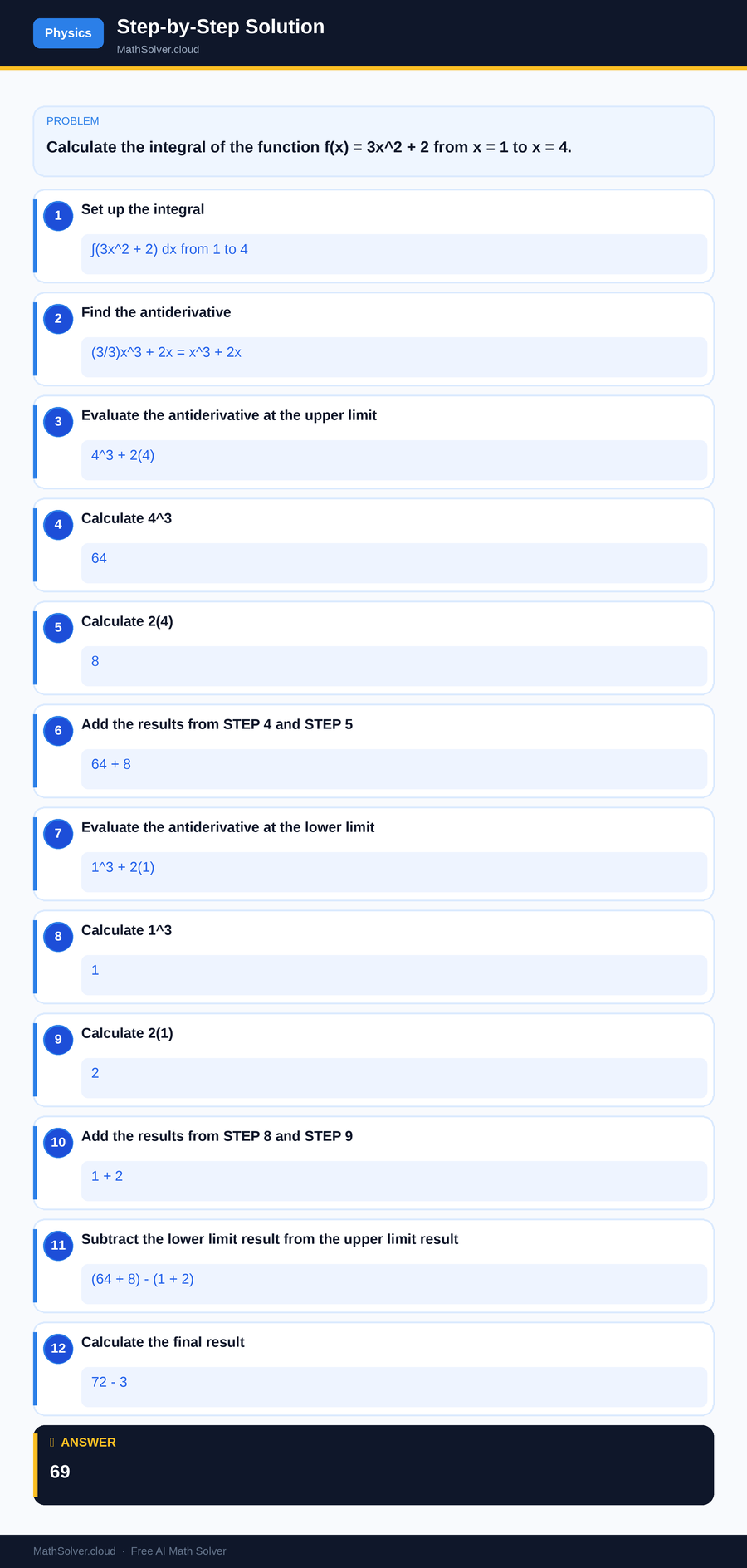
MathSolver Chrome extension solving this problem step-by-step
Example 2
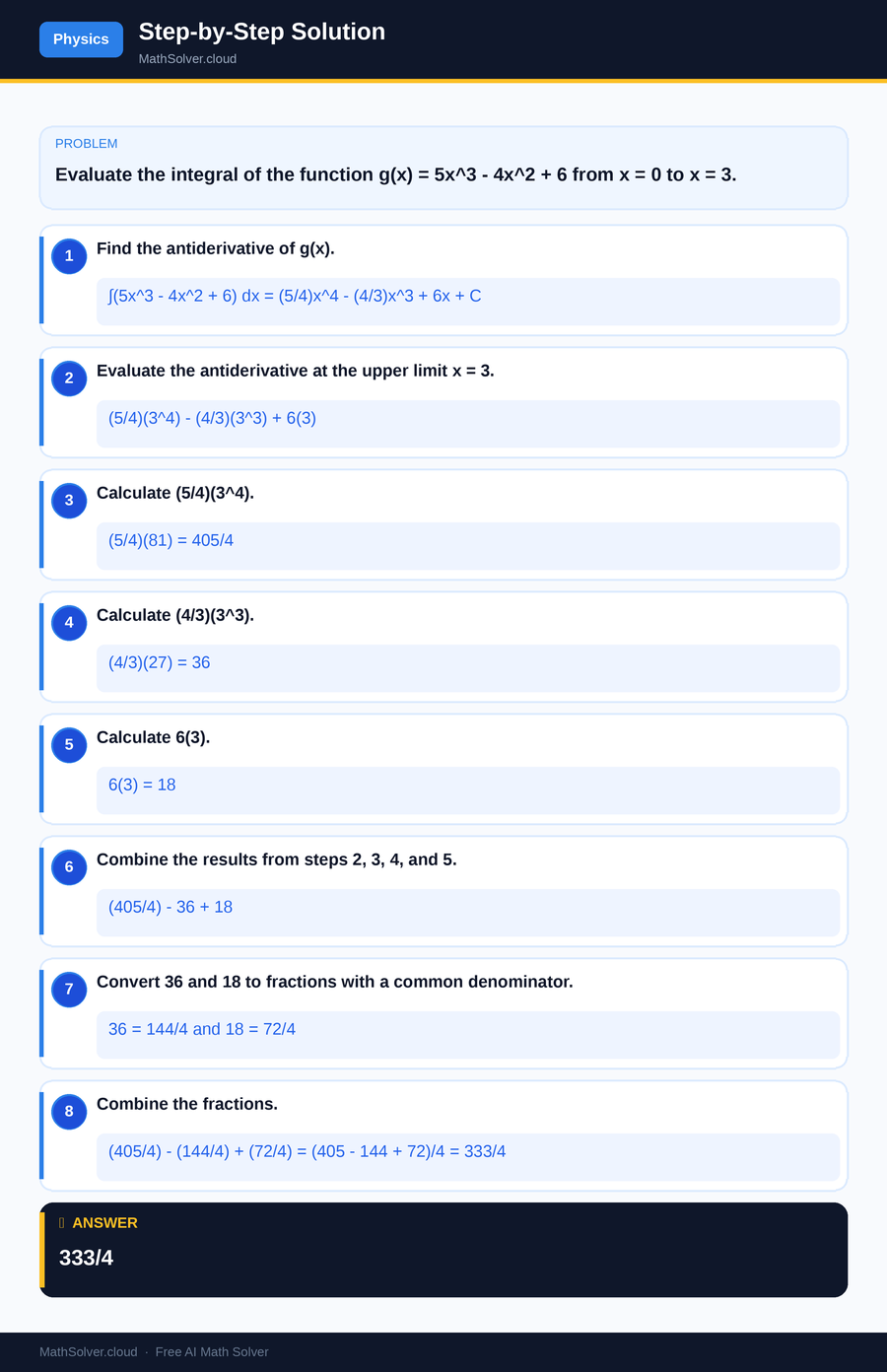
MathSolver Chrome extension solving this problem step-by-step
Common Mistakes to Avoid
One common mistake students make with the integration math formula is failing to correctly find the antiderivative. It's crucial to apply the correct integration rules and double-check your calculations. Another frequent error is neglecting to apply the limits of integration properly, which can lead to incorrect results. Always substitute the limits carefully and perform the subtraction accurately to avoid mistakes.
Another error is misunderstanding the notation and setup of the integral. The limits of integration must be clearly defined, and the function must be correctly written with the differential dx. Misplacing the limits or miswriting the function can result in a completely different problem. Practice setting up integrals correctly to ensure you have the right framework for solving them.
Real-World Applications
The integration math formula is not just a theoretical concept; it has numerous real-world applications. For instance, in physics, integration is used to calculate quantities like work, energy, and angular velocity. Engineers use integration to determine areas and volumes in design projects, ensuring structures are built safely and efficiently.
In economics, integration helps in finding consumer and producer surplus, analyzing how markets operate and respond to changes. In biology, it can be used to model population growth and decay. These examples show that mastering the integration math formula is valuable not only in academic settings but also in solving practical problems in various fields.
Frequently Asked Questions
❓ What is the integration math formula used for?
❓ Why do students struggle with integration?
❓ How can AI help with the integration math formula?
❓ What are some common techniques for integration?
❓ How does integration relate to physics equations?
🚀 Solve any math problem instantly
2,000+ students use MathSolver every day — join them for free
📥 Add to Chrome — It's Free