How to Solve Two Step Equations: A Comprehensive Guide
📋 In this guide
Learning how to solve two step equations is a fundamental skill in algebra that often poses a challenge for many students. These equations, which involve finding the value of an unknown variable by performing two mathematical operations, can be daunting at first glance. Students may struggle because they are transitioning from simple one-step equations to more complex problems, requiring a deeper understanding of mathematical concepts and operations. In this article, we will break down the process of solving two step equations, making it approachable and manageable for learners at any level.
Understanding how to solve two step equations is crucial as it forms the basis for more advanced topics in algebra and beyond. Students often find themselves puzzled by these equations because they involve multiple steps that must be executed in a specific order. By mastering this skill, students will build a strong foundation for tackling more complex multi step equations, which are common in higher-level math courses. This article aims to demystify the process, providing clear and concise guidance that will empower students to approach these problems with confidence.
By the end of this guide, you will have a comprehensive understanding of how to solve two step equations, including those that involve fractions and division. You will learn a step-by-step approach, see worked examples, and gain insight into common mistakes to avoid. Whether you're a student struggling with algebra or someone looking to refresh your skills, this article will serve as a valuable resource on your mathematical journey.
Step-by-Step: How to Solve How To Solve Two Step Equations
Step 1: Identify the Operations and Inverse Operations
The first step in how to solve two step equations is to identify the operations being performed on the variable. This usually involves looking for addition, subtraction, multiplication, or division. Recognizing these operations is crucial because solving the equation involves reversing these operations using inverse operations. For instance, if the equation includes addition, you will need to subtract to eliminate the constant. Similarly, for multiplication, you will need to divide. By identifying these operations, you set the stage for systematically isolating the variable.
Step 2: Eliminate the Constant Term
In this step, focus on eliminating the constant term that is added or subtracted to the variable term. This is typically done by performing the inverse operation. If your equation is of the form ax + b = c, you would subtract b from both sides to get ax = c - b. This step simplifies the equation to a one-step equation, making it easier to solve for the variable. Remember, whatever operation you perform on one side of the equation, you must also perform on the other side to maintain balance.
Step 3: Isolate the Variable Term
Now that you've removed the constant term, the next step is to isolate the variable term. If the variable is being multiplied by a coefficient, as in ax = c - b, you will need to divide both sides by the coefficient a to solve for x. This will leave you with x = (c - b)/a, where x is now isolated. Isolation of the variable is crucial because it brings you one step closer to finding the solution.
Step 4: Verify the Solution
The final step in how to solve two step equations is to verify your solution. Substitute the value of the variable back into the original equation to ensure that both sides of the equation are equal. This step is essential because it confirms the accuracy of your solution and helps you catch any possible errors made during the calculation process. A correct solution should satisfy the original equation, proving that the steps were followed correctly.
🤖 Stuck on a math problem?
Take a screenshot and let our AI solve it step-by-step in seconds
⚡ Try MathSolver Free →Worked Examples
Example 1
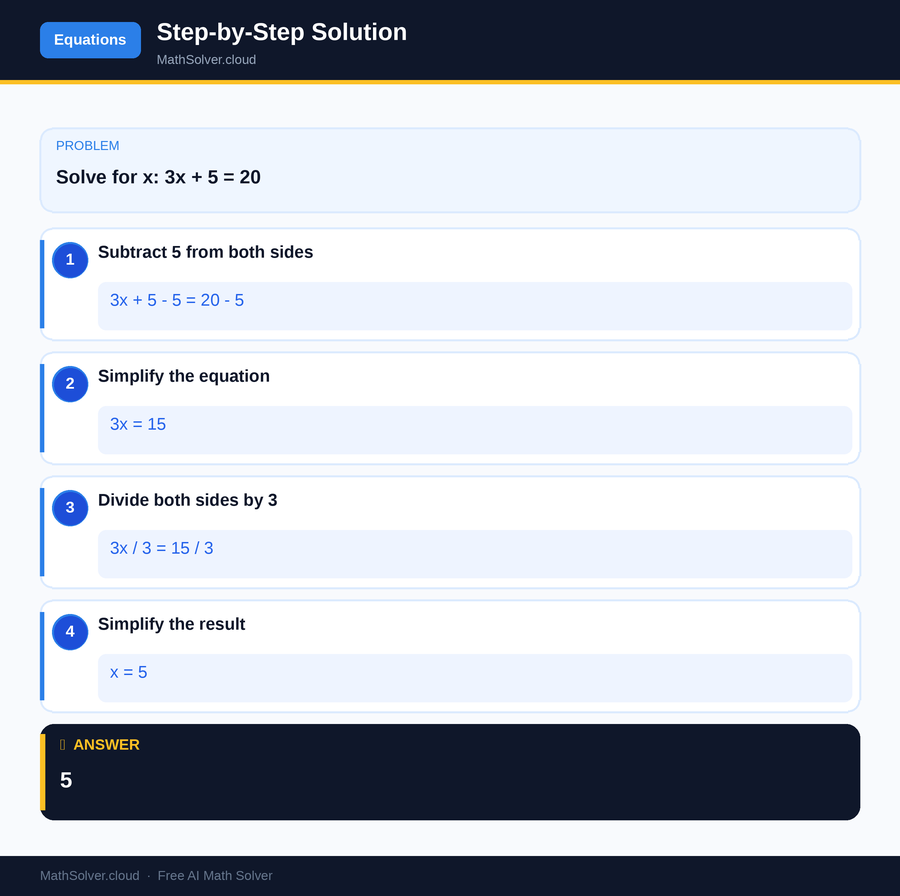
MathSolver Chrome extension solving this problem step-by-step
Example 2
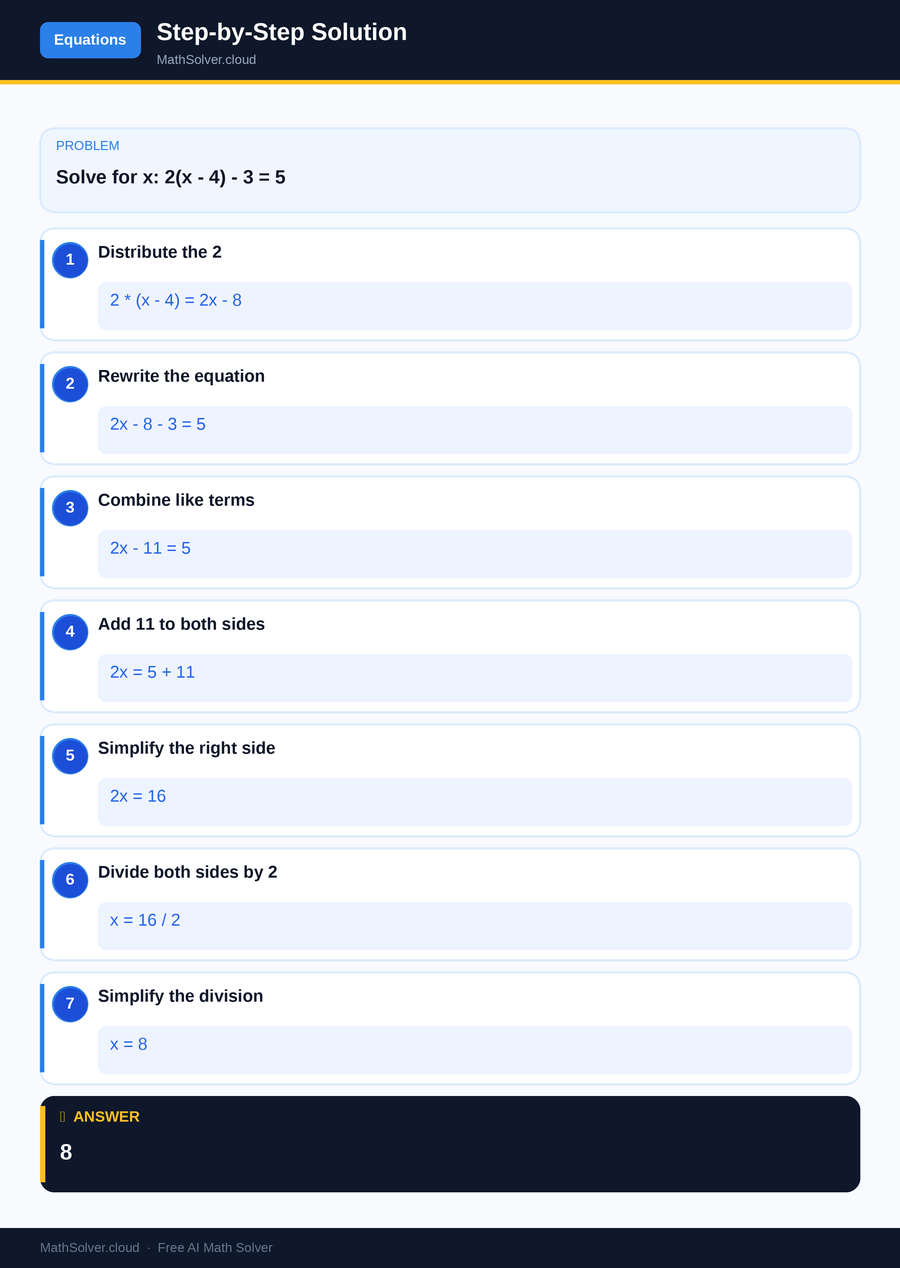
MathSolver Chrome extension solving this problem step-by-step
Common Mistakes to Avoid
One common mistake in how to solve two step equations is neglecting to apply the inverse operations correctly. Students may forget to perform the operation on both sides of the equation, leading to incorrect solutions. Always remember that maintaining the balance of the equation is crucial, so any operation performed on one side must be mirrored on the other side.
Another common error is incorrectly simplifying equations involving fractions or negative numbers. Students may become confused when dealing with negative signs or fail to correctly simplify fractions, resulting in errors. To avoid these mistakes, take your time when simplifying expressions and double-check your work to ensure accuracy.
Real-World Applications
Understanding how to solve two step equations is essential in various real-world scenarios. For instance, they are used in financial calculations such as determining interest rates or loan payments, where you need to isolate a variable to find the unknown value. Similarly, in engineering, two step equations are used to solve for forces, distances, or other quantities that involve linear relationships.
Another example is in everyday problem-solving, such as calculating the total cost of items when given a budget. By understanding two step equations, you can determine how many items you can purchase within a certain budget, helping in making informed financial decisions.
Frequently Asked Questions
❓ What is the easiest way to understand how to solve two step equations?
❓ Why do I struggle with two step equations?
❓ How can AI help with how to solve two step equations?
❓ Can two step equations involve fractions?
❓ Where can I find practice problems for two step equations?
🚀 Solve any math problem instantly
2,000+ students use MathSolver every day — join them for free
📥 Add to Chrome — It's Free