How to Solve Multi Step Equations
📋 In this guide
Learning how to solve multi step equations is a fundamental skill in algebra that many students find challenging. Unlike simpler equations that can be solved in one or two steps, multi step equations require a series of operations to isolate the variable. These equations can involve fractions, parentheses, and variables on both sides, making them appear complex at first glance. However, with practice and the right approach, mastering how to solve these equations becomes a manageable and rewarding task.
Many students struggle with multi step equations because they often involve combining several algebraic techniques. You might need to use the distributive property, combine like terms, and apply inverse operations, all within a single problem. This complexity can be overwhelming, leading to common mistakes such as incorrect distribution or sign errors. Fortunately, with a clear step-by-step strategy, you can overcome these hurdles and solve these equations with confidence.
In this article, you’ll learn how to solve multi step equations, including those with fractions, variables on both sides, and parentheses. By breaking down the process into manageable steps, you will develop a clear understanding of how to approach these problems. You’ll also see worked examples and discover common pitfalls to avoid. Whether you're preparing for a test or just looking to improve your algebra skills, this guide will provide the insights you need to tackle multi step equations effectively.
Step-by-Step: How to Solve How To Solve Multi Step Equations
Step 1: Simplify Both Sides of the Equation
The first step in solving multi step equations is to simplify each side of the equation as much as possible. This may involve distributing any terms that are multiplied by parentheses and combining like terms. For example, if the equation is 4(2x - 1) + 3, you would first apply the distributive property to get 8x - 4 + 3. After simplifying this side, you would move to the other side of the equation if necessary. By simplifying both sides, you reduce the complexity of the equation, making it easier to isolate the variable in later steps.
Step 2: Move Variables to One Side
Once each side of the equation is simplified, the next step is to get all variable terms on one side of the equation and all constant terms on the other. This may involve adding or subtracting terms from both sides. For example, in the equation 3x + 5 = 20 - 2x, you would add 2x to both sides to get 5x + 5 = 20. By consolidating variables on one side, you streamline the equation, which is crucial for the next steps in the process.
Step 3: Isolate the Variable
After getting all terms with the variable on one side, the goal is to isolate the variable itself. This often involves using inverse operations to undo any addition or subtraction, and then multiplication or division. Continuing from the previous example, you would subtract 5 from both sides to get 5x = 15. Then, divide each side by 5 to solve for x, resulting in x = 3. The key here is to perform operations that leave the variable alone on one side of the equation.
Step 4: Check Your Solution
The final step is to check your work by substituting your solution back into the original equation. This ensures that the solution is correct and that no mistakes were made during the process. For instance, substituting x = 3 back into the original equation 3x + 5 = 20 - 2x should satisfy both sides of the equation. If both sides equal the same number, your solution is correct. If not, re-evaluate your steps to find where the error might have occurred.
🤖 Stuck on a math problem?
Take a screenshot and let our AI solve it step-by-step in seconds
⚡ Try MathSolver Free →Worked Examples
Example 1
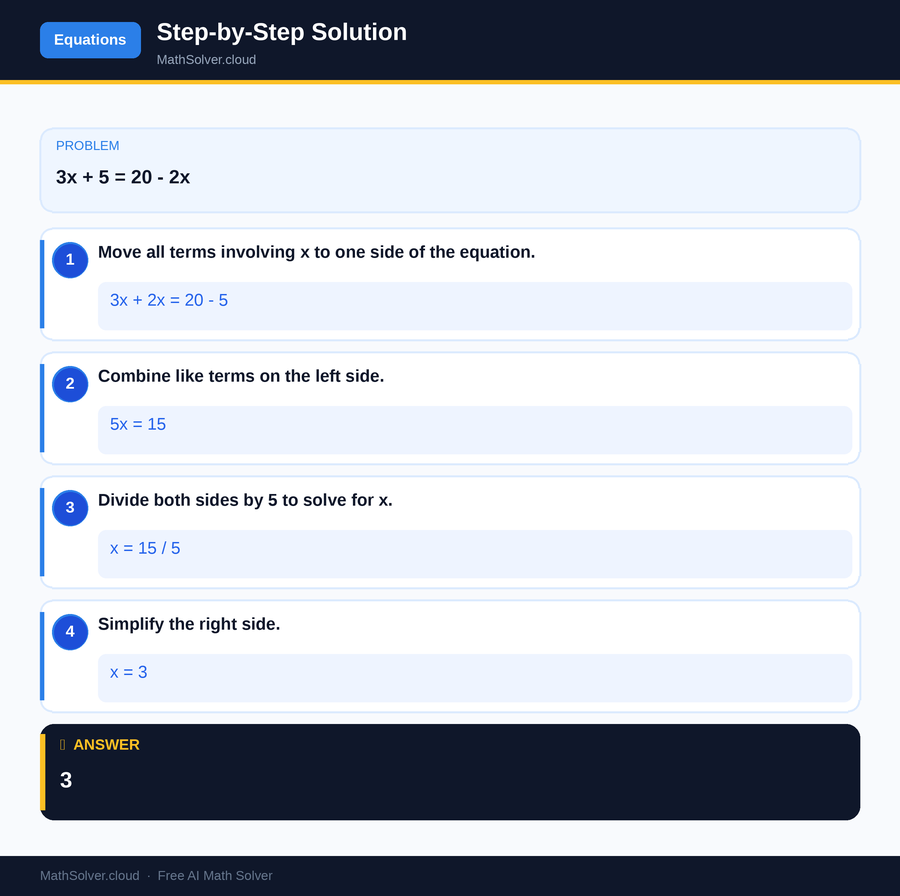
MathSolver Chrome extension solving this problem step-by-step
Example 2
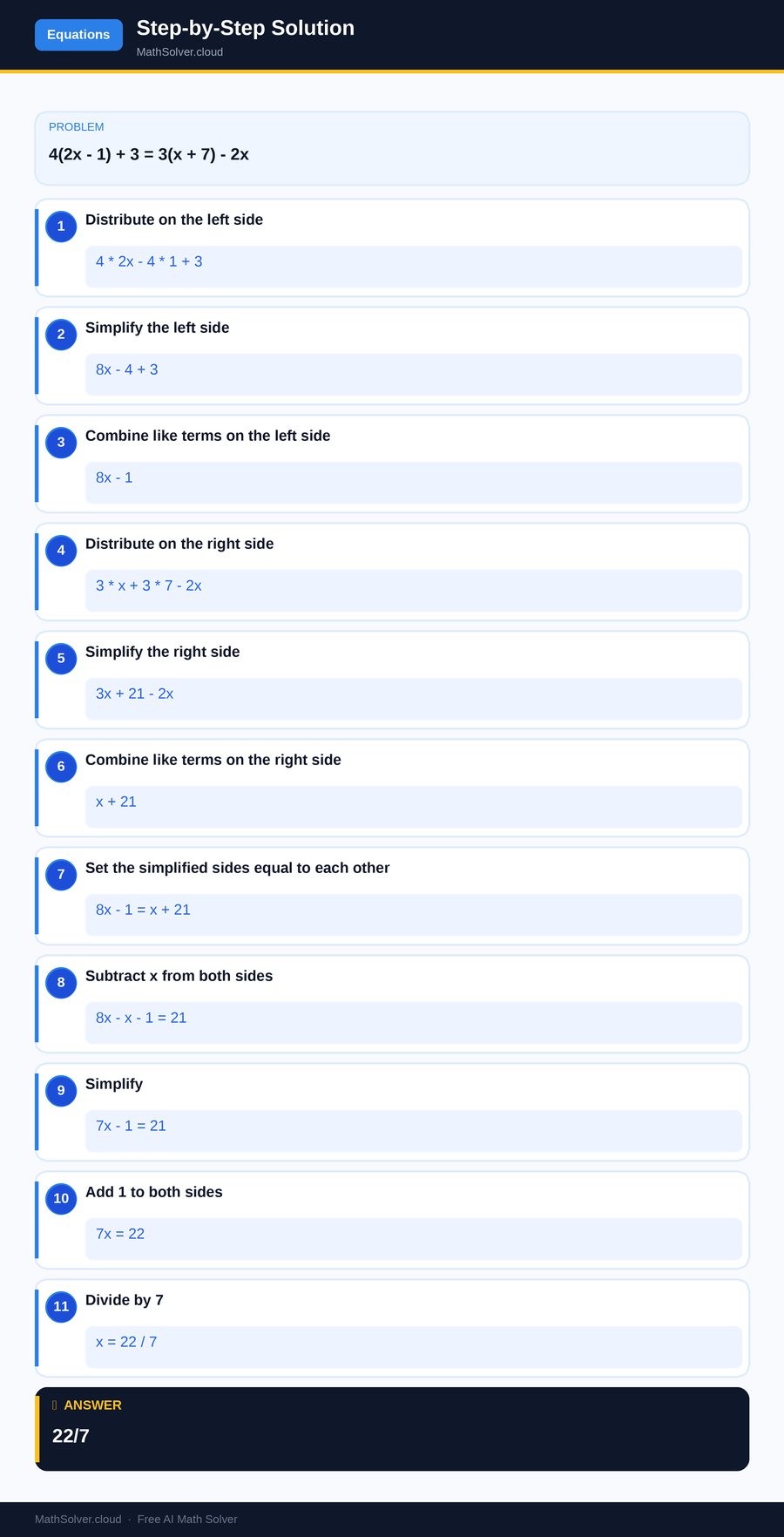
MathSolver Chrome extension solving this problem step-by-step
Common Mistakes to Avoid
One common mistake in solving multi step equations is failing to distribute correctly. When applying the distributive property, ensure that every term inside the parentheses is multiplied by the term outside. Another frequent error is neglecting to combine like terms properly, which can lead to incorrect simplification. Always double-check that terms are combined only when they share the same variable and exponent.
Another pitfall is incorrect application of inverse operations. It’s crucial to perform the same operation on both sides of the equation to maintain equality. Forgetting to change the signs when moving terms across the equals sign is a common oversight. To avoid these errors, take your time with each step and verify your work by substituting your solution back into the original equation.
Real-World Applications
Understanding how to solve multi step equations is valuable beyond the classroom. In real life, these skills are used in various fields such as engineering, physics, and economics. For example, engineers often use multi step equations to calculate forces and stresses in structures, ensuring safety and stability.
In finance, multi step equations can be used to model and solve problems related to loans and investments, where multiple variables and constraints must be considered. By mastering these equations, you gain tools that are applicable in analyzing and solving complex problems in everyday scenarios.
Frequently Asked Questions
❓ How do you approach how to solve multi step equations effectively?
❓ What should I do if an equation has variables on both sides?
❓ How can AI help with how to solve multi step equations?
❓ How do you handle fractions in multi step equations?
❓ Why is it important to check your solution?
🚀 Solve any math problem instantly
2,000+ students use MathSolver every day — join them for free
📥 Add to Chrome — It's Free