How to Solve Inverse of Matrix
📋 In this guide
Understanding how to solve inverse of matrix is an essential skill in linear algebra, crucial for students working with systems of equations, transformations, and more. The inverse of a matrix is akin to the reciprocal of a number; when multiplied by the original matrix, it yields the identity matrix. Students often find this topic challenging due to the intricacies involved in matrix operations, such as calculating determinants and performing row operations. This guide will break down the process into manageable steps, ensuring a comprehensive understanding of how to solve inverse of matrix, making it easier for students to tackle these problems confidently.
In this article, we will explore the method of finding the inverse of a matrix, which is not only a fundamental skill in mathematics but also a gateway to understanding more complex concepts in linear algebra. We will discuss key formulas, provide step-by-step instructions, and go through detailed examples to reinforce learning. Additionally, we will address common mistakes, real-world applications, and frequently asked questions to give you a well-rounded understanding of how to solve inverse of matrix.
By the end of this article, you'll have a firm grasp on how to solve inverse of matrix, equipped with the knowledge to apply this skill in both academic and practical scenarios. Whether you're a student struggling with the concept or just looking to refresh your understanding, this guide will serve as a valuable resource. Let's dive into the core formula that underpins this process.
Step-by-Step: How to Solve How To Solve Inverse Of Matrix
Step 1: Check the Determinant
The first step in how to solve inverse of matrix is to calculate the determinant. For a 2x2 matrix, this is straightforward: det(A) = ad - bc, where A = [[a, b], [c, d]]. If the determinant is zero, the matrix is singular and does not have an inverse. For larger matrices, finding the determinant involves more complex calculations or using a determinant matrix solver to simplify the process. It is crucial to confirm the determinant is non-zero before proceeding.
Step 2: Apply the Adjugate Method
Once you've ensured the determinant is non-zero, proceed to find the adjugate (or adjoint) of the matrix. For a 2x2 matrix, this involves swapping the positions of a and d, and changing the signs of b and c. The adjugate of matrix A = [[a, b], [c, d]] is [[d, -b], [-c, a]]. For larger matrices, the adjugate involves calculating the cofactor matrix and transposing it.
Step 3: Calculate the Inverse
With the adjugate matrix ready, calculate the inverse by multiplying the adjugate by 1/det(A). This step in how to solve inverse of matrix is crucial as it combines the determinant and the adjugate to yield the inverse matrix. The formula becomes A^(-1) = (1/det(A)) * adj(A). Ensure accurate multiplication to avoid errors.
Step 4: Verify the Solution
After calculating, verify your solution by multiplying the original matrix with its inverse. If the result is the identity matrix, your calculations are correct. This verification step is vital, especially when manually solving larger matrices, and can be aided by tools like a matrix multiplication solver to ensure precision.
🤖 Stuck on a math problem?
Take a screenshot and let our AI solve it step-by-step in seconds
⚡ Try MathSolver Free →Worked Examples
Example 1
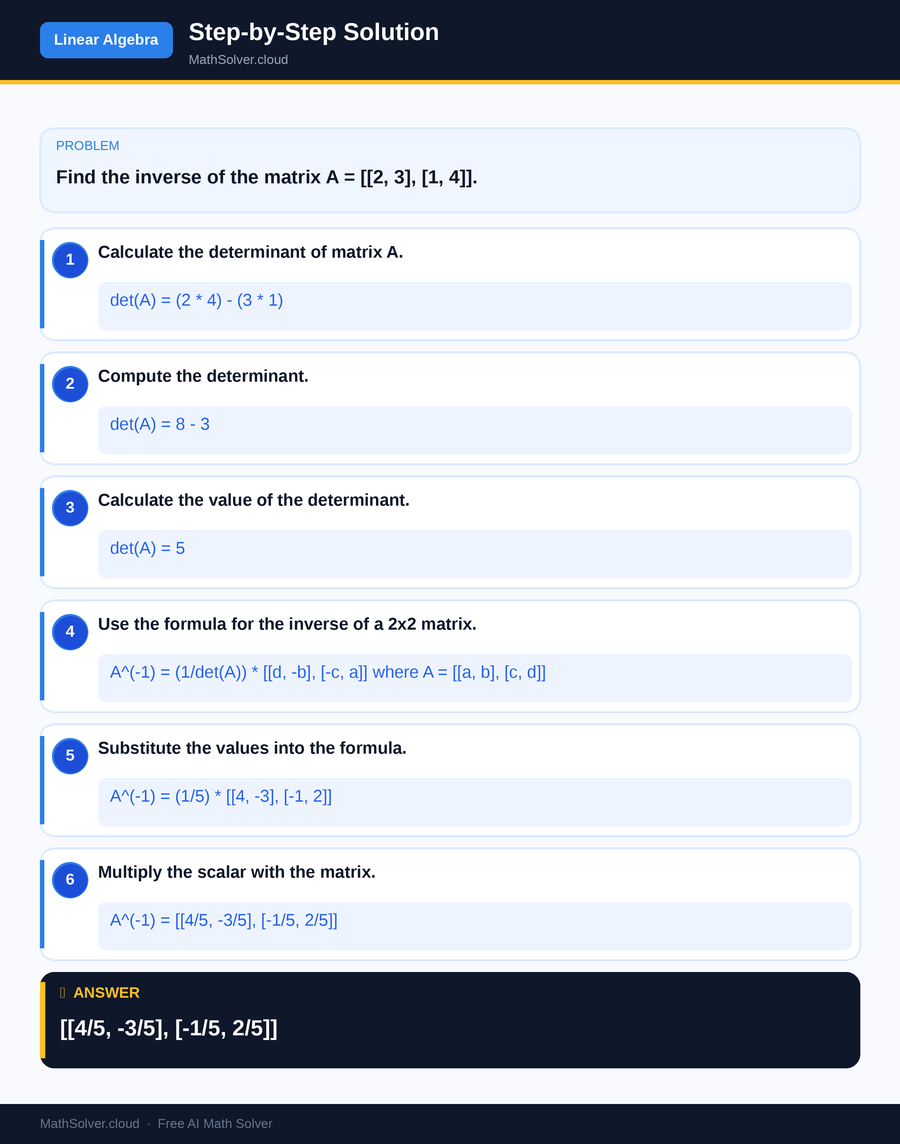
MathSolver Chrome extension solving this problem step-by-step
Example 2
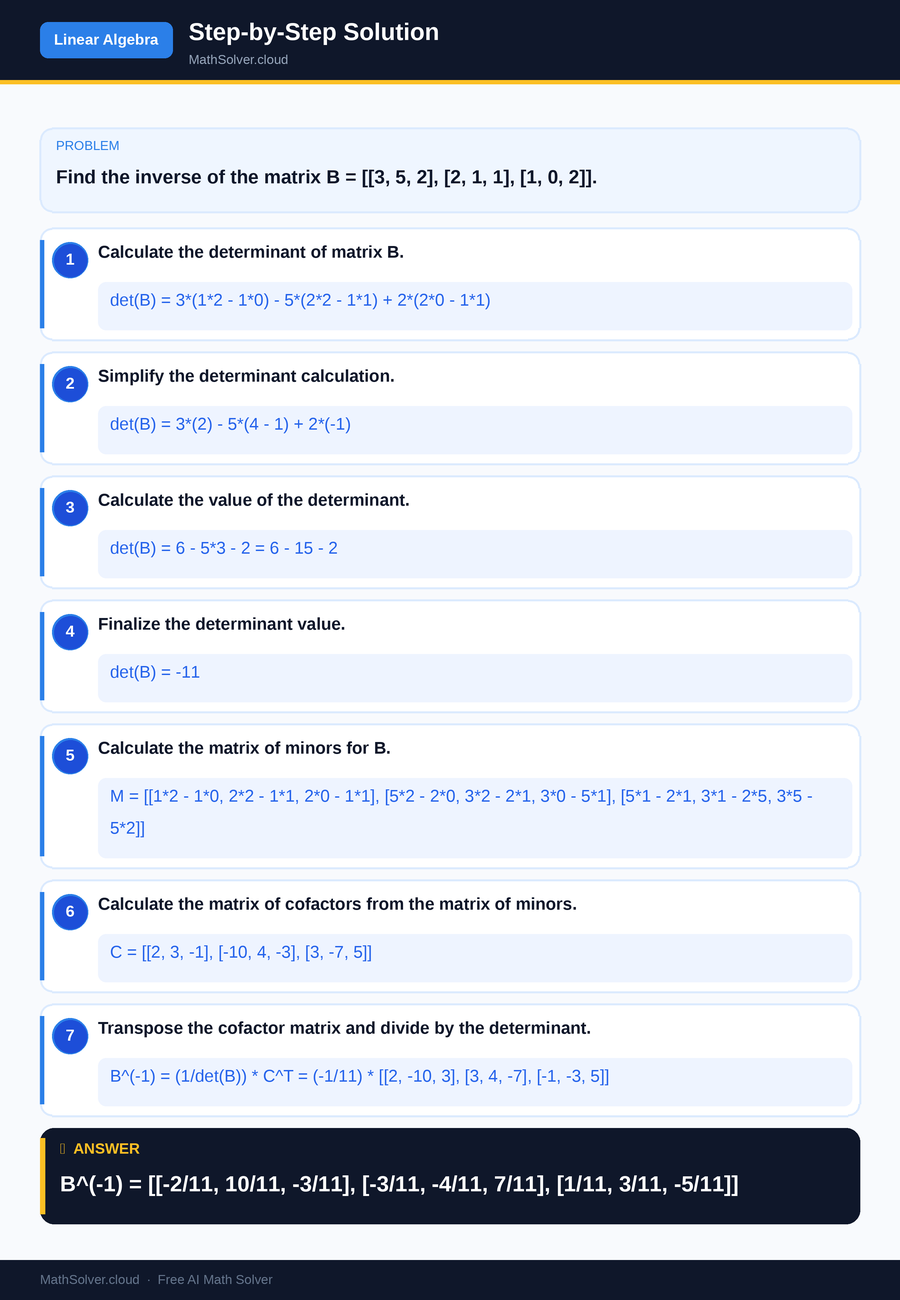
MathSolver Chrome extension solving this problem step-by-step
Common Mistakes to Avoid
One common mistake students make when learning how to solve inverse of matrix is neglecting to check if the matrix is singular. Always calculate the determinant first; a zero determinant means the matrix has no inverse. Another error involves incorrect calculation of the adjugate, particularly for larger matrices, where it's easy to miscalculate cofactors or transpose incorrectly. Using a reliable equation solver can help verify calculations.
Additionally, students often forget to verify their solution by multiplying the original matrix with its inverse. This step is crucial for confirming the accuracy of your solution. Overlooking this verification can lead to incorrect conclusions about the existence or correctness of the inverse.
Real-World Applications
Understanding how to solve inverse of matrix is not just an academic exercise; it has practical applications in various fields. In computer graphics, matrix inverses are used to manipulate and transform images, enabling rotations, translations, and scaling. This is particularly important in video game development and animation, where precise control over visual elements is essential.
In engineering, matrices and their inverses are used to solve systems of linear equations that model real-world phenomena, such as electrical circuits or structural mechanics. The ability to find the inverse of a matrix enables engineers to simulate and predict system behaviors accurately, making it a vital skill in design and analysis.
Frequently Asked Questions
❓ How do I solve the inverse of a matrix?
❓ What if the determinant is zero?
❓ How can AI help with how to solve inverse of matrix?
❓ Can all matrices be inverted?
❓ Why is finding the inverse of a matrix important?
🚀 Solve any math problem instantly
2,000+ students use MathSolver every day — join them for free
📥 Add to Chrome — It's Free