How to Solve Inverse Matrix Problems: A Comprehensive Guide
📋 In this guide
Understanding how to solve inverse matrix problems is a crucial skill in linear algebra, often causing students to feel overwhelmed. The inverse of a matrix is akin to the reciprocal of a number, but the process is more complex, especially as the size of the matrix increases. Students frequently struggle with this concept due to the detailed calculations involved, including determinants and adjugates, which require precision and accuracy. In this article, you will learn how to solve inverse matrix problems using a step-by-step approach, ensuring you can tackle matrices of various sizes confidently.
To master how to solve inverse matrix problems, one must first grasp the theoretical foundations and then apply those principles through practice. The process involves several mathematical operations, each of which builds upon the previous. Many students find these operations challenging because missing a single calculation can lead to an incorrect result. By the end of this guide, you will have a clear understanding of each step needed to find the inverse of matrices, from 2x2 to 4x4, and you will be equipped with strategies to avoid common pitfalls.
In addition to manual calculations, this article will explore how technology, such as calculators and software tools, can aid in solving inverse matrices. You'll also discover practical applications of inverse matrices in fields like engineering and computer science. Whether you're tackling a 3x3 matrix or learning how to solve inverse matrix on calculator, this guide is designed to make inverse matrices accessible and manageable.
Step-by-Step: How to Solve How To Solve Inverse Matrix
Step 1: Determine If the Matrix Has an Inverse
The first step in how to solve inverse matrix problems is determining if the matrix is invertible. A matrix must be square and have a non-zero determinant. The determinant for a 2x2 matrix A = [[a, b], [c, d]] is calculated as ad-bc. If this value is zero, the matrix does not have an inverse. For larger matrices, like 3x3 or 4x4, the determinant calculation is more complex but follows a similar logic, using cofactor expansion or other techniques.
Step 2: Calculate the Determinant
For a 3x3 matrix, the determinant can be found using cofactor expansion: det(B) = a(ei − fh) − b(di − fg) + c(dh − eg), where B = [[a, b, c], [d, e, f], [g, h, i]]. For 4x4 matrices, the process involves breaking the matrix into smaller parts and applying similar principles. Calculating the determinant accurately is crucial, as it is used in the next steps to find the inverse. This step is critical, especially when learning how to solve inverse matrix 3x3 and 4x4.
Step 3: Find the Adjugate of the Matrix
The adjugate of a matrix is the transpose of its cofactor matrix. For a 2x2 matrix, this is straightforward, but for larger matrices, it requires calculating the cofactor for each element. The cofactor is determined by removing the row and column of each element and finding the determinant of the resulting submatrix. This process might seem tedious, but it's essential for determining the inverse accurately.
Step 4: Calculate the Inverse Matrix
Once you have the determinant and the adjugate, the inverse of a matrix A is calculated as A^(-1) = (1/det(A)) * adj(A). This involves multiplying each element of the adjugate by 1/det(A). For those learning how to solve inverse matrix using calculator, many modern calculators can perform these operations automatically, but understanding the manual process ensures proficiency and helps in verifying the results.
🤖 Stuck on a math problem?
Take a screenshot and let our AI solve it step-by-step in seconds
⚡ Try MathSolver Free →Worked Examples
Example 1
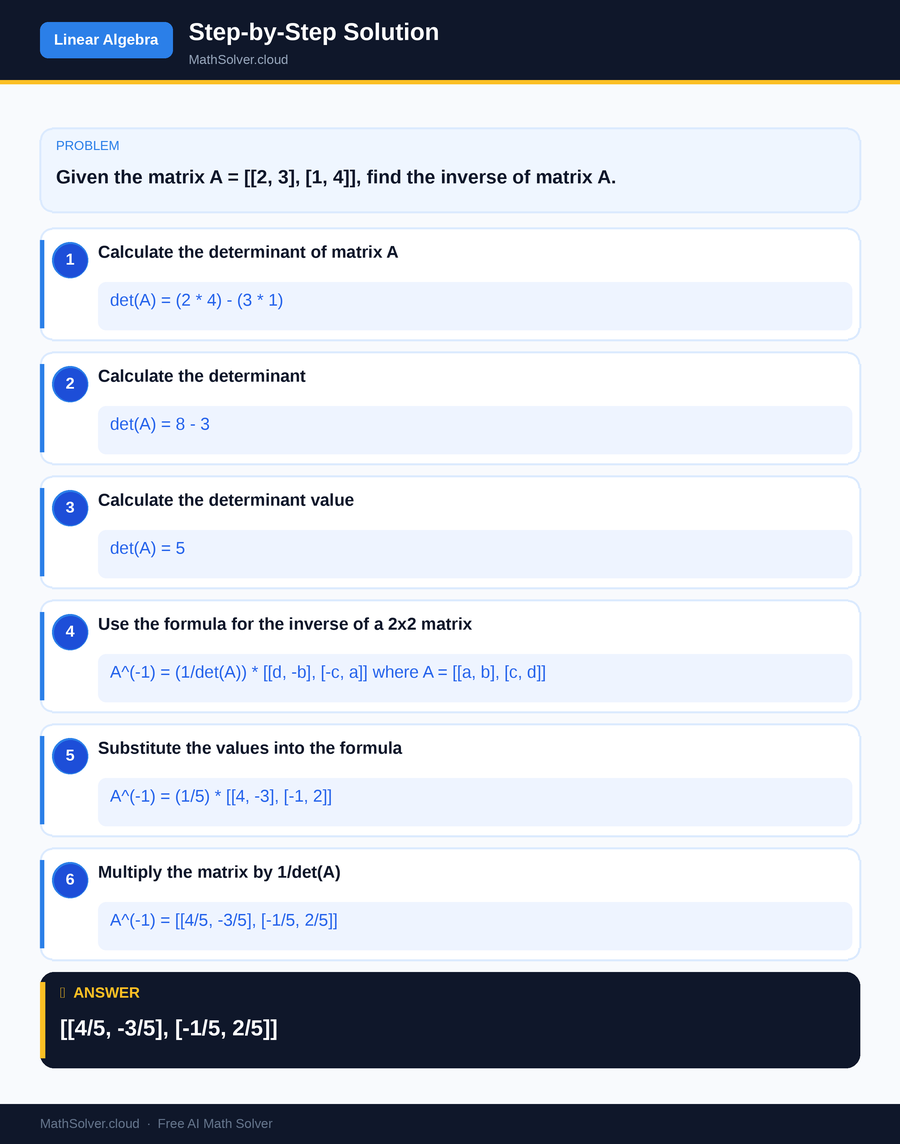
MathSolver Chrome extension solving this problem step-by-step
Example 2
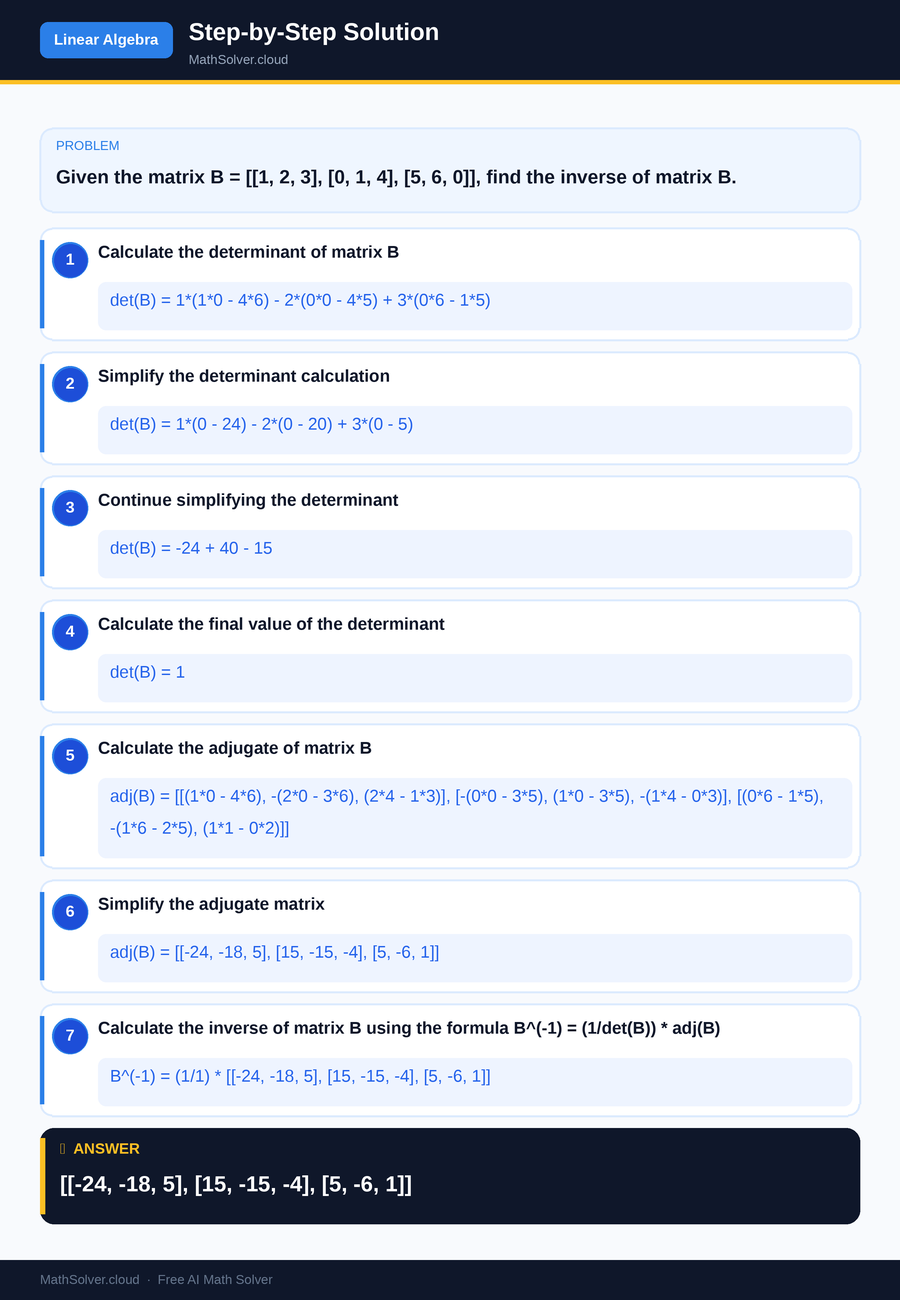
MathSolver Chrome extension solving this problem step-by-step
Common Mistakes to Avoid
One common mistake when learning how to solve inverse matrix problems is miscalculating the determinant. This error can lead to incorrect conclusions about the invertibility of a matrix. Always double-check determinant calculations, especially for larger matrices, where the process is more intricate.
Another frequent error is neglecting the order of operations when finding the adjugate and calculating the inverse. Ensure each step follows logically, and verify each part before proceeding.
Another pitfall is relying too heavily on technology without understanding the underlying principles. While calculators and software can simplify the process, they can also mislead if inputs are incorrect. Understanding each step manually ensures you can interpret results and verify accuracy, whether you're working with a 2x2 or 4x4 matrix.
Real-World Applications
Inverse matrices have significant applications in various fields. In engineering, they are used to solve systems of linear equations, which are foundational to structural analysis and circuit design. Understanding how to solve inverse matrix problems allows engineers to model and simulate complex systems accurately.
In computer science, inverse matrices are crucial in graphics and image processing. They enable transformations and manipulations of images, such as scaling and rotation, which are essential in developing video games and simulations. Knowing how to solve inverse matrix problems enriches your ability to work on cutting-edge technology and applications.
Frequently Asked Questions
❓ How do I solve an inverse matrix problem manually?
❓ What are some common challenges students face with inverse matrices?
❓ How can AI help with how to solve inverse matrix problems?
❓ Can I use a calculator to solve inverse matrices?
❓ What is the importance of the inverse matrix in practical applications?
🚀 Solve any math problem instantly
2,000+ students use MathSolver every day — join them for free
📥 Add to Chrome — It's Free