Mastering How to Solve for X
📋 In this guide
Understanding how to solve for x is a foundational skill in algebra that students encounter early in their math journey. This process involves finding the value of the variable x that makes an equation true. Although it sounds straightforward, many students find it challenging due to the variety of equations they might face, such as linear, quadratic, or even those involving exponents and fractions. In this article, we will break down the process into manageable steps, offering clarity and confidence to students tackling these mathematical problems.
The challenge of solving for x often stems from the diverse ways equations can be presented. From basic two-step equations to more complex multi-step equations, each type requires a specific approach. Students might also struggle with equations involving fractions or exponents, making it crucial to understand the underlying principles and strategies for each scenario. By the end of this article, you will be equipped with the essential tools and techniques needed to solve a wide range of equations effectively.
Throughout this guide, we will cover key formulas and definitions, provide step-by-step instructions, and work through specific examples to illustrate the process. We'll also discuss common mistakes to avoid, explore real-world applications of solving for x, and answer frequently asked questions. Whether you're just starting out or looking to refine your skills, this comprehensive guide will support you in mastering how to solve for x with confidence.
Step-by-Step: How to Solve How To Solve For X
Step 1: Understand the Equation
The first step in solving for x is to thoroughly understand the equation at hand. Identify the type of equation you are dealing with—is it a simple linear equation, a multi-step equation, or one involving fractions or exponents? Recognizing the form of the equation will guide your approach. For example, if you have an equation with fractions, you'll need to consider strategies for clearing the fractions, whereas equations with exponents might require logarithmic operations.
Step 2: Simplify Each Side
Once you understand the equation, the next step is to simplify each side as much as possible. This means combining like terms and using distributive properties to eliminate parentheses. For instance, if an equation reads 2(x + 3) = x + 10, distribute the 2 to get 2x + 6 = x + 10. Simplifying each side makes it easier to see what operations are needed to isolate x.
Step 3: Isolate the Variable
With the equation simplified, focus on isolating x. Start by moving all terms involving x to one side of the equation and constant terms to the other side. You can do this by adding or subtracting terms from both sides. Afterward, use multiplication or division to solve for x. For example, if you have 3x + 5 = 20, subtract 5 from both sides to get 3x = 15, then divide by 3 to find x = 5.
Step 4: Check Your Solution
After finding a solution, it's crucial to verify that it satisfies the original equation. Substitute your solution back into the original equation to ensure both sides are equal. This step helps confirm that no errors were made during the solving process. If the equation balances, you can be confident in your solution.
🤖 Stuck on a math problem?
Take a screenshot and let our AI solve it step-by-step in seconds
⚡ Try MathSolver Free →Worked Examples
Example 1

MathSolver Chrome extension solving this problem step-by-step
Example 2
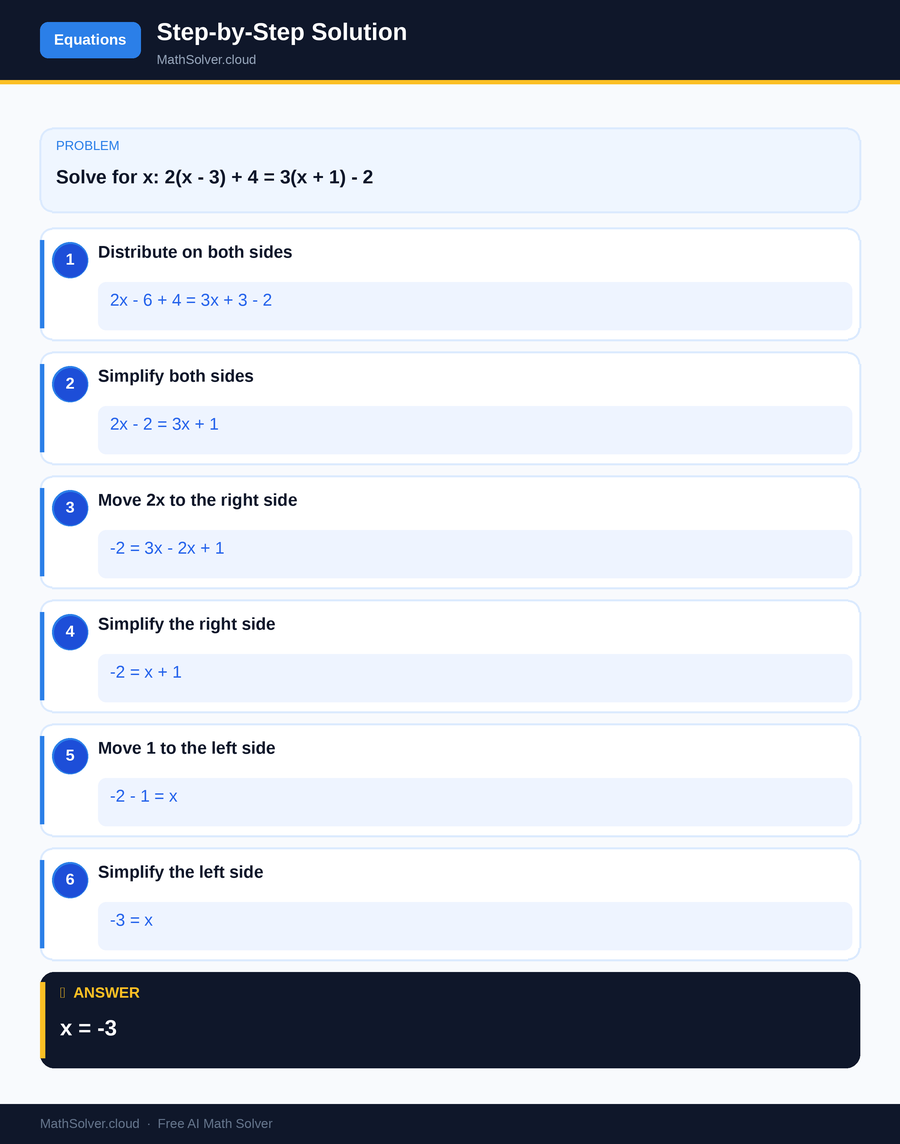
MathSolver Chrome extension solving this problem step-by-step
Common Mistakes to Avoid
One common mistake when learning how to solve for x is not properly simplifying the equation before attempting to isolate x. Students might overlook combining like terms or fail to correctly apply the distributive property, leading to errors in subsequent steps. To avoid this, always take time to simplify each side of the equation fully before proceeding.
Another frequent error involves sign mistakes, especially when adding or subtracting terms on both sides. It's easy to lose track of negative signs, which can completely change the solution. To prevent this, carefully track each operation and double-check your work at every step. Consistent practice and thorough checking can help reduce these errors.
Real-World Applications
Solving for x is not just an academic exercise; it has numerous real-world applications. For instance, in finance, solving for x can help determine the interest rate needed to achieve a certain investment goal. By setting up equations based on financial formulas, you can solve for unknown variables that impact savings or loan conditions.
In engineering, how to solve for x is a crucial skill for designing systems and structures. Engineers often set up equations to model physical systems, and solving for x helps them find critical dimensions or forces. Whether it's calculating the load on a beam or determining the resistance needed in an electrical circuit, solving for x is integral to creating efficient and safe designs.
Frequently Asked Questions
❓ How do you solve for x in an equation with fractions?
❓ What should I do if I encounter a more complex equation with multiple steps?
❓ How can AI help with how to solve for x?
❓ How do I solve for x when x is an exponent?
❓ Can solving for x help in everyday decision-making?
🚀 Solve any math problem instantly
2,000+ students use MathSolver every day — join them for free
📥 Add to Chrome — It's Free