How to Solve for x with Fractions: A Comprehensive Guide
📋 In this guide
Understanding how to solve for x with fractions is a fundamental skill in mathematics that many students find challenging. This process involves manipulating equations that contain fractions in order to isolate the variable x. Fractions can be daunting because they require a solid grasp of arithmetic operations and sometimes the additional complexity of dealing with mixed numbers or improper fractions. However, with the right approach and practice, solving for x in equations with fractions becomes a manageable and even rewarding task.
Students often struggle with how to solve for x with fractions because it involves multiple steps and the application of several mathematical principles at once. It's easy to become overwhelmed by the different operations and the need to find common denominators or convert mixed numbers. Furthermore, students might be more familiar with solving equations that involve whole numbers, making the presence of fractions seem intimidating. The key to overcoming this challenge is to break down the process into simple, clear steps and to practice regularly.
In this article, we will explore how to solve for x with fractions by providing clear explanations, step-by-step guides, and worked examples. You'll learn not only how to handle equations with fractions on one side but also how to tackle equations with fractions on both sides and those that combine fractions with whole numbers. By the end of this guide, you'll have the tools and confidence to approach these problems with ease.
Step-by-Step: How to Solve How To Solve For X With Fractions
Step 1: Clear the Fractions
The first step in solving for x with fractions is to eliminate the fractions from the equation. This can be done by multiplying every term in the equation by the least common denominator (LCD) of all the fractions involved. The LCD is the smallest number that all the denominators divide into evenly. By multiplying through by the LCD, you transform the equation into one with whole numbers, simplifying the process significantly.
Step 2: Simplify the Equation
Once you've cleared the fractions, you can simplify the equation by combining like terms and reducing any common factors. This step might involve distributing multiplication over addition or subtraction, combining constants, or simplifying expressions that result from the elimination of fractions. The goal here is to make the equation as simple as possible, setting the stage for isolating x.
Step 3: Isolate the Variable
Next, focus on isolating the variable x. This involves using inverse operations to move any terms not containing x to the other side of the equation. For instance, if x is being subtracted by a number, add that number to both sides. If x is multiplied by a coefficient, divide both sides by that coefficient to solve for x. The aim is to have x equal to some numeric expression.
Step 4: Verify the Solution
Finally, it's important to verify your solution by substituting the value of x back into the original equation. This step ensures that the solution is correct and that no mistakes were made in the calculations. If the left side of the equation equals the right side after substitution, then the solution is correct. If not, recheck each step for possible errors.
🤖 Stuck on a math problem?
Take a screenshot and let our AI solve it step-by-step in seconds
⚡ Try MathSolver Free →Worked Examples
Example 1
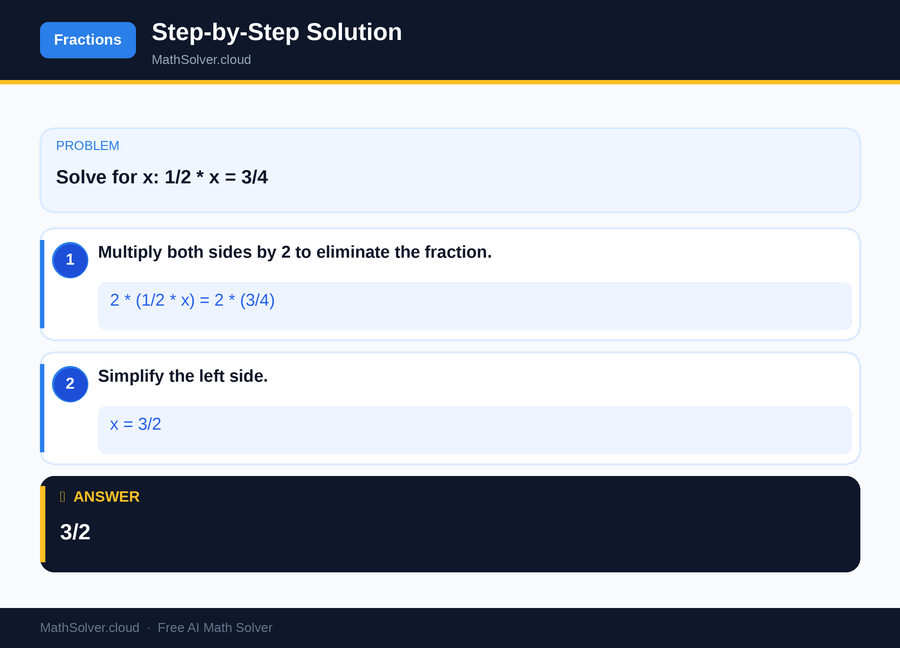
MathSolver Chrome extension solving this problem step-by-step
Example 2
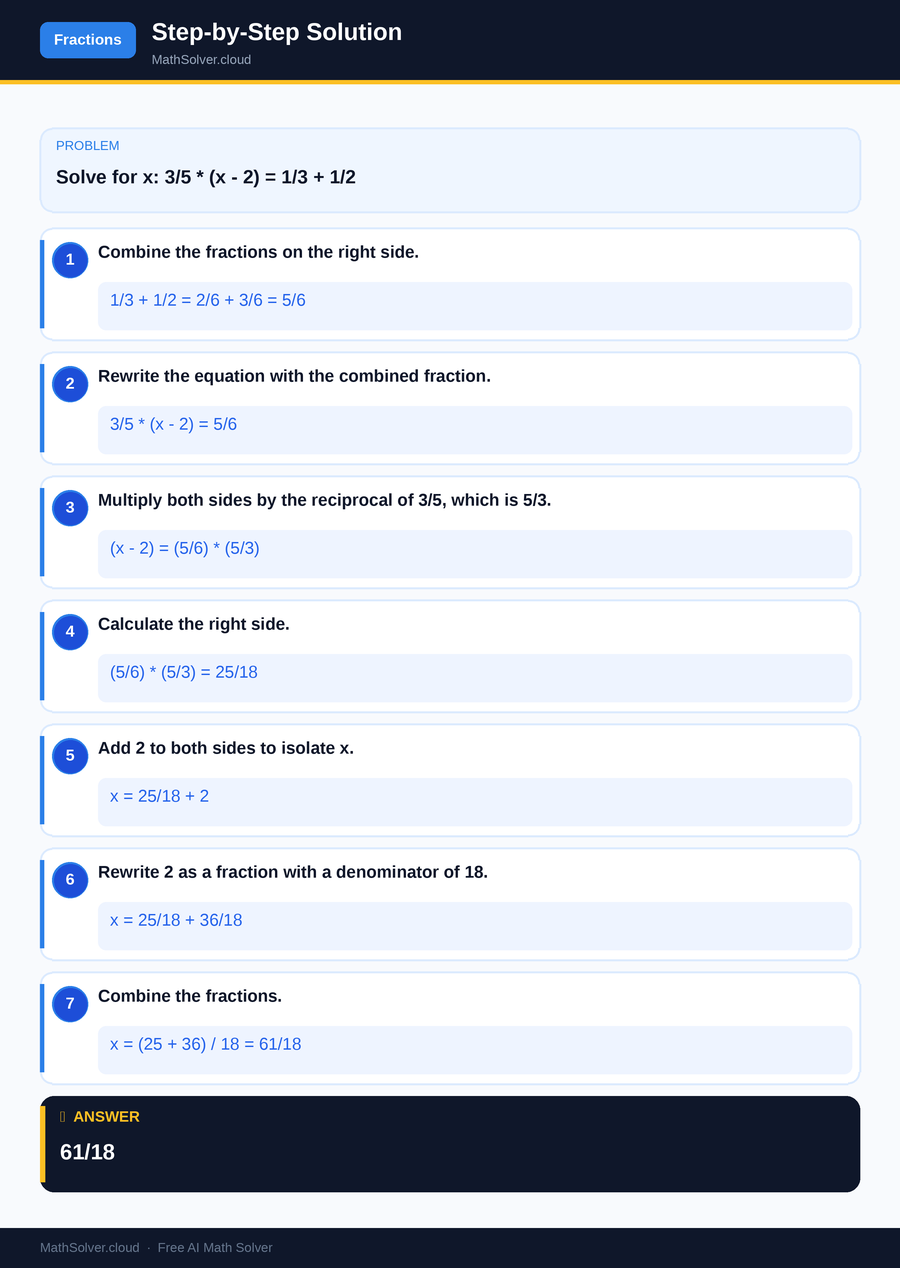
MathSolver Chrome extension solving this problem step-by-step
Common Mistakes to Avoid
One common mistake when learning how to solve for x with fractions is failing to properly find and use the least common denominator. This oversight can lead to incorrect simplification and ultimately the wrong solution. To avoid this, always double-check that you have the correct LCD before proceeding with multiplication. Another frequent error is neglecting to distribute multiplication across all terms within parentheses when fractions are involved. This can result in incomplete or incorrect equations. Always ensure that each term is properly accounted for in your calculations.
Another pitfall is neglecting to verify your solution. Students may assume their answer is correct without checking it by substituting back into the original equation. This critical step helps catch errors made during the solving process and provides assurance that the solution is accurate. By practicing these steps methodically and reviewing your work, you can avoid these common errors.
Real-World Applications
Understanding how to solve for x with fractions is not only essential in academic settings but also has practical real-world applications. For example, in engineering, fractions are often used to calculate dimensions, tolerances, and other precise measurements. Solving for unknowns in these equations is crucial for designing and building structures or machinery with exact specifications.
In everyday life, fractions play a role in financial calculations such as interest rates, loan amortizations, and budgeting. When determining how much money is saved through interest or how payments are divided over time, solving equations with fractions allows for accurate financial planning and decision-making. These skills are not only applicable in professional environments but also in personal finance management.
Frequently Asked Questions
❓ What is the best way to learn how to solve for x with fractions?
❓ How can I solve for x with fractions on both sides of the equation?
❓ How can AI help with how to solve for x with fractions?
❓ How do you solve for x with fractions and whole numbers?
❓ Can solving for x with fractions be applied in proportional relationships?
🚀 Solve any math problem instantly
2,000+ students use MathSolver every day — join them for free
📥 Add to Chrome — It's Free