How to Solve Exponential Equations
📋 In this guide
Learning how to solve exponential equations is a crucial skill for students tackling algebra and higher-level math. Exponential equations are equations in which the variables appear as exponents. Many students find these equations challenging because they involve both understanding exponential functions and applying logarithmic concepts. By the end of this article, you will understand the various methods for solving these equations, including using logarithms and dealing with different bases. We'll walk you through step-by-step examples and common pitfalls, ensuring you're well-equipped to handle exponential equations in your studies.
Exponential equations often appear intimidating at first glance. The sight of variables perched as exponents can seem daunting because it requires a shift from more straightforward arithmetic or linear algebraic thinking. Students often struggle with exponential equations because they require a strong grasp of both exponents and logarithms. This blend of concepts can lead to confusion if the foundational understanding is not solid. However, by breaking down the process into clear, manageable steps, you'll find that solving these equations becomes much more approachable.
In this article, you'll learn how to solve exponential equations by using different methods, including how to solve exponential equations with different bases and how to solve exponential equations with logarithms. Whether you're dealing with equations that have the number e or logs, we'll cover the techniques you need to succeed. By following our structured approach and examples, you'll gain confidence in tackling these problems with ease. Let's dive into the key formula and step-by-step guide to mastering exponential equations.
Step-by-Step: How to Solve How To Solve Exponential Equations
Step 1: Equalize the Bases
The first step in how to solve exponential equations is to equalize the bases, if possible. This means rewriting both sides of the equation so that they have the same base. For example, if you have 2^x = 8, you can rewrite 8 as 2^3. This gives you an equation where the bases are the same, allowing you to set the exponents equal to each other. This is a straightforward method when possible, as it simplifies the equation immediately to a basic algebraic form.
Step 2: Apply Logarithms
When you cannot readily equalize the bases, the next step is to apply logarithms. Using logarithms helps to bring the exponent down so that it can be solved algebraically. If you have an equation like 3^x = 20, you can take the logarithm of both sides. Applying log base 10 or natural log (ln) is common; for instance, log(3^x) = log(20) can be rewritten using the power rule of logarithms as x * log(3) = log(20). This allows you to solve for x by dividing both sides by log(3).
Step 3: Solve the Resulting Equation
Once the equation is simplified using logarithms, the next step is to solve for the variable. This may involve basic algebra, such as isolating the variable on one side of the equation. Continuing from the previous step: x * log(3) = log(20), divide both sides by log(3) to solve for x, giving x = log(20)/log(3). This step boils down to ensuring the variable is isolated and calculated correctly.
Step 4: Check Your Solution
The final step in how to solve exponential equations is checking your solution. Substitute your value back into the original equation to ensure it satisfies the equation. This is crucial because it verifies the accuracy of your solution and confirms that no errors were made during calculation. For example, if you calculated x = 2.7268 for the equation 3^x = 20, you should substitute it back to check if 3^2.7268 is approximately equal to 20.
🤖 Stuck on a math problem?
Take a screenshot and let our AI solve it step-by-step in seconds
⚡ Try MathSolver Free →Worked Examples
Example 1

MathSolver Chrome extension solving this problem step-by-step
Example 2
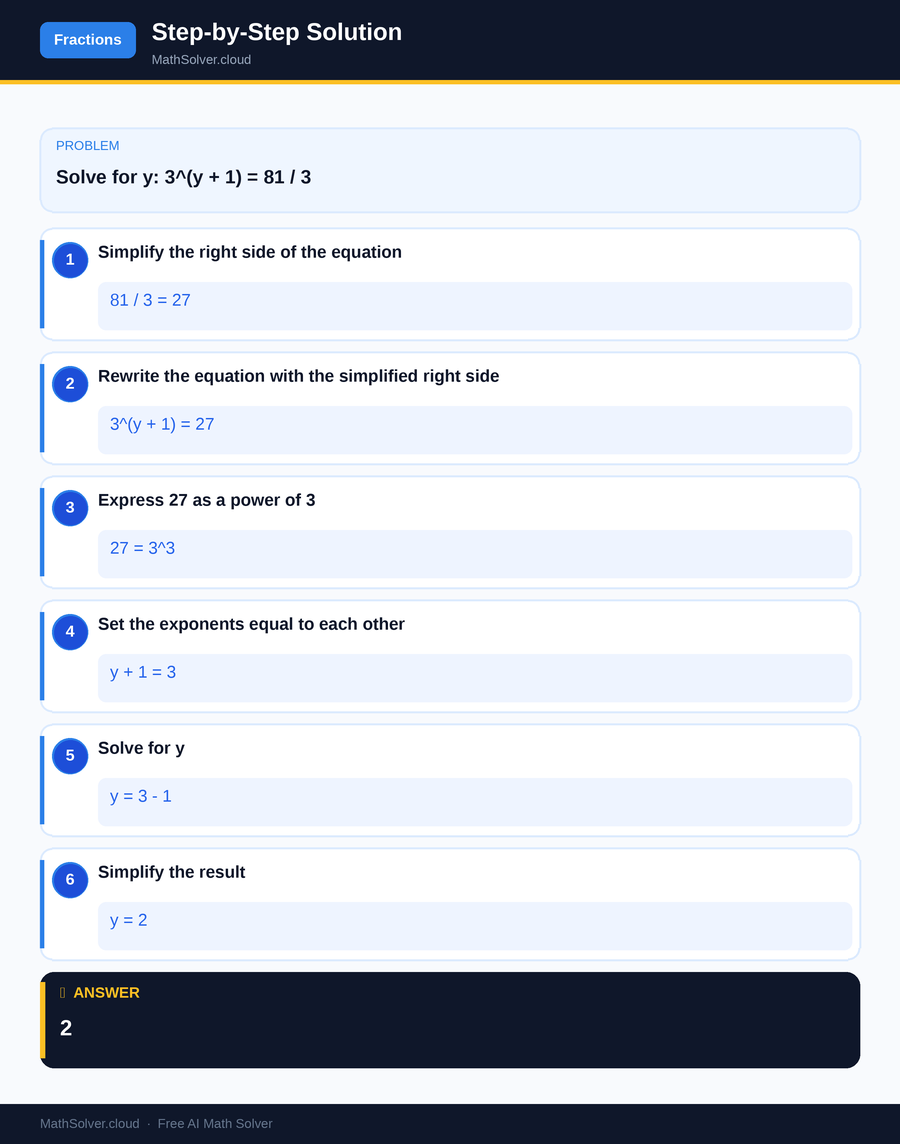
MathSolver Chrome extension solving this problem step-by-step
Common Mistakes to Avoid
A common mistake students make is failing to check if the bases can be equalized before jumping to logarithms. Always try to convert expressions to the same base first, as it often simplifies the problem significantly. Another error is incorrectly applying logarithm rules, especially the power rule. Always remember that log(a^b) = b * log(a) and ensure correct application to avoid mistakes.
Additionally, students might forget to check their solutions, which can lead to unverified and possibly incorrect answers. Always substitute the solution back into the original equation to confirm its validity. This step is crucial for ensuring your solution is correct and confidently moving forward with your calculations.
Real-World Applications
Understanding how to solve exponential equations is not just an academic exercise; it has practical applications in various fields. In finance, exponential equations are used to calculate compound interest, which is fundamental for understanding investments and loans. Knowing how to manipulate these equations can help you make better financial decisions by accurately predicting growth over time.
In science, exponential equations model phenomena such as population growth, radioactive decay, and the spread of disease. For example, epidemiologists use exponential models to predict how fast a virus can spread, which is crucial for planning public health strategies. Engineers also use these equations in signal processing and electrical circuits, showcasing their wide-ranging utility in solving real-world problems.
Frequently Asked Questions
❓ How do you approach how to solve exponential equations with different bases?
❓ What are the advantages of learning how to solve exponential equations with logarithms?
❓ How can AI help with how to solve exponential equations?
❓ Why is how to solve exponential equations with e important?
❓ How does solving exponential equations apply to daily life?
🚀 Solve any math problem instantly
2,000+ students use MathSolver every day — join them for free
📥 Add to Chrome — It's Free