Mastering How to Solve Equations: A Comprehensive Guide
📋 In this guide
Learning how to solve equations is a fundamental skill in mathematics that serves as a gateway to understanding more complex mathematical concepts. Many students find themselves struggling with this topic because it involves multiple steps and requires a strong grasp of algebraic principles. Despite these challenges, mastering the art of solving equations is essential for progressing in math and achieving success in various STEM fields. In this article, we will break down the process of solving equations into manageable steps, making it accessible for students at all levels.
Equations are the mathematical statements that assert the equality of two expressions, and solving them involves finding the value(s) of the variable(s) that make the equation true. Students often grapple with how to solve equations because it involves applying a series of operations to isolate the variable. Additionally, equations can come in various forms, such as linear, quadratic, and those involving fractions or absolute values, each requiring different techniques to solve.
By the end of this article, you will have a clear understanding of how to solve equations, including those with variables on both sides and different variables. We will also explore how to tackle equations with absolute values, two variables, and fractions. Through step-by-step guides, worked examples, and practical insights, you'll gain the confidence and knowledge needed to navigate the challenges of equation solving.
Step-by-Step: How to Solve How To Solve Equations
Step 1: Simplify Both Sides of the Equation
Begin by simplifying both sides of the equation, if necessary. This may include distributing multiplication over addition or subtraction, combining like terms, and simplifying any fractions. The goal here is to make the equation as straightforward as possible before proceeding to isolate the variable. For example, in an equation like 2(x + 3), distribute the 2 to get 2x + 6.
Step 2: Move Variables to One Side
Next, if the equation contains variables on both sides, use addition or subtraction to move all variables to one side of the equation. This step is crucial when learning how to solve equations with variables on both sides. For instance, in the equation 3x + 5 = x + 9, subtract x from both sides to get 2x + 5 = 9.
Step 3: Isolate the Variable
With the variables on one side, focus on isolating the variable by performing inverse operations. This involves reversing addition with subtraction, multiplication with division, and so on. For example, if you have 2x + 5 = 9, subtract 5 from both sides to get 2x = 4, then divide both sides by 2 to solve for x, yielding x = 2.
Step 4: Check Your Solution
Finally, substitute the solution back into the original equation to verify its accuracy. This step ensures that no errors were made during the solving process and that the solution satisfies the equation. For instance, substituting x = 2 back into the original equation 3x + 5 = 20 should yield a true statement.
🤖 Stuck on a math problem?
Take a screenshot and let our AI solve it step-by-step in seconds
⚡ Try MathSolver Free →Worked Examples
Example 1
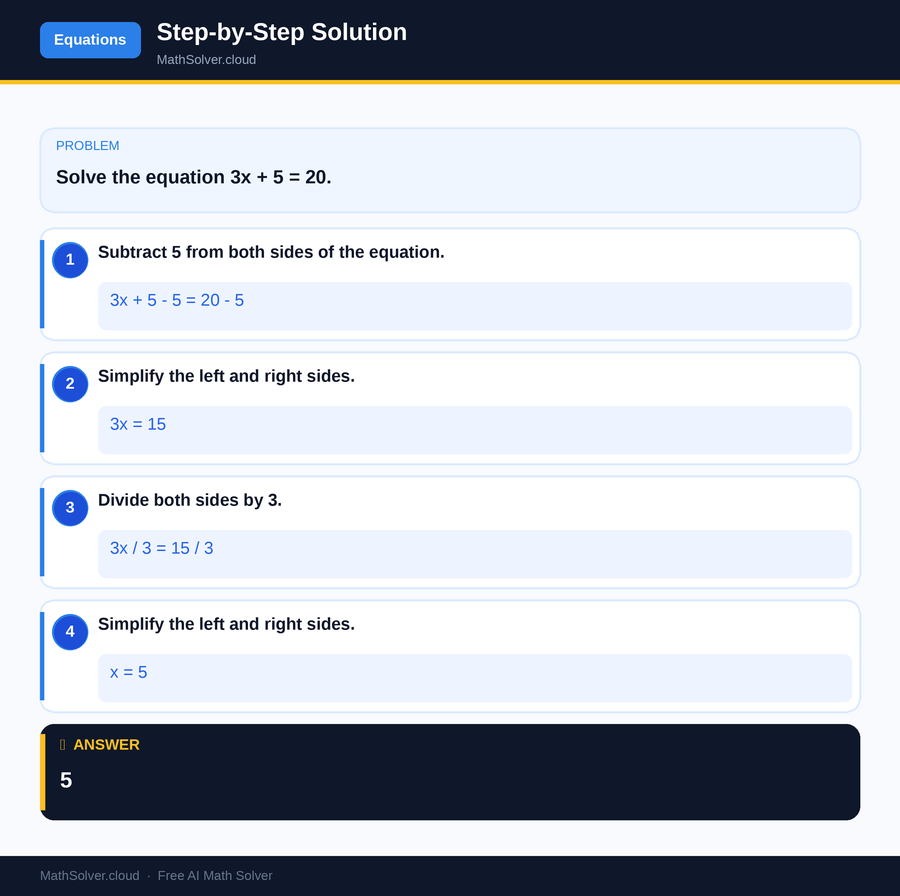
MathSolver Chrome extension solving this problem step-by-step
Example 2
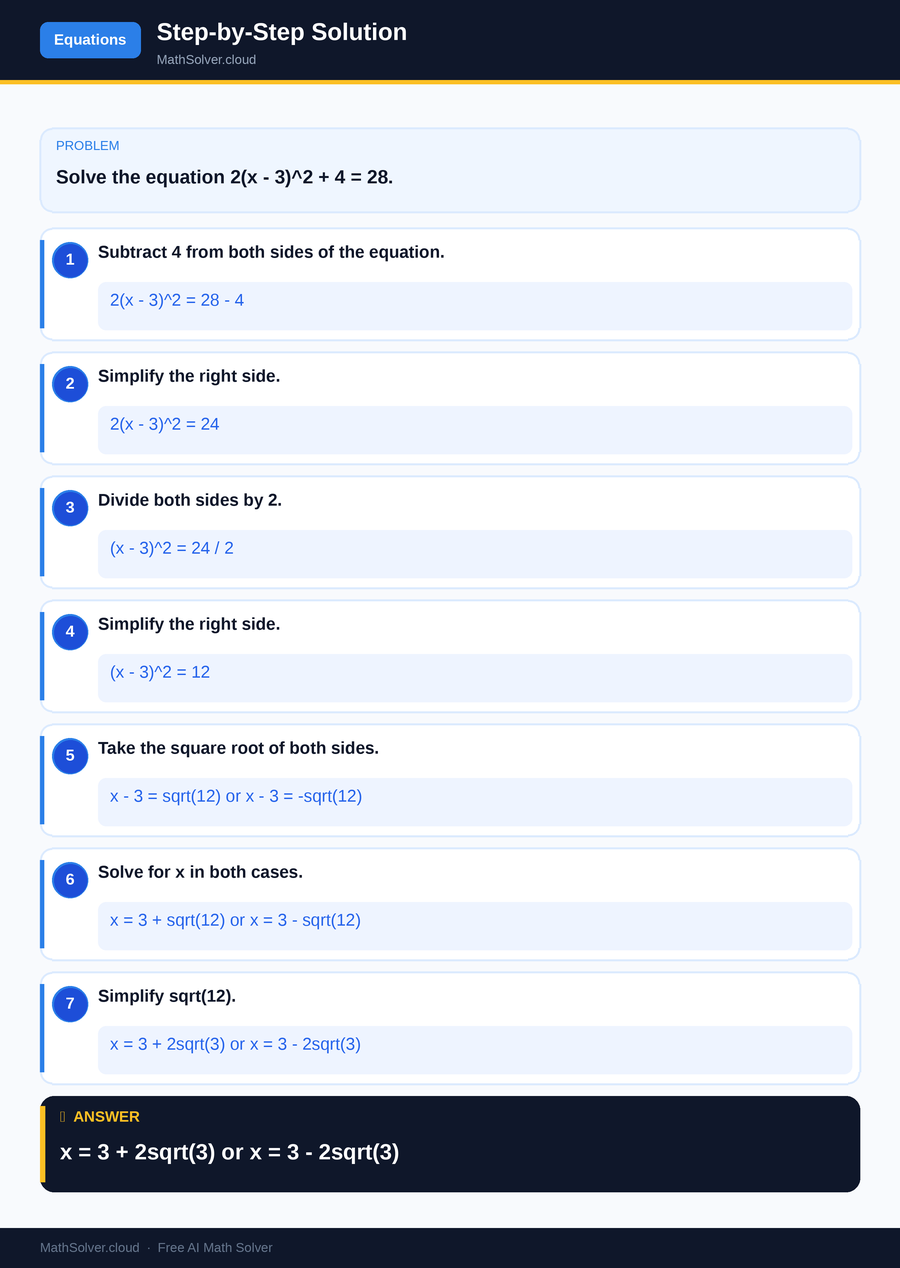
MathSolver Chrome extension solving this problem step-by-step
Common Mistakes to Avoid
One of the most common errors students make when learning how to solve equations is failing to perform the same operation on both sides of the equation. This can lead to incorrect solutions and frustration. Always remember to maintain the balance of the equation by applying operations equally on both sides.
Another frequent mistake is incorrectly simplifying expressions, especially when dealing with negative signs and distribution. Carefully check your work at each step, particularly when working with multi-step equations. Taking the time to write each step clearly can help avoid these errors and lead to correct solutions.
Real-World Applications
Understanding how to solve equations is crucial in many real-world scenarios. For example, engineers use equations to calculate forces, stresses, and material requirements in construction projects. By accurately solving equations, they ensure structures are safe and functional.
In finance, equations are used to model investment growth, calculate interest rates, and analyze financial markets. Solving equations in these contexts helps make informed decisions that can impact economic outcomes. The ability to solve equations efficiently is a valuable skill in both professional and everyday life.
Frequently Asked Questions
❓ What is the best way to learn how to solve equations?
❓ How do I solve equations with different variables?
❓ How can AI help with how to solve equations?
❓ What are two step equations, and how do they differ from multi step equations?
❓ How do I solve equations with fractions?
🚀 Solve any math problem instantly
2,000+ students use MathSolver every day — join them for free
📥 Add to Chrome — It's Free