How to Solve a Matrix: A Step-by-Step Guide
📋 In this guide
How to solve a matrix is a fundamental skill in mathematics, essential for students tackling linear algebra and various applications in science and engineering. Many students find this topic challenging due to its abstract nature and the complexity of operations involved, such as row reductions, determinants, and inverses. However, with clear guidance and practice, anyone can master these techniques. This article aims to demystify the process of solving matrices by offering a step-by-step guide, detailed examples, and insights into common pitfalls.
Understanding how to solve a matrix is critical because matrices are used to represent complex systems of equations and data transformations. Whether you're dealing with simple linear equations or advanced multivariable systems, being able to manipulate and solve matrices will empower you to find solutions efficiently. As we journey through this topic, you'll learn the fundamental concepts, explore practical examples, and discover tools that can assist in solving matrices, including calculators like the TI-84 and online resources.
By the end of this article, you'll have a comprehensive understanding of how to solve a matrix and be equipped with the knowledge to tackle matrix-related problems confidently. From foundational theories to real-world applications, we will illuminate every aspect to ensure you have a well-rounded grasp of the subject.
Step-by-Step: How to Solve How To Solve A Matrix
Step 1: Set Up the Matrix Equation
To solve any matrix problem, start by setting up your equations in matrix form. For a system of linear equations, express the equations as AX = B. Identify the coefficient matrix A, the variable matrix X, and the constants matrix B. This foundational step helps visualize the problem and sets the stage for applying matrix operations to solve it.
Step 2: Use Row Operations to Simplify
Once the matrix equation is set up, the next step is to simplify the matrix A using row operations, such as row swapping, scaling, and adding multiples of rows to each other. These operations aim to transform the matrix A into an upper triangular or row-echelon form, making it easier to solve. This process, known as Gaussian elimination, is crucial in reducing the complexity of the system.
Step 3: Solve for the Variable Matrix
After simplifying the matrix, solve for the variable matrix X through back substitution if the matrix is in row-echelon form, or by using the inverse matrix solver if the matrix is invertible. In cases where the determinant of A is non-zero, you can find X by calculating the inverse of A and multiplying it by B, i.e., X = A^(-1)B. This step provides the specific values for the variables.
Step 4: Verify the Solution
Finally, verify your solution by substituting the values obtained for the variables back into the original equations. This ensures that the solution satisfies all the given equations. Additionally, check for consistency and uniqueness of the solution, especially in cases of infinite solutions or no solution scenarios. This verification step is crucial for confirming the accuracy of your results.
🤖 Stuck on a math problem?
Take a screenshot and let our AI solve it step-by-step in seconds
⚡ Try MathSolver Free →Worked Examples
Example 1
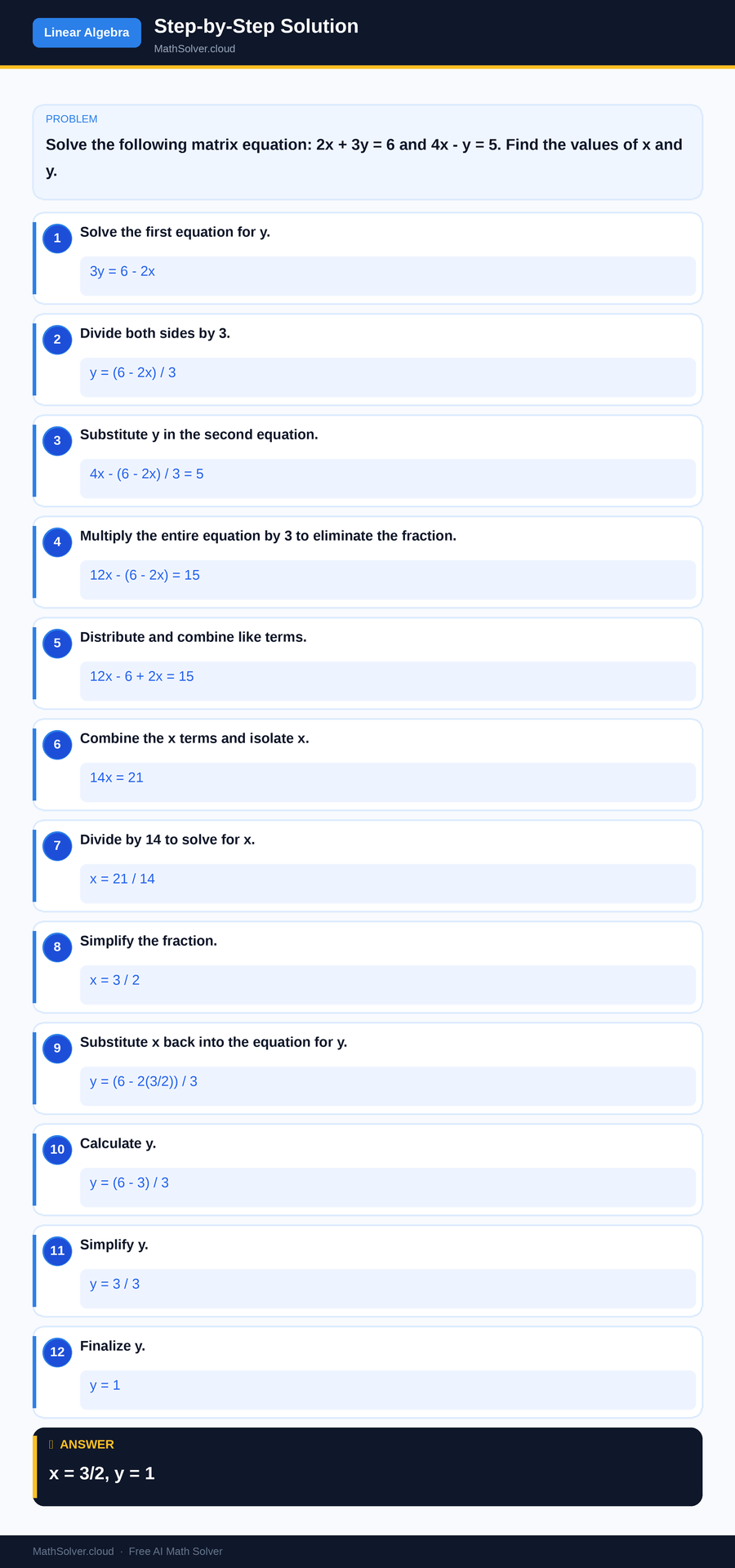
MathSolver Chrome extension solving this problem step-by-step
Example 2
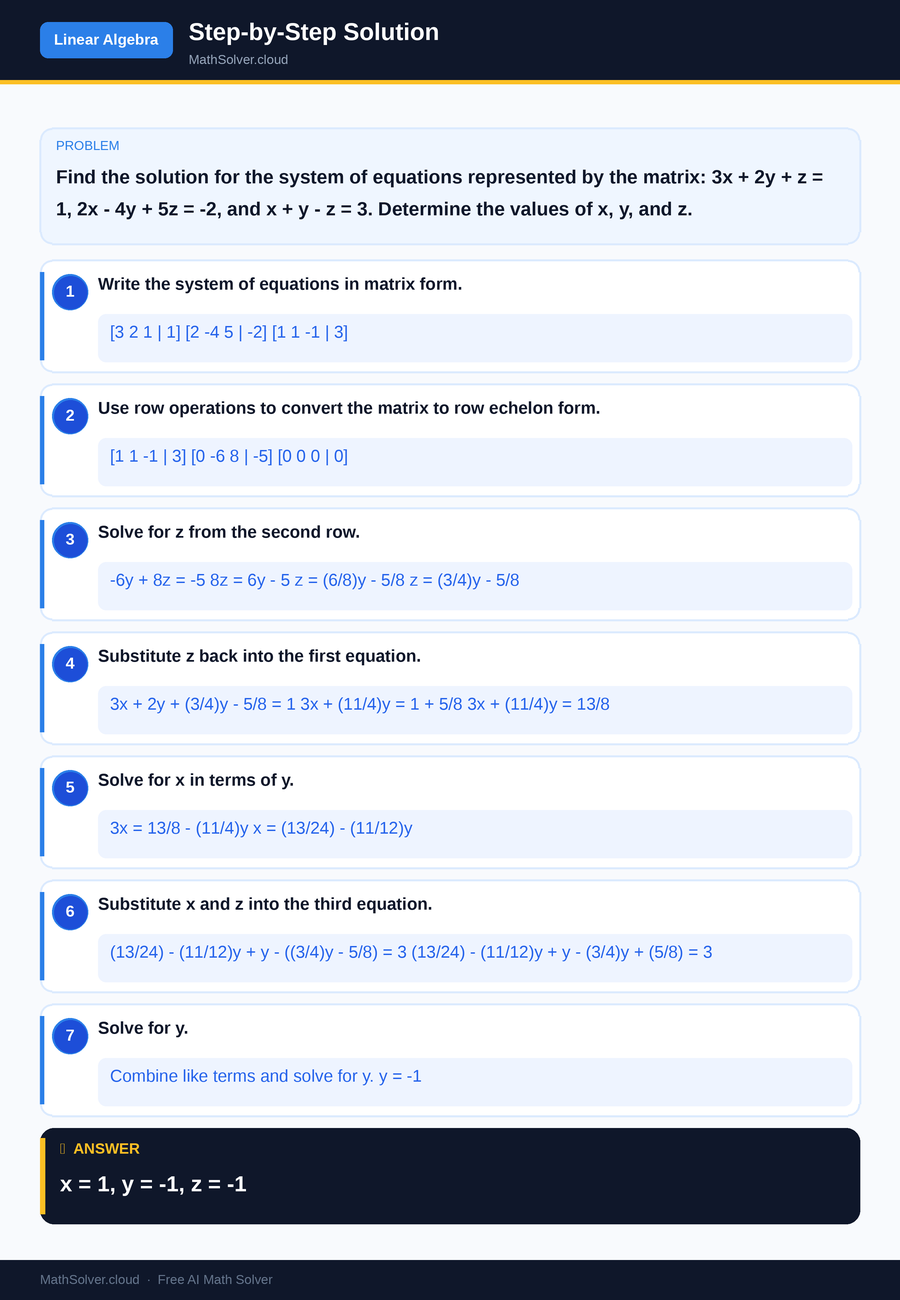
MathSolver Chrome extension solving this problem step-by-step
Common Mistakes to Avoid
A frequent mistake students make is misapplying row operations, which can lead to incorrect results. Ensure each operation is executed carefully and that the arithmetic is checked at each step.
Additionally, students often forget to verify the determinant before attempting to find the inverse of a matrix; remember that the inverse only exists if the determinant is non-zero.
Another common error is neglecting to verify the solution. Always substitute the values back into the original equations to confirm their validity. This step ensures that any oversight in earlier calculations is caught and corrected before finalizing the solution.
Real-World Applications
Understanding how to solve a matrix is not limited to academia; it has practical applications in numerous fields. In computer graphics, matrices are used to perform transformations such as rotations and translations, essential for rendering 3D scenes.
Engineers use matrices to model and solve systems of linear equations, which are critical for designing and analyzing complex structures and circuits.
In economics, matrices help in modeling and solving input-output models to understand economic activities. Additionally, matrices play a crucial role in data science, where they are used in algorithms for machine learning, helping to uncover patterns and make predictions from vast datasets.
Frequently Asked Questions
❓ What is the best way to learn how to solve a matrix?
❓ How to solve a matrix on a calculator?
❓ How can AI help with how to solve a matrix?
❓ Are there specific calculators recommended for solving matrices?
❓ What is a determinant matrix solver?
🚀 Solve any math problem instantly
2,000+ students use MathSolver every day — join them for free
📥 Add to Chrome — It's Free