Understanding the Gravitational Force Equation
📋 In this guide
The gravitational force equation is a fundamental concept in physics that explains the attractive force between two masses. It often poses challenges for students due to its abstract nature and the mathematical skills required to solve problems using it. In this article, you'll explore what the gravitational force equation is, why it can be a hurdle for learners, and how you can master it with ease. By the end, you'll have a clear understanding of how to apply this equation in various contexts, enhancing your problem-solving skills in physics.
Students commonly struggle with the gravitational force equation because it involves understanding both the physical concept of gravity and the algebraic manipulation required to solve related problems. The equation is not just about plugging in numbers; it requires comprehension of the relationship between mass, distance, and gravitational force. This article is designed to break down these concepts into manageable steps, providing you with a solid foundation to tackle gravitational problems confidently.
Throughout this guide, you'll also encounter real-world applications and common mistakes to avoid, making the gravitational force equation more relatable and less daunting. Whether you're a high school student tackling physics for the first time or preparing for advanced studies, this article will serve as a helpful resource on your learning journey.
Step-by-Step: How to Solve Gravitational Force Equation
Step 1: Understanding the Components of the Equation
Before using the gravitational force equation, it's essential to understand each component. The gravitational constant, G, is a fixed value that makes the equation applicable universally. The masses, m1 and m2, are the weights of the two objects in question, typically measured in kilograms. The distance, r, is the separation between the centers of mass of these objects, measured in meters. Understanding these components helps in correctly setting up the problem, ensuring that you have the right units and values.
Step 2: Setting Up the Equation
Once you understand the components, the next step is to set up the equation correctly. Begin by writing down the formula: F = G * (m1 * m2) / r^2. Insert the known values into the equation, ensuring that all your units are consistent with the SI system (kilograms for mass, meters for distance). This setup is crucial because any mistakes here can lead to incorrect results. If you're using a calculator, double-check that you're entering the values correctly, especially the gravitational constant, which is a small number and easy to mistype.
Step 3: Solving the Equation
With the equation set up, the next step is to solve it. Start by multiplying the masses (m1 and m2), then multiply this result by the gravitational constant G. Afterward, calculate the square of the distance r, and finally, divide the product of G, m1, and m2 by r^2. Carefully perform each operation in sequence to avoid errors. If needed, break the calculation into smaller steps to ensure accuracy, especially when dealing with powers of ten.
Step 4: Interpreting the Results
Once you have calculated the gravitational force, it's essential to interpret the results correctly. The force, F, will be measured in newtons (N), which indicates the magnitude of the gravitational attraction between the two objects. A larger value of F implies a stronger gravitational pull, while a smaller value indicates a weaker force. Understanding the result's significance helps in applying it to real-world scenarios, such as understanding the gravitational pull between celestial bodies or engineering applications.
🤖 Stuck on a math problem?
Take a screenshot and let our AI solve it step-by-step in seconds
⚡ Try MathSolver Free →Worked Examples
Example 1
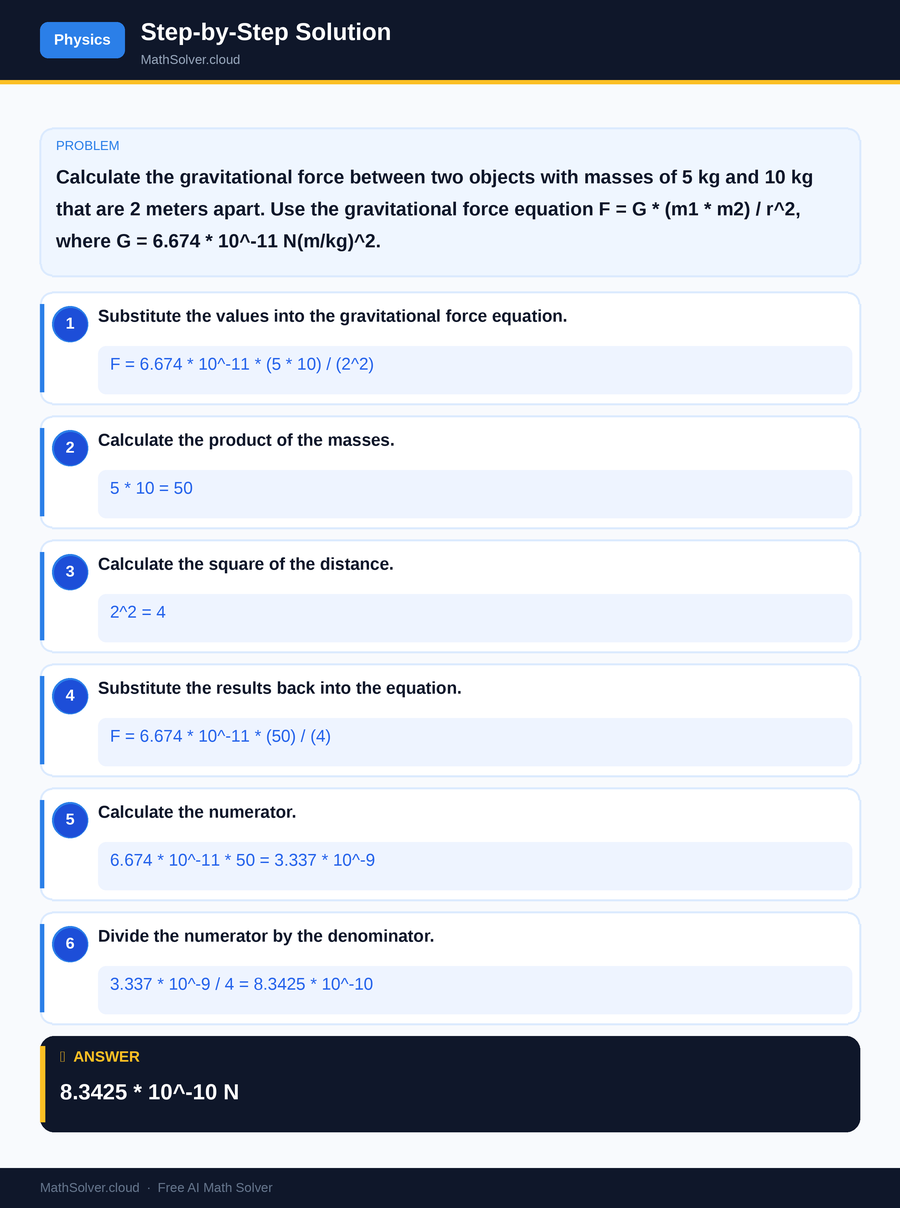
MathSolver Chrome extension solving this problem step-by-step
Example 2
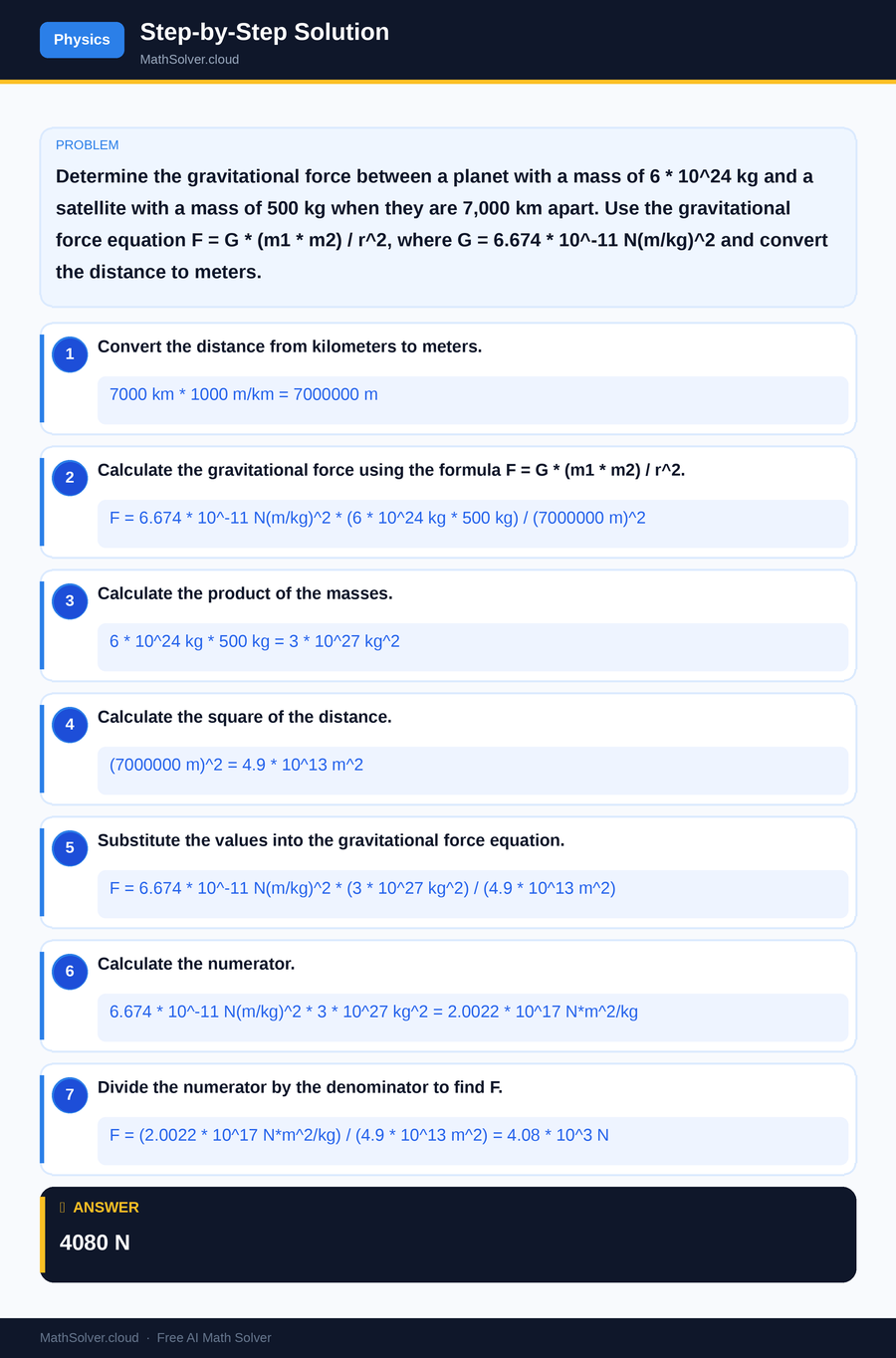
MathSolver Chrome extension solving this problem step-by-step
Common Mistakes to Avoid
One common mistake when using the gravitational force equation is confusing the units. Always ensure that masses are in kilograms, distances are in meters, and the gravitational constant is applied correctly. This is crucial because even small errors in units can lead to incorrect results. Another frequent error is miscalculating the square of the distance or incorrectly entering values into a calculator. Take time to carefully follow each step of the calculation, and double-check your work to avoid these pitfalls.
Another mistake students often make is misunderstanding the significance of the gravitational constant G. Remember, G is a very small number, which means the gravitational force between everyday objects is usually negligible. This misunderstanding can lead to unrealistic expectations about the results. Keep in mind that the gravitational force equation is most useful for calculating forces involving large masses, such as planets or stars.
Real-World Applications
The gravitational force equation is fundamental in understanding celestial mechanics. It helps explain the orbits of planets and moons, allowing scientists to predict their movements accurately. For instance, NASA uses this equation to determine the trajectories of spacecraft and satellites, ensuring they reach their intended destinations safely and effectively.
Beyond astronomy, the gravitational force equation is also vital in engineering and construction. Engineers use it to calculate the forces acting on structures, such as bridges and skyscrapers, ensuring they can withstand gravitational forces and remain stable. Understanding these applications highlights the importance of mastering the gravitational force equation, as it plays a critical role in both scientific discovery and practical problem-solving.
Frequently Asked Questions
❓ What is the gravitational force equation used for?
❓ Why do students find the gravitational force equation challenging?
❓ How can AI help with the gravitational force equation?
❓ What other equations are essential in physics besides the gravitational force equation?
❓ How is the gravitational force equation applied in engineering?
🚀 Solve any math problem instantly
2,000+ students use MathSolver every day — join them for free
📥 Add to Chrome — It's Free