Understanding Geometry Dash the Meltdown
📋 In this guide
Geometry Dash the Meltdown is a popular level pack expansion for the original Geometry Dash game, and it has captivated players with its rhythmic challenges and vibrant graphics. While the game itself is a fun and engaging platformer, the concept behind it can be challenging for students who are learning geometry. This difficulty often stems from the abstract nature of geometric principles and their application in dynamic scenarios. In this article, we will explore the basics of "geometry dash the meltdown," and focus on breaking down complex geometric concepts into simple, digestible steps.
Students often struggle with geometry because it requires a different way of thinking compared to arithmetic or algebra. Geometry involves spatial reasoning, visualization, and an understanding of shapes and their properties. When it comes to "geometry dash the meltdown," these skills are crucial as the game essentially mimics geometric principles through its level design and mechanics. By the end of this article, you will gain a clearer understanding of these concepts, which will help you not only in the game but also in your academic pursuits.
Geometry Dash is more than just a game; it's an opportunity to apply geometric concepts in a fun and interactive way. By learning how to navigate the challenges of "geometry dash the meltdown," you'll develop a stronger grasp of geometry. We will cover essential formulas, provide step-by-step guides, and work through examples to ensure you feel confident in your skills. Let's dive in!
Step-by-Step: How to Solve Geometry Dash The Meltdown
Understanding Regular Shapes
A regular shape is one where all sides and angles are equal, like a regular hexagon. In geometry dash, players often encounter regular shapes as obstacles or platforms. Understanding these shapes helps in predicting movements and planning strategies. Recognizing symmetry and equal segments is crucial for mastering levels in "geometry dash the meltdown."
Calculating Perimeters
To calculate the perimeter of regular polygons, identify the number of sides and the length of each side. For example, the perimeter of a regular hexagon with side length 's' is 6 * s. This calculation is straightforward but essential when visualizing or designing levels in geometry dash. Practicing this with various polygons will enhance your geometric intuition.
Analyzing Circle Segments
In geometry, a sector of a circle is a portion enclosed by two radii and an arc. Calculating the area and arc length involves understanding the central angle. The area of a sector is given by (angle/360) * pi * radius^2, and the arc length is (angle/360) * 2 * pi * radius. These calculations are applicable when analyzing curved obstacles in geometry dash.
Applying Geometric Concepts in Gameplay
In "geometry dash the meltdown," applying these geometric concepts can improve your gameplay. Recognizing patterns, calculating distances, and predicting movements are all part of the experience. Use your knowledge of geometry to navigate through the levels efficiently, avoiding obstacles and mastering the game.
🤖 Stuck on a math problem?
Take a screenshot and let our AI solve it step-by-step in seconds
⚡ Try MathSolver Free →Worked Examples
Example 1
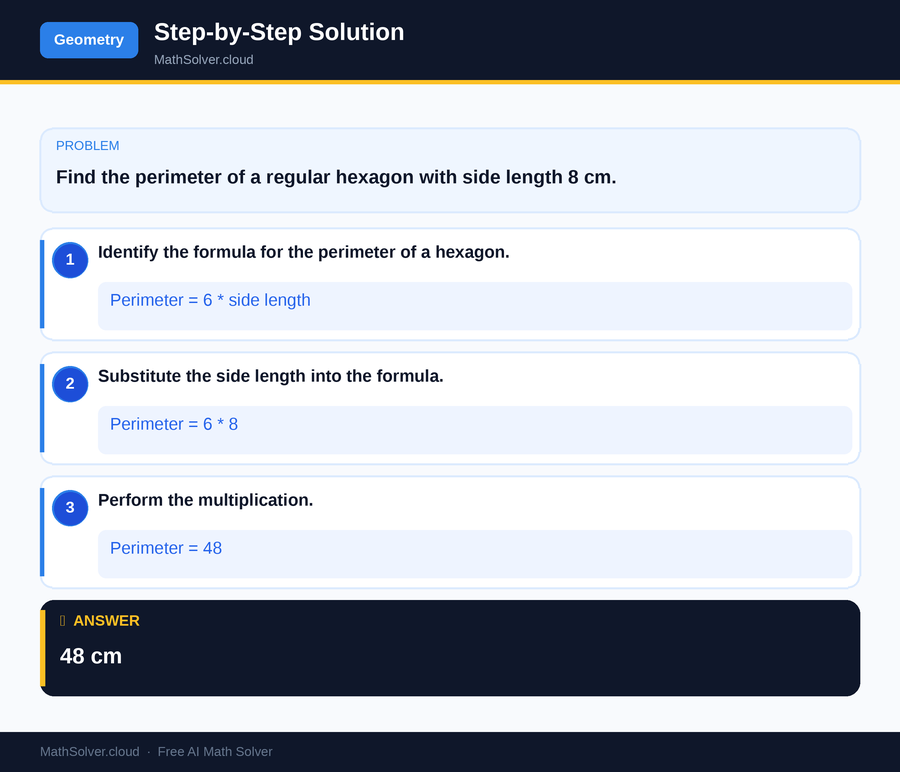
MathSolver Chrome extension solving this problem step-by-step
Example 2
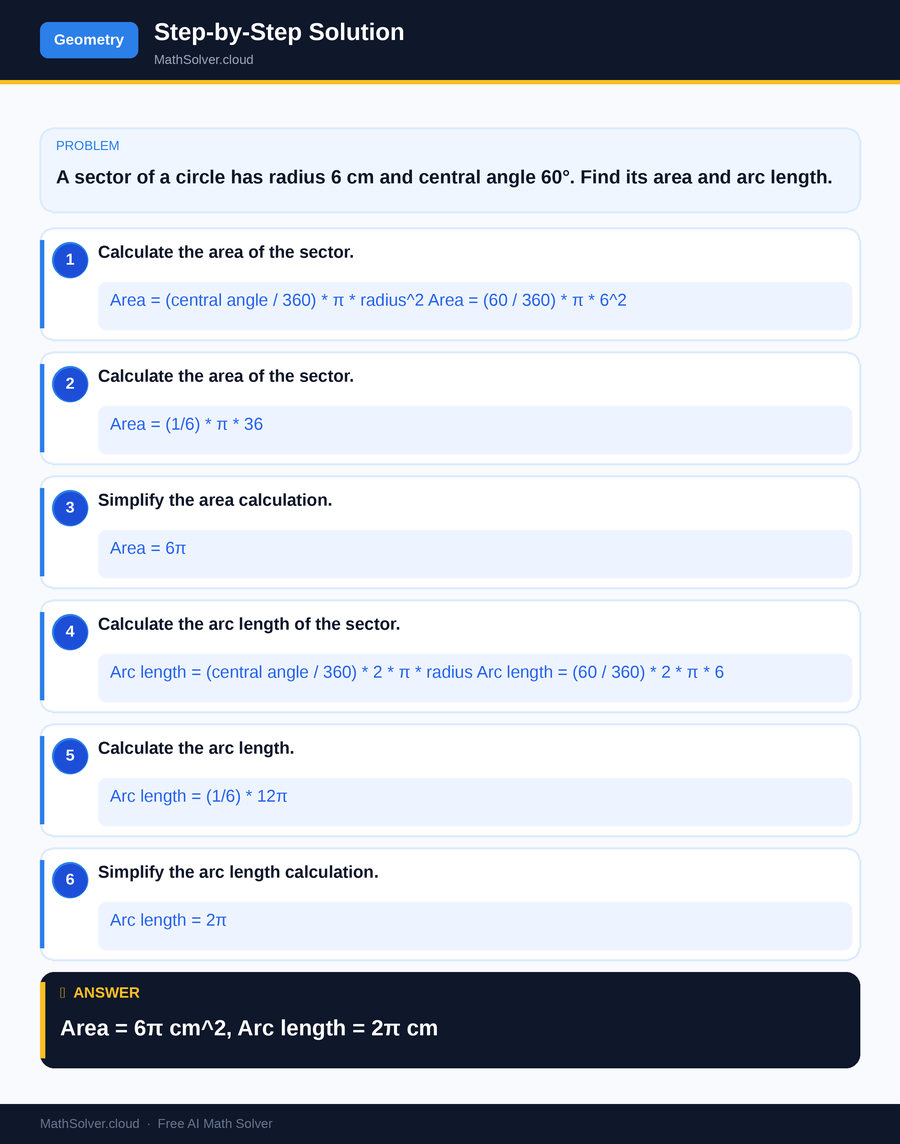
MathSolver Chrome extension solving this problem step-by-step
Common Mistakes to Avoid
One common mistake students make is confusing the formulas for different geometric calculations. For example, mixing up the formulas for perimeter and area can lead to incorrect results. To avoid this, always double-check the type of measurement you are dealing with and use the appropriate formula.
Another frequent error is neglecting units of measurement. In geometry, it is crucial to keep track of units to ensure accuracy in your answers. Whether you are calculating lengths, areas, or volumes, remember to include the units in your final answer. Practicing problems consistently will help reinforce these habits.
Real-World Applications
Geometry Dash the Meltdown can be seen as a metaphor for real-world applications of geometry. The principles of symmetry, balance, and spatial reasoning you learn in geometry are directly applicable in fields such as architecture, engineering, and design. Understanding how to calculate perimeters and areas can assist in projects ranging from simple home designs to complex architectural structures.
Additionally, the problem-solving skills developed through geometry and games like "geometry dash the meltdown" are valuable in various careers. Whether it's optimizing resource allocation in business or designing efficient transportation systems, the ability to apply geometric reasoning is a highly sought-after skill in today’s job market.
Frequently Asked Questions
❓ What is the main challenge in Geometry Dash the Meltdown?
❓ How do I calculate the area of complex shapes in geometry dash levels?
❓ How can AI help with geometry dash the meltdown?
❓ Why is understanding symmetry important in geometry dash?
❓ How do geometry lessons enhance gameplay in geometry dash?
🚀 Solve any math problem instantly
2,000+ students use MathSolver every day — join them for free
📥 Add to Chrome — It's Free