Fraction Solver with Whole Numbers
📋 In this guide
A fraction solver with whole numbers is a tool or method that helps students and individuals simplify the process of solving mathematical problems involving fractions and whole numbers. Fractions can be intimidating because they require a different set of operations compared to whole numbers, and many students find themselves struggling with concepts like common denominators, multiplication, and division of fractions. This article aims to demystify the process, providing a clear path to understanding how to navigate these challenges. You'll learn step-by-step instructions, common mistakes to avoid, and real-world applications of fraction solvers with whole numbers.
Fractions are an integral part of mathematics, and understanding how to work with them alongside whole numbers is essential for solving a variety of problems. Students often find themselves confused by the different rules that apply to fractions compared to whole numbers. This article will walk you through the processes involved in using a fraction solver with whole numbers, making the topic accessible and manageable. Whether you're a student struggling with homework or a parent helping your child, this guide will provide valuable insights.
Fractions appear in numerous mathematical problems, and the ability to solve them efficiently is a crucial skill. This article will not only explain the key formula and definitions but will also provide a comprehensive step-by-step guide to solving problems involving fractions and whole numbers. By the end of this article, you'll be equipped with the knowledge to tackle these problems confidently and accurately.
Step-by-Step: How to Solve Fraction Solver With Whole Numbers
Step 1: Understanding the Problem
The first step in using a fraction solver with whole numbers is to thoroughly understand the problem you are trying to solve. Determine what the fraction represents and how it interacts with the whole number. Are you multiplying, dividing, adding, or subtracting? This understanding will guide the method you use to solve the problem. For example, if you are asked to find 3/4 of 16, you need to understand that you are multiplying the fraction 3/4 by the whole number 16.
Step 2: Multiplying Fractions with Whole Numbers
When multiplying a fraction by a whole number, the key is to multiply the numerator by the whole number. If the fraction is a/b and the whole number is c, the process involves calculating (a * c)/b. This operation allows you to effectively scale the fraction to the whole number, finding what portion of the whole is represented by the fraction. It is crucial to keep the denominator unchanged during this operation.
Step 3: Simplifying the Result
After performing the multiplication, you often need to simplify the result. Simplifying involves reducing the fraction to its simplest form, where the numerator and denominator share no common factors other than 1. This step helps present the answer in a more understandable and standardized form. For example, if you end up with a fraction like 16/24, you would simplify it by dividing both the numerator and the denominator by their greatest common divisor, which in this case is 8, resulting in 2/3.
Step 4: Double-Checking Your Work
Once you have your simplified result, it's important to verify your work to ensure accuracy. Double-check calculations, especially the multiplication of the numerator and the simplification process. Ensuring that your operations were performed correctly will help prevent common errors and solidify your understanding of the process. If possible, use a math solver or ai math solver tool to verify your solutions, providing an additional layer of confidence in your answer.
🤖 Stuck on a math problem?
Take a screenshot and let our AI solve it step-by-step in seconds
⚡ Try MathSolver Free →Worked Examples
Example 1
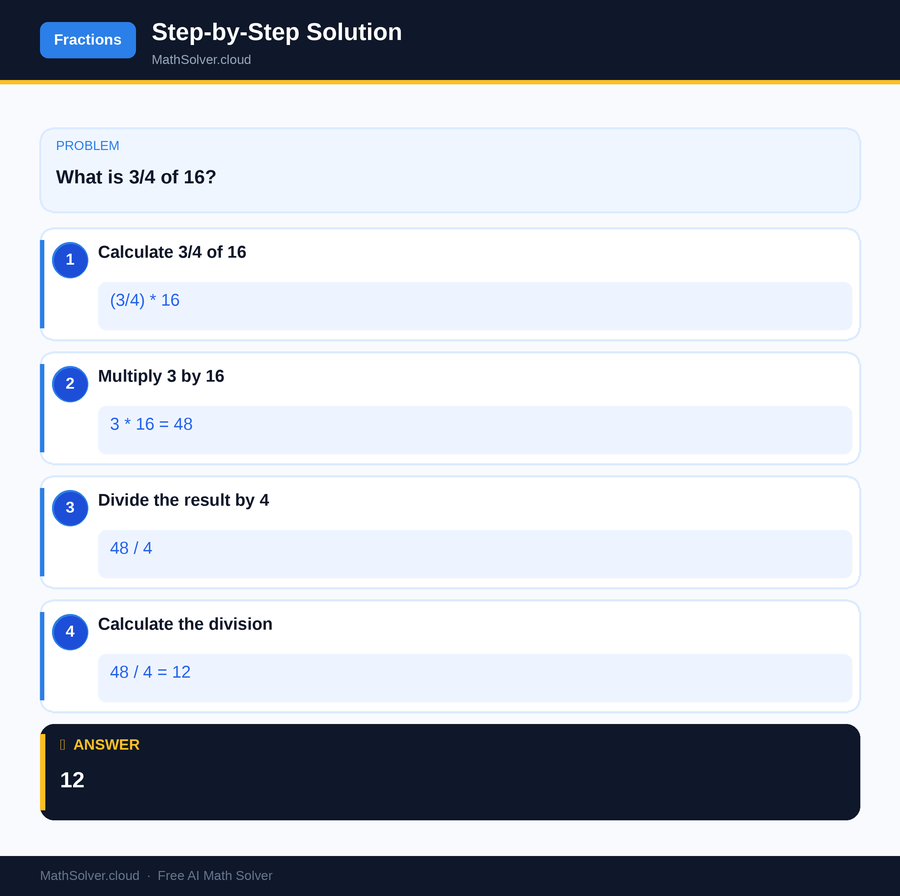
MathSolver Chrome extension solving this problem step-by-step
Example 2

MathSolver Chrome extension solving this problem step-by-step
Common Mistakes to Avoid
One common mistake when using a fraction solver with whole numbers is neglecting to simplify the final answer. Students often stop at the first answer they obtain without checking if it can be reduced further. Simplifying your results is crucial to ensure they are in the most understandable form.
Another frequent error is incorrect multiplication of the fraction's numerator with the whole number, often due to misalignment of numbers or misunderstanding of the problem's requirements.
Another mistake is forgetting to keep the denominator the same when multiplying a fraction by a whole number. This error can lead to incorrect results, as the denominator dictates the size of each part that the whole is divided into. To avoid this, practice careful multiplication and double-check your operations to ensure consistency throughout the problem-solving process.
Real-World Applications
Fraction solvers with whole numbers are incredibly useful in everyday situations. One practical application is in cooking, where you often need to adjust recipes. If a recipe calls for 3/4 cup of an ingredient and you're making double the amount, you need to calculate 3/4 of 2 to determine how much to use. Understanding how to perform these calculations ensures you prepare the correct quantity.
Fractions are also used in financial contexts, such as calculating discounts. For instance, if an item is on sale for 1/5 off its original price, you need to determine this fraction of the whole price to find out how much you will save. Being able to quickly and accurately solve these types of problems can lead to better money management and savings.
Frequently Asked Questions
❓ What is a fraction solver with whole numbers?
❓ Why do students struggle with fractions and whole numbers?
❓ How can AI help with fraction solver with whole numbers?
❓ What is the importance of simplifying fractions?
❓ Can a fraction solver with whole numbers be used for financial calculations?
🚀 Solve any math problem instantly
2,000+ students use MathSolver every day — join them for free
📥 Add to Chrome — It's Free