Understanding the Force Equation
📋 In this guide
The force equation is a fundamental concept in physics that describes the interaction between objects. It is essential for understanding how objects move and interact with each other. Many students find the force equation challenging because it involves not just math but also a conceptual grasp of how forces work in different contexts. In this article, you'll learn about various types of force equations, including the gravitational force equation, drag force equation, friction force equation, spring force equation, and electric force equation. By the end, you should have a clearer understanding of how to apply these equations to solve problems.
Students often struggle with the force equation due to its abstract nature and the need to connect mathematical formulas to real-world physical interactions. For those new to physics, distinguishing between different types of forces and knowing when to apply each formula can be overwhelming. This article aims to demystify these concepts and provide you with a solid foundation to tackle force-related problems confidently.
We'll break down the force equation into manageable pieces, offering step-by-step guides and worked examples. You'll learn to identify common pitfalls and discover how these equations are applied in real-world scenarios. By integrating knowledge from this article with resources like our complete Physics & Formulas guide at MathSolver.cloud, you'll enhance your problem-solving skills and become more proficient in using these critical physics tools.
Step-by-Step: How to Solve Force Equation
Step 1: Understanding the Concept of Force
Before diving into the calculations, it's crucial to grasp what force means. Force is a vector quantity, meaning it has both magnitude and direction. It can cause an object to start moving, stop moving, or change its velocity or direction. Understanding the nature of force helps in applying the force equation accurately. For example, if a force is applied at an angle, only the component of the force in the direction of interest will affect the acceleration. Recognizing these nuances is vital for solving problems correctly.
Step 2: Identifying the Forces at Play
In any given problem, the first step is to identify all the forces acting on the object. These could include gravitational force, frictional force, drag force, and any applied forces. Knowing the forces involved helps in setting up the force equation correctly. For example, if an object is on an inclined plane, both gravitational and normal forces will play roles. Listing all forces helps in visualizing the problem and determining which force equation to apply.
Step 3: Setting Up the Equation
Once you've identified the forces, the next step is to set up the equation. Use the primary force equation F = m * a, and substitute the known values for force, mass, and acceleration. If the problem involves multiple forces, you'll need to sum them up to find the net force. Don't forget to consider the direction of each force, as this will affect how they combine. Setting up the equation properly is crucial for arriving at the correct solution.
Step 4: Solving the Equation
With the equation set up, the final step is to solve for the unknown variable, whether it's force, mass, or acceleration. Rearrange the equation if necessary and plug in the known values. Solve step by step, checking each calculation for accuracy. If the problem involves additional forces or vectors, ensure that all components are considered. This methodical approach ensures a complete and accurate solution.
🤖 Stuck on a math problem?
Take a screenshot and let our AI solve it step-by-step in seconds
⚡ Try MathSolver Free →Worked Examples
Example 1
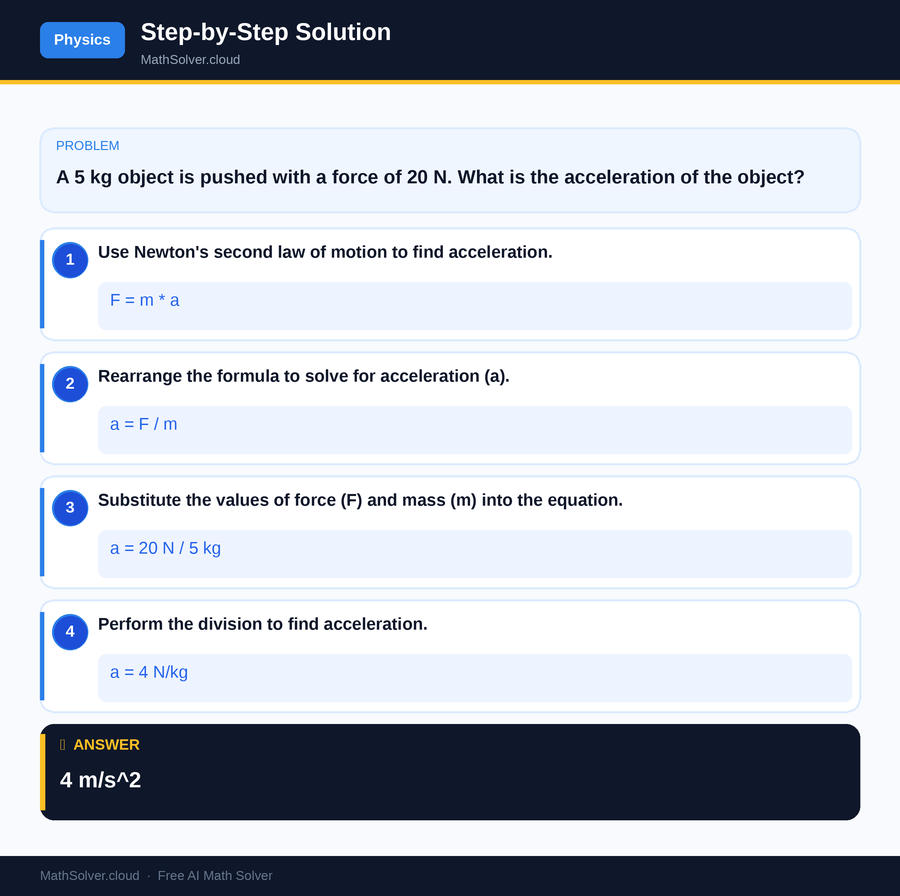
MathSolver Chrome extension solving this problem step-by-step
Example 2
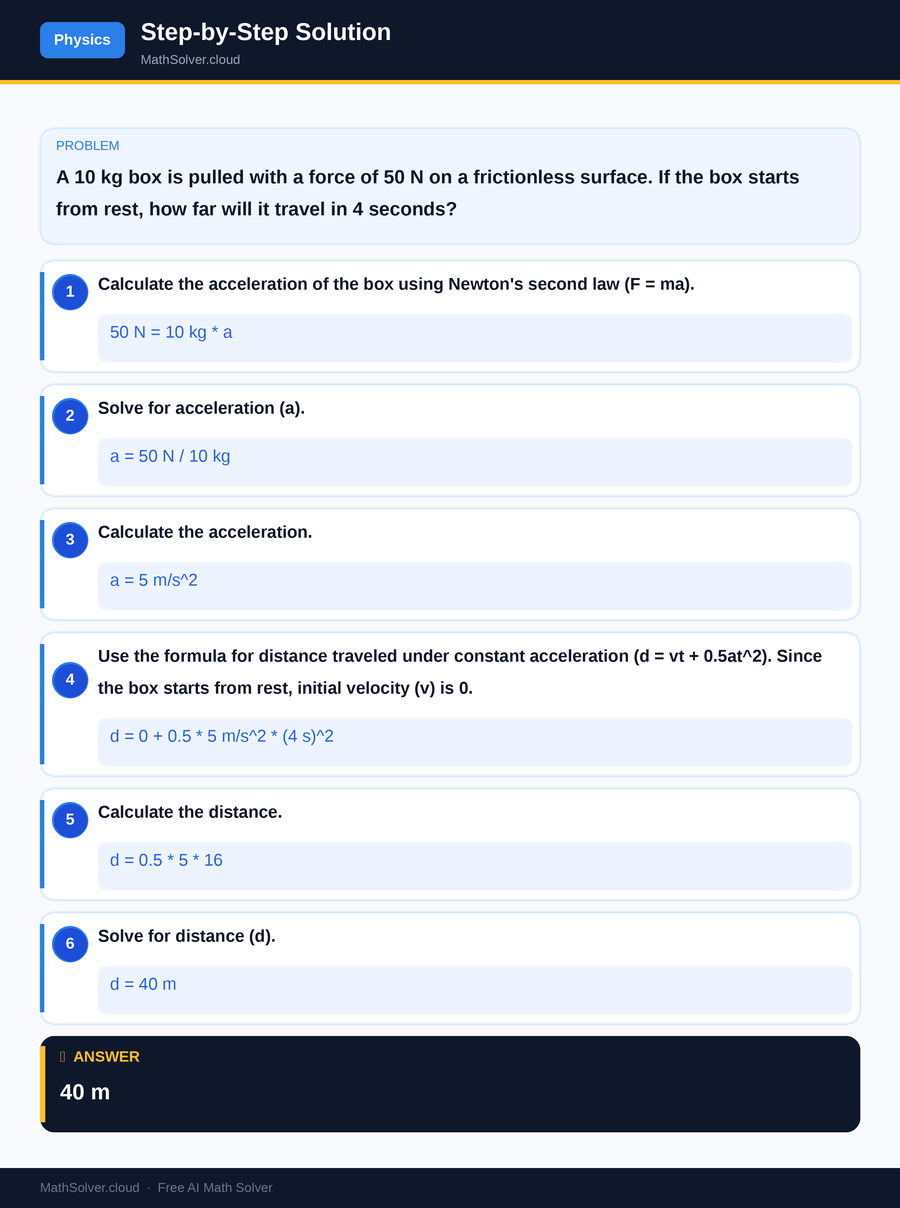
MathSolver Chrome extension solving this problem step-by-step
Common Mistakes to Avoid
One common mistake is neglecting the direction of forces. Since force is a vector, its direction affects the resulting motion. Students sometimes treat force as a scalar, leading to incorrect solutions. Always consider the direction and ensure that vector components are appropriately included in calculations. Another frequent error is misidentifying the forces at play, such as forgetting to include friction or drag when relevant. Double-checking all forces can prevent such oversights.
Another pitfall is incorrect unit conversion. Physics problems often involve converting units, such as from grams to kilograms or centimeters to meters. Failing to do so can lead to errors in calculations. Always ensure that all units are consistent before solving the equation. This attention to detail is crucial for obtaining accurate results.
Real-World Applications
The force equation has numerous real-world applications, making it a vital tool in various fields. For example, engineers use the force equation to design safe and efficient vehicles, ensuring that they can withstand forces during acceleration and braking. This application requires a deep understanding of the forces involved and how they interact with the vehicle's mass to influence performance.
In the field of sports science, the force equation helps analyze athletic performance. By calculating the forces exerted by athletes, trainers can optimize techniques to improve speed, strength, and endurance. Whether it's a sprinter pushing off the starting blocks or a gymnast landing a jump, understanding the forces at play can lead to enhanced performance and reduced injury risk.
Frequently Asked Questions
❓ What is a force equation?
❓ Why do students struggle with force equations?
❓ How can AI help with force equations?
❓ How does the gravitational force equation differ from the basic force equation?
❓ What practical situations require understanding the drag force equation?
🚀 Solve any math problem instantly
2,000+ students use MathSolver every day — join them for free
📥 Add to Chrome — It's Free