Mastering the Exponential Growth Equation
📋 In this guide
The exponential growth equation is a powerful mathematical tool used to describe processes that increase rapidly over time. At its core, it is a formula that allows us to calculate how quantities grow exponentially, rather than linearly. Students often struggle with the exponential growth equation because its rapid increase can be counterintuitive, especially when compared to linear growth, which adds a constant amount over each time period. In this article, you will learn what the exponential growth equation is, how to apply it, and how to avoid common pitfalls.
Understanding the exponential growth equation is crucial for students, as it appears frequently in both academic problems and real-world scenarios. From biology to finance, this equation helps explain phenomena like population growth, investment returns, and even the spread of diseases. By mastering this concept, you'll have a valuable tool in your mathematical toolkit, enabling you to tackle a wide range of problems with confidence.
Throughout this guide, we'll break down the exponential growth equation into digestible parts. We'll start by defining the equation and then walk you through a step-by-step process for solving problems involving exponential growth. You'll also see worked examples and learn about real-world applications. By the end of this article, you'll be well-equipped to understand and apply the exponential growth equation in various contexts.
Step-by-Step: How to Solve Exponential Growth Equation
Step 1: Understand the Components
Before diving into calculations, it's crucial to understand each component of the exponential growth equation. N0 is the initial value or starting point of the quantity you are examining. The growth rate, r, is usually expressed as a decimal, and it represents how quickly the quantity is increasing. The variable t represents time, which can be in any unit such as hours, days, or years, depending on the context of the problem. The base e is a mathematical constant approximately equal to 2.71828, which is used in natural exponential functions.
Step 2: Set Up the Equation
Once you understand the components, the next step is to set up the exponential growth equation using the information provided in the problem. Identify the initial quantity, the growth rate, and the time period over which the growth occurs. Substitute these values into the formula N(t) = N0 * e^(rt). This setup is critical as it forms the foundation for solving the problem. Make sure to convert percentages into decimals if the growth rate is given as a percentage.
Step 3: Perform the Calculations
With the equation set up, the next step is to perform the actual calculations. Begin by calculating the exponent, which is the product of the growth rate and the time period (r * t). Then, use this value as the exponent of e. Calculate e^(rt) using a calculator that can handle exponential functions. Finally, multiply this result by the initial quantity, N0, to find N(t), the quantity at time t.
Step 4: Interpret the Results
After calculating N(t), take a moment to interpret the results within the context of the problem. Consider whether the value makes sense based on what you know about the situation. Does the calculated quantity match your expectations for exponential growth? Reflect on how changes in the growth rate or time period might affect the outcome. This interpretation helps to solidify your understanding of exponential growth and its implications.
🤖 Stuck on a math problem?
Take a screenshot and let our AI solve it step-by-step in seconds
⚡ Try MathSolver Free →Worked Examples
Example 1

MathSolver Chrome extension solving this problem step-by-step
Example 2
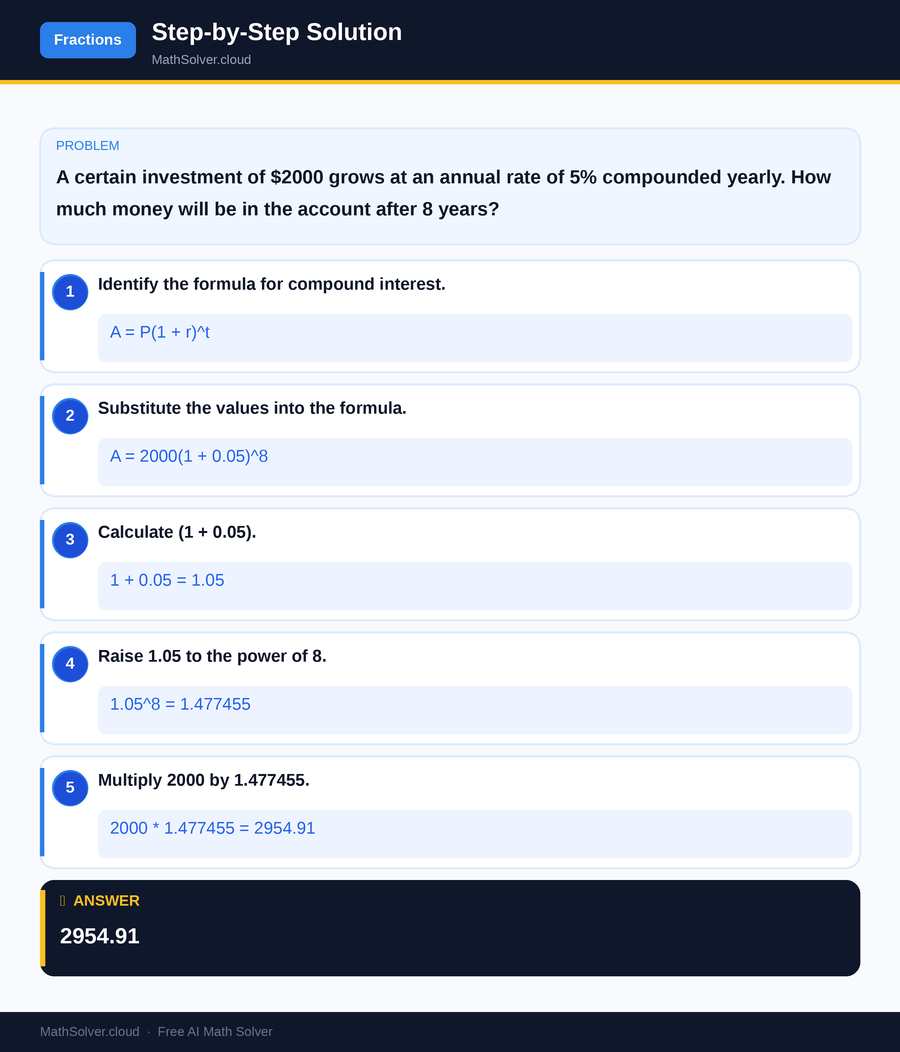
MathSolver Chrome extension solving this problem step-by-step
Common Mistakes to Avoid
One common mistake students make when dealing with the exponential growth equation is failing to convert the growth rate from a percentage to a decimal. Always remember to divide the percentage by 100 to get the correct decimal value for the growth rate. Another frequent error is miscalculating the exponent. Ensure that you multiply the growth rate and time correctly before using it as the exponent of e. Double-check your calculations at each step to avoid these pitfalls.
Additionally, students sometimes misinterpret the results by expecting linear growth outcomes. Exponential growth can lead to surprisingly large numbers quickly, so it's important to adjust your expectations accordingly. Familiarize yourself with the properties of exponential functions to better anticipate the results and avoid confusion.
Real-World Applications
The exponential growth equation is widely used in various fields. In biology, it models population growth, helping scientists understand how organisms multiply over time. For example, understanding the population exponential growth equation can aid in predicting the spread of diseases or the growth of bacterial cultures in a lab.
In finance, exponential growth equations are crucial for calculating compound interest, allowing investors to predict how their investments will grow over time. This equation is also used in physics and engineering, where it helps describe processes like radioactive decay and heat transfer. Understanding exponential growth is essential for making informed decisions in these and other fields.
Frequently Asked Questions
❓ What is the exponential growth equation?
❓ How do I know if a problem involves exponential growth?
❓ How can AI help with the exponential growth equation?
❓ What are some differences between linear and exponential growth?
❓ How is the exponential growth equation used in population studies?
🚀 Solve any math problem instantly
2,000+ students use MathSolver every day — join them for free
📥 Add to Chrome — It's Free