Understanding Exponential Equations
📋 In this guide
Exponential equations are a fascinating and essential part of mathematics that students often encounter in algebra and beyond. These equations involve variables in the exponent, which can make them seem daunting at first glance. The primary challenge students face with exponential equations is understanding how to manipulate and solve them, especially when they involve complex numbers or require the use of logarithms. This article will guide you through the basics of exponential equations, offer step-by-step instructions on how to solve them, and explore their real-world applications.
Understanding exponential equations is crucial for students, particularly those studying algebra and calculus. These equations are not just theoretical; they have practical uses in fields like science, finance, and engineering. However, students often struggle because they might not have a solid grasp of the underlying concepts or because the equations can appear more complicated than they actually are. By the end of this article, you will have a clear understanding of exponential equations and the confidence to tackle them in your studies.
In the following sections, we will delve into the key formulas and definitions of exponential equations, provide a step-by-step guide to solving them, and highlight common mistakes to avoid. Additionally, we will show you how exponential equations are used in real-world scenarios and answer some frequently asked questions. Whether you're working on common core algebra 2 homework or preparing for exams, this comprehensive guide will be your go-to resource for mastering exponential equations.
Step-by-Step: How to Solve Exponential Equations
Step 1: Recognizing the Form of the Equation
The first step in solving exponential equations is to identify the form of the equation you are dealing with. Look for terms where the variable is in the exponent. If the equation is in the form a^x = b, check to see if the bases on either side of the equation can be made the same. Understanding the form will help you decide the best method to solve it. If the bases are already the same, you can move directly to setting the exponents equal.
Step 2: Simplifying the Equation
Once you recognize the form, the next step is to simplify the equation as much as possible. This might involve rewriting the equation to have a common base. For instance, if you have 2^x = 8, you can rewrite 8 as 2^3, making it easier to set the exponents equal. Simplifying the equation can also involve combining like terms or factoring in cases where the equation is more complex.
Step 3: Solving the Equation
After simplification, solve the equation by isolating the variable in the exponent. If the bases are the same, equate the exponents and solve for the variable. If the bases are different and cannot be rewritten as powers of the same base, use logarithms to solve the equation. For example, you can take the natural logarithm or logarithm base 10 of both sides and use the property that log(a^x) = x*log(a) to solve for the variable.
Step 4: Checking Your Solution
The final step is to check your solution to ensure it satisfies the original equation. Substitute the value of the variable back into the original equation and verify that both sides are equal. Checking your solution is crucial as it helps confirm the accuracy of your work and ensures you haven't made any errors in your calculations or assumptions.
🤖 Stuck on a math problem?
Take a screenshot and let our AI solve it step-by-step in seconds
⚡ Try MathSolver Free →Worked Examples
Example 1
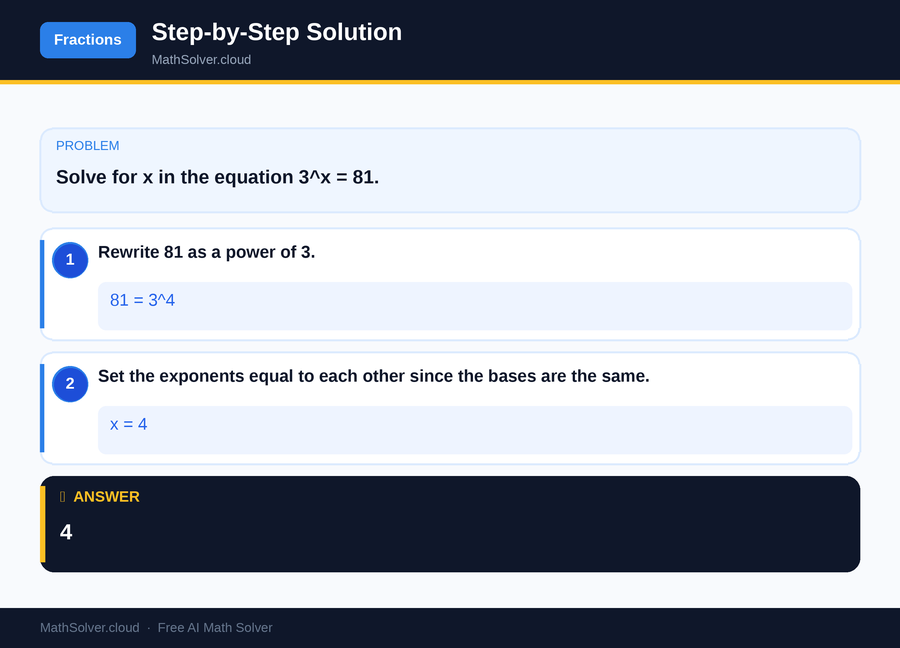
MathSolver Chrome extension solving this problem step-by-step
Example 2

MathSolver Chrome extension solving this problem step-by-step
Common Mistakes to Avoid
One common mistake students make when solving exponential equations is neglecting to simplify both sides of the equation before solving. This can lead to incorrect solutions or unnecessary complexity. Always simplify the equation as much as possible before attempting to solve it, whether that involves rewriting terms with a common base or simplifying fractions.
Another frequent error is failing to check the solution after solving the equation. This step is crucial because it verifies the correctness of your work. Without checking, you might miss simple arithmetic errors or misunderstandings about the relationship between the terms in the equation. Always substitute the solution back into the original equation to ensure it holds true.
Real-World Applications
Exponential equations have numerous real-world applications, particularly in fields that involve growth or decay processes. For example, they are used in calculating compound interest in finance, where the amount of money grows exponentially over time. Understanding how to solve exponential equations can help in determining how long it will take for an investment to grow to a certain amount.
In science, exponential equations are used to model population growth, radioactive decay, and the spread of diseases. For instance, the rate at which a bacterial culture grows can be modeled using an exponential function, allowing scientists to predict future growth and plan accordingly. These applications demonstrate the importance of mastering exponential equations beyond the classroom.
Frequently Asked Questions
❓ What are exponential equations?
❓ Why are exponential equations challenging for students?
❓ How can AI help with exponential equations?
❓ What is the relationship between exponential equations and logarithms?
❓ How do you graph exponential equations?
🚀 Solve any math problem instantly
2,000+ students use MathSolver every day — join them for free
📥 Add to Chrome — It's Free