Mastering the Exponential Equation Formula
📋 In this guide
The exponential equation formula is a critical concept in mathematics, particularly within algebra and calculus. It describes equations where variables appear as exponents, which can often present a challenge for students. Many learners struggle with these equations due to the non-linear nature of exponentials, which can be less intuitive compared to linear or quadratic equations. However, understanding how to work with these equations is crucial, as they appear frequently in various scientific fields and real-world applications.
By mastering the exponential equation formula, students can unlock a deeper understanding of mathematical growth patterns, such as compound interest, population growth, and radioactive decay. In this article, we will delve into what the exponential equation formula is, provide a step-by-step guide for solving these equations, and explore real-world applications. Additionally, we will work through examples, address common mistakes, and answer frequently asked questions to ensure a comprehensive understanding.
This guide aims to equip you with the tools needed to tackle exponential equations confidently. Whether you're preparing for an exam or looking to enhance your math skills, understanding this fundamental formula is essential. By the end of this article, you will have a clearer insight into how exponential equations work and how to solve them efficiently.
Step-by-Step: How to Solve Exponential Equation Formula
Step 1: Identify the Base and Exponent
The first step in solving an exponential equation is to clearly identify the base and the exponent. The base is the number that is raised to a power, while the exponent is the variable or number indicating how many times the base is multiplied by itself. For example, in the equation 5^x = 25, the base is 5, and the exponent is x. Recognizing these components is crucial to applying the correct methods for solving the equation.
Step 2: Isolate the Exponential Expression
Next, you need to isolate the exponential expression on one side of the equation. This may involve simple algebraic manipulations such as dividing or multiplying both sides of the equation by the same number. For instance, if you have the equation 3^(2x) = 81, you want to ensure that only the exponential term is on one side of the equation. This step sets the stage for applying logarithms or recognizing patterns to solve for the variable.
Step 3: Apply Logarithms or Recognize Patterns
Once the exponential term is isolated, the next step is to apply logarithms or recognize patterns. If the equation can be simplified by recognizing that both sides have the same base, you can equate the exponents directly. For example, in 2^x = 8, recognizing that 8 is 2^3 allows you to solve x = 3. If the bases are different, using logarithms becomes necessary. Taking the logarithm of both sides allows you to bring the exponent down, making it easier to solve for the variable.
Step 4: Solve for the Variable
Finally, with the exponent isolated, you can solve for the variable. This may involve additional algebraic steps if logarithms are used. For instance, if you have taken the logarithm of both sides, you would solve for x by dividing or using properties of logarithms. In other cases, once the exponents are equated, the solution becomes straightforward. Ensure that you check your solution by substituting it back into the original equation to verify its correctness.
🤖 Stuck on a math problem?
Take a screenshot and let our AI solve it step-by-step in seconds
⚡ Try MathSolver Free →Worked Examples
Example 1
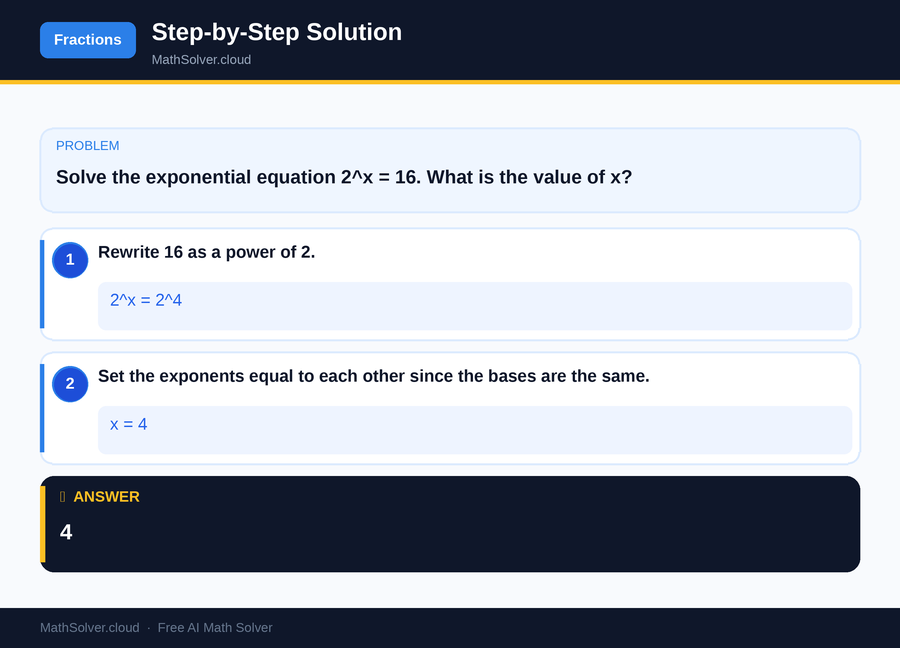
MathSolver Chrome extension solving this problem step-by-step
Example 2

MathSolver Chrome extension solving this problem step-by-step
Common Mistakes to Avoid
One common mistake students make when solving exponential equations is neglecting to isolate the exponential term before applying logarithms. This can lead to incorrect simplifications and ultimately, incorrect solutions. Always ensure that the exponential expression is alone on one side of the equation before proceeding with further steps.
Another frequent error involves improper application of logarithms. Students may forget to apply the same logarithmic operation to both sides of the equation or may not fully understand the properties of logarithms. It's important to be comfortable with these properties and apply them correctly to avoid errors and solve the equation accurately.
Real-World Applications
Exponential equations have numerous real-world applications, making them essential to understand. In finance, they are used to calculate compound interest, where the amount of interest earned grows exponentially over time. This is crucial for understanding investment growth and loan repayments.
In science, exponential equations model population growth and radioactive decay. For example, scientists use these equations to predict how populations increase over time or to determine how long it takes for a radioactive substance to decay to a certain level. These applications highlight the importance of mastering exponential equations for practical problem-solving.
Frequently Asked Questions
❓ What is the exponential equation formula?
❓ How do you solve an exponential equation formula example?
❓ How can AI help with the exponential equation formula?
❓ What are common algebra equations related to exponentials?
❓ Can an exponential equation formula calculator solve these problems?
🚀 Solve any math problem instantly
2,000+ students use MathSolver every day — join them for free
📥 Add to Chrome — It's Free