Mastering Exponential Equations
📋 In this guide
An exponential equation is a mathematical expression where variables appear as exponents. These equations are fundamental in various fields, yet many students find them challenging due to their unique characteristics compared to linear or quadratic equations. Exponential equations can model real-world scenarios like population growth, radioactive decay, and compound interest, making them essential to understand.
Students often struggle with exponential equations because they involve concepts that differ from the arithmetic and algebra they are used to. The challenge lies in manipulating the exponents and understanding logarithms, which are often introduced simultaneously. Through this article, you will learn how to solve exponential equations systematically and confidently, using both simple and complex techniques.
By the end of this guide, you'll be equipped with strategies to tackle exponential equations effectively. We will cover essential definitions, a step-by-step guide to solving these equations, and provide detailed solutions to sample problems. Additionally, we'll explore real-world applications and address common mistakes, ensuring a comprehensive understanding of the topic.
Step-by-Step: How to Solve Exponential Equation
Step 1: Identify the Exponential Equation
The first step in solving an exponential equation is recognizing its form. Look for equations where the variable is in the exponent position. For example, in the equation 5^x = 125, the variable "x" is an exponent. Identifying this allows you to determine the appropriate methods for solving the equation. Ensure you rewrite the equation in a simpler form if possible, such as expressing 125 as 5^3, which makes recognizing the relationship between the base and the exponent straightforward.
Step 2: Equalize the Bases (if Possible)
If the bases in the exponential equation can be made the same, this simplifies the process significantly. Consider the equation 2^x = 16. Recognize that 16 can be rewritten as 2^4. By expressing both sides of the equation with the same base, you can equate the exponents directly, leading to a simple algebraic solution. This step requires familiarity with powers of numbers and is a powerful technique when applicable.
Step 3: Use Logarithms for Different Bases
When equalizing the bases isn't possible, logarithms become essential. Logarithms are the inverse of exponentiation and can be used to solve equations where the bases differ. For instance, in solving exponential equations using logarithms common core algebra 2 homework, apply the logarithm to both sides of the equation. This allows the exponent to be brought down in front of the logarithm, transforming the equation into a linear form that can be solved using algebraic methods.
Step 4: Solve the Resulting Equation
After simplifying or transforming the exponential equation, solve the resulting linear or simple equation. For example, after applying logarithms, you might end up with an equation like x * log(3) = log(81). Solve for "x" by dividing both sides by log(3), yielding x = log(81) / log(3). This step involves basic algebraic manipulation, and the solution provides the value of the variable that satisfies the original exponential equation.
🤖 Stuck on a math problem?
Take a screenshot and let our AI solve it step-by-step in seconds
⚡ Try MathSolver Free →Worked Examples
Example 1
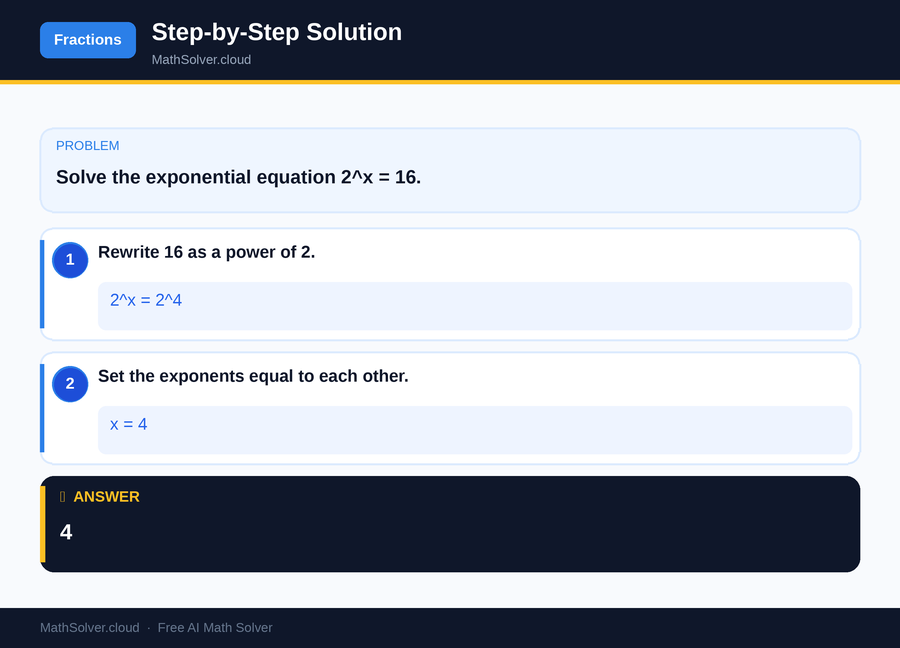
MathSolver Chrome extension solving this problem step-by-step
Example 2

MathSolver Chrome extension solving this problem step-by-step
Common Mistakes to Avoid
One common mistake when solving exponential equations is failing to properly equate the bases before setting the exponents equal. This often leads to incorrect algebraic manipulations. Ensure you thoroughly check whether both sides of the equation can be rewritten to have the same base before proceeding with equating exponents.
Another frequent error involves the misuse of logarithms. Students sometimes forget that applying a logarithm to both sides of an equation requires consistent application of logarithmic properties. For example, forgetting to apply the same logarithm base or incorrectly simplifying the resulting terms can lead to incorrect solutions. Always double-check your logarithmic calculations and ensure consistent application of properties.
Real-World Applications
Exponential equations have numerous real-world applications. In finance, they are used to model compound interest scenarios where the amount of interest earned grows exponentially over time. This is crucial for calculating future investment values or loan repayments, making understanding exponential equations vital for financial literacy.
In science, exponential equations are used to describe processes like radioactive decay. For instance, the decay of a radioactive substance can be modeled using an exponential equation, where the remaining quantity of the substance decreases exponentially over time. This application is essential in fields such as nuclear physics and environmental science.
Frequently Asked Questions
❓ What is an exponential equation?
❓ Why do students find exponential equations challenging?
❓ How can AI help with exponential equations?
❓ What role do logarithms play in solving exponential equations?
❓ Can exponential equations model proportional relationships?
🚀 Solve any math problem instantly
2,000+ students use MathSolver every day — join them for free
📥 Add to Chrome — It's Free