Mastering the Equation of a Circle
📋 In this guide
The equation of a circle is a fundamental concept in geometry that describes all the points equidistant from a central point, known as the center. Students often grapple with understanding this concept due to its reliance on both algebraic and geometric principles. In this article, we'll demystify the equation of a circle, breaking down its components and explaining it in simple terms. By the end, you'll have a solid grasp of how to derive and apply the equation of a circle in various contexts.
Understanding the equation of a circle is crucial as it forms the basis for further exploration in geometry, including more complex shapes and figures. Students frequently encounter challenges as they transition from understanding linear equations to dealing with curves. This article aims to smooth that transition by providing clear, step-by-step guidance and practical examples. We'll cover essential topics such as the standard equation of a circle, how to find a circle's equation given its center and radius, and solve problems involving circles.
If you've ever wondered what the equation of a circle is or how to apply it in solving problems, you're in the right place. We'll explore the formula for the equation of a circle, delve into practical examples, and discuss common mistakes to help you avoid pitfalls. Whether you're tackling geometry lessons or preparing for exams, this guide will equip you with the knowledge and confidence to master the equation of a circle.
Step-by-Step: How to Solve Equation Of A Circle
Step 1: Identify the Center and Radius
The first step in deriving the equation of a circle is to identify its center and radius. The center is typically given as a point (h, k), while the radius is a positive number 'r'. If you're given a circle's diameter, remember that the radius is half the diameter. Accurate identification of these components is crucial as they directly influence the equation.
Step 2: Substitute into the Standard Formula
Once you have the center and radius, substitute these values into the standard equation of a circle: (x - h)^2 + (y - k)^2 = r^2. This substitution will start to form the specific equation for your circle. Ensure you correctly square the radius, as this often trips up students who forget to apply the exponent.
Step 3: Simplify the Equation
After substitution, simplify the equation if necessary. This might involve expanding squared terms or combining like terms. Simplification helps in making the equation more manageable and easier to work with, especially when solving related problems or graphing the circle.
Step 4: Verify and Apply
Finally, verify your equation by ensuring it correctly represents the circle's properties, such as its center and radius. You can also apply the equation to solve related problems, such as finding points on the circle or determining intersections with other geometric figures. This step ensures that your solution is both accurate and functional.
🤖 Stuck on a math problem?
Take a screenshot and let our AI solve it step-by-step in seconds
⚡ Try MathSolver Free →Worked Examples
Example 1

MathSolver Chrome extension solving this problem step-by-step
Example 2
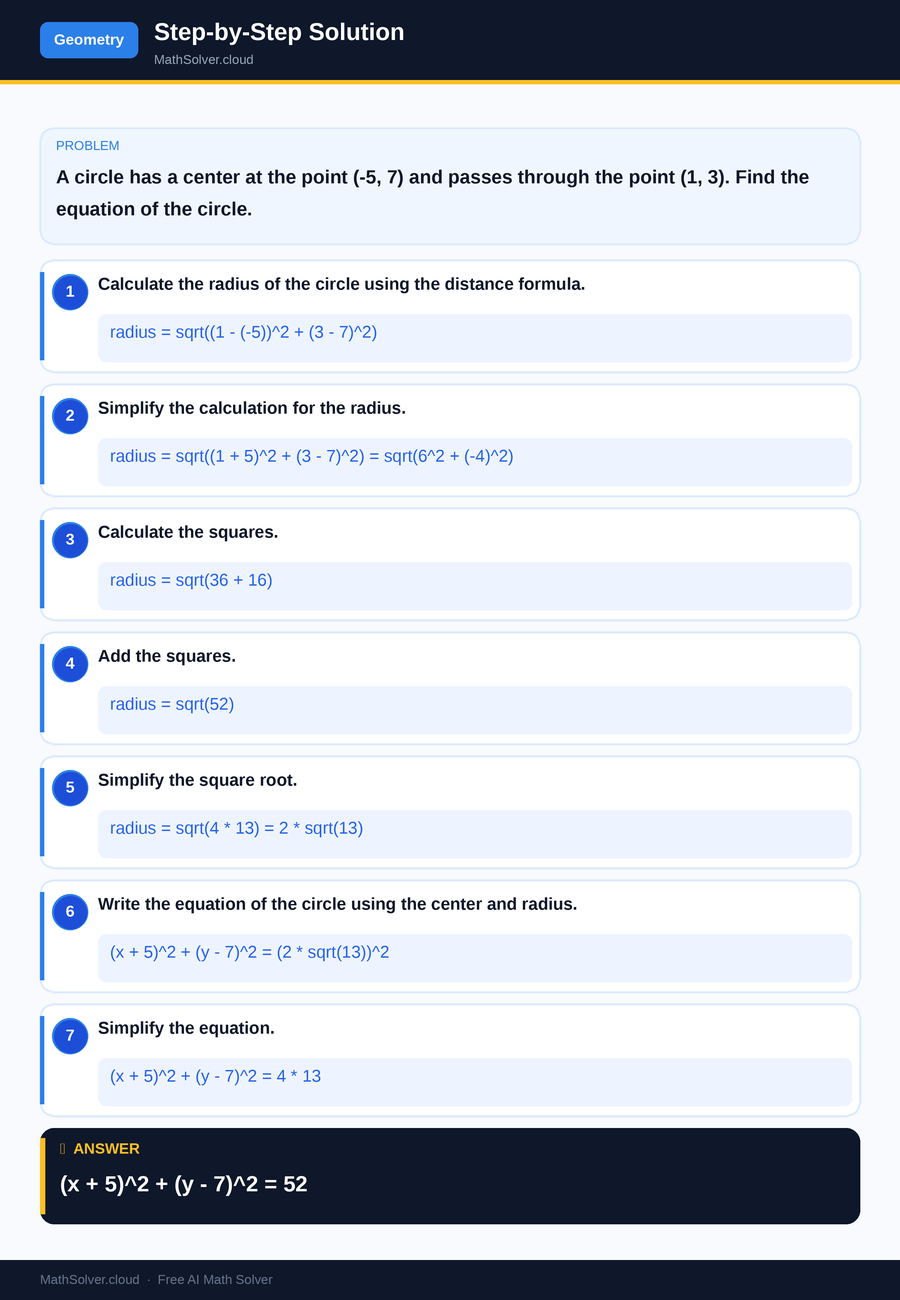
MathSolver Chrome extension solving this problem step-by-step
Common Mistakes to Avoid
One common mistake students make is confusing the signs in the standard equation of a circle. Remember that if the center is at (h, k), the equation involves (x - h) and (y - k). Mixing up these signs can lead to incorrect equations and solutions. Always double-check your signs after substitution to ensure accuracy.
Another frequent error is miscalculating the radius, especially when derived from a given diameter or using the distance formula. Ensure that you square the radius when substituting into the equation. Keeping track of these details will help avoid mistakes and lead to correct solutions.
Real-World Applications
The equation of a circle is not just a theoretical concept but has practical applications in various fields. For instance, it is used in computer graphics to render images and shapes, as circles are fundamental to creating round objects and curves. Understanding this equation is crucial in designing animations and simulations.
Circles also play a vital role in engineering, particularly in designing wheels, gears, and other circular components. Knowing the equation of a circle helps engineers ensure these parts function correctly and fit within the required specifications. The ability to calculate and apply the equation of a circle is essential in these real-world contexts.
Frequently Asked Questions
❓ What is the equation of a circle?
❓ How do you find the radius from the equation of a circle?
❓ How can AI help with the equation of a circle?
❓ Can the equation of a circle be used in graphing?
❓ How is the equation of a circle used in technology?
🚀 Solve any math problem instantly
2,000+ students use MathSolver every day — join them for free
📥 Add to Chrome — It's Free