Mastering the Equation for Exponential Growth
📋 In this guide
The equation for exponential growth is a powerful mathematical tool that allows us to understand how quantities increase over time at a consistent percentage rate. This concept is vital in fields like biology, finance, and environmental science. However, many students struggle with grasping this concept due to its abstract nature and the complexity of the calculations involved. In this article, we will break down the equation for exponential growth, offering a clear and detailed understanding that will empower you to tackle these problems with confidence.
Exponential growth occurs when the growth rate of a mathematical function is proportional to the function's current value. This means that the larger the quantity grows, the faster it increases. Students often find exponential growth challenging because it differs from linear growth, where quantities increase by a constant amount. Understanding exponential growth requires a shift in thinking, as the growth accelerates over time, leading to much larger values than one might initially expect.
By the end of this article, you will have a thorough understanding of the equation for exponential growth, be able to solve related algebra equations, and apply this knowledge to real-world scenarios. We will cover everything from the basic formula to common mistakes and practical applications. Whether you're a student preparing for a homework lesson on equations for proportional relationships or simply curious about the topic, this guide will provide you with the insights you need.
Step-by-Step: How to Solve Equation For Exponential Growth
Step 1: Understanding the Components
Before diving into calculations, it's essential to understand each component of the equation for exponential growth. P0 is the initial value or starting point of the quantity you're examining. This could be a population size, an investment amount, or any baseline number. The growth rate, r, is the rate at which the quantity increases as a decimal. For example, a 5% growth rate would be represented as 0.05. Finally, t represents the time period over which the growth occurs. Understanding these components is crucial for setting up and solving exponential growth problems correctly.
Step 2: Setting Up the Equation
Once you grasp the components, the next step is to set up the equation. Begin by identifying the initial quantity (P0), the growth rate (r), and the time period (t) from the problem statement. Substitute these values into the equation P = P0 * (1 + r)^t. This setup will form the basis of your calculations. Pay close attention to the units of time and ensure they are consistent across the problem. For instance, if the growth rate is annual, time should be measured in years.
Step 3: Performing the Calculations
With the equation set up, perform the calculations by following the order of operations: parentheses, exponents, multiplication, and division. First, calculate the expression within the parentheses, 1 + r. Then, raise this sum to the power of t to determine the growth factor. Finally, multiply the initial quantity (P0) by this growth factor to find the final quantity (P). Ensure your calculations are accurate and double-check each step to avoid errors.
Step 4: Interpreting the Results
After calculating the final quantity, take a moment to interpret the results in the context of the problem. Consider what the number represents and how it relates to the initial conditions. This step is crucial for ensuring that your answer makes sense. Ask yourself whether the result is reasonable given the initial quantity and growth rate. Understanding the implications of your solution will reinforce your comprehension of exponential growth and its real-world applications.
🤖 Stuck on a math problem?
Take a screenshot and let our AI solve it step-by-step in seconds
⚡ Try MathSolver Free →Worked Examples
Example 1
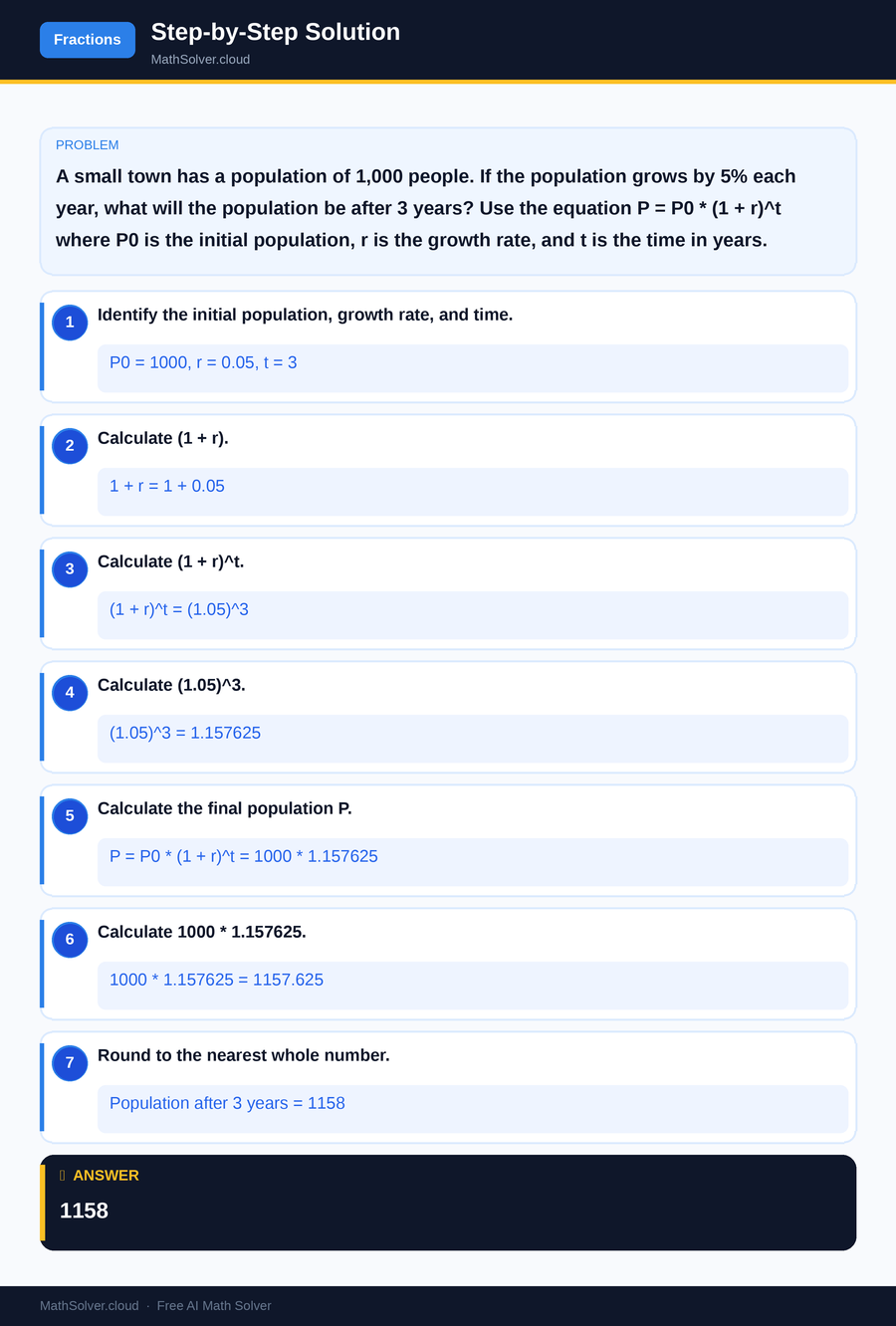
MathSolver Chrome extension solving this problem step-by-step
Example 2
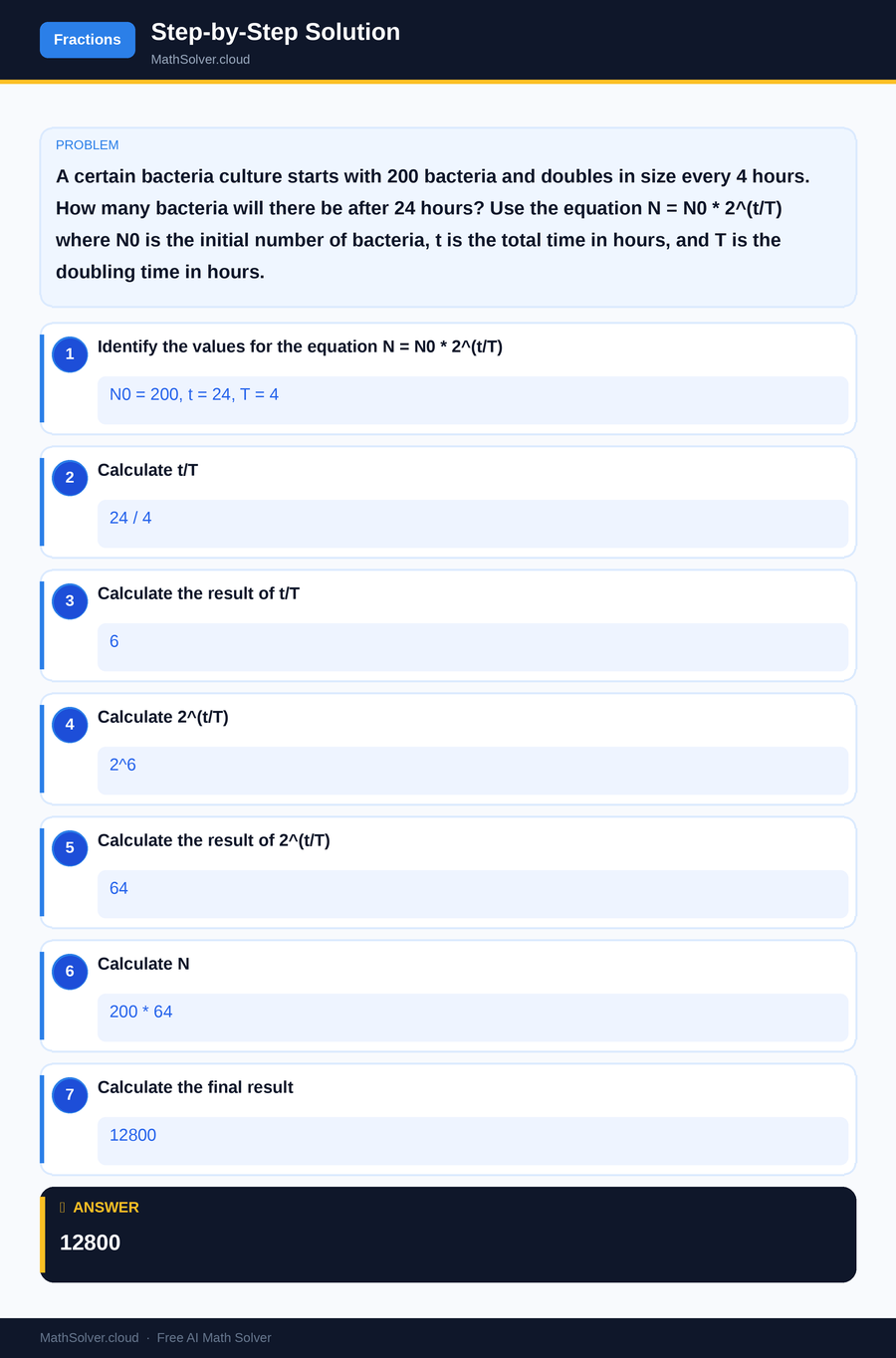
MathSolver Chrome extension solving this problem step-by-step
Common Mistakes to Avoid
One common mistake students make when working with the equation for exponential growth is miscalculating the growth rate. It's crucial to convert percentage rates into decimal form before substituting them into the equation. For example, a 5% growth rate should be entered as 0.05, not 5. Failing to do so can lead to significantly incorrect results.
Another frequent error is neglecting to use consistent time units. If the growth rate applies annually, ensure that the time period t is also in years. Mixing units, such as using months for t when the rate is annual, will result in inaccurate calculations. Always double-check that your units align with the context of the problem.
Real-World Applications
The equation for exponential growth is not just a theoretical concept; it has numerous real-world applications. In finance, it is used to model compound interest, allowing investors to predict the future value of their investments. Understanding exponential growth in this context can help individuals make informed decisions about saving and investing.
In biology, exponential growth models population dynamics, such as the rapid increase of a bacterial culture or the growth of a species in a favorable environment. Additionally, the photosynthesis equation reflects the exponential growth of plants under optimal conditions. These applications highlight the relevance of exponential growth in understanding and predicting natural phenomena.
Frequently Asked Questions
❓ What is the equation for exponential growth used for?
❓ How does exponential growth differ from linear growth?
❓ How can AI help with the equation for exponential growth?
❓ What should I do if I keep getting the wrong answer?
❓ Can exponential growth be applied to understand viral outbreaks?
🚀 Solve any math problem instantly
2,000+ students use MathSolver every day — join them for free
📥 Add to Chrome — It's Free