Comprehensive Guide to the Equation for Exponential Decay
📋 In this guide
The equation for exponential decay is a mathematical expression that describes how a quantity decreases at a rate proportional to its current value. Understanding this equation is crucial for students studying algebra, calculus, or any field that involves growth and decay processes, such as physics or biology. Despite its importance, many students find exponential decay challenging because it involves both algebraic manipulation and an understanding of exponential functions. In this article, we will delve into the equation for exponential decay, providing a comprehensive guide that will help students grasp this concept with clarity and confidence.
Students often struggle with the equation for exponential decay because it requires them to interpret and manipulate exponential expressions, which can seem abstract and complex. Additionally, understanding the implications of the decay constant and how it affects the rate of decay adds another layer of complexity. However, with a clear explanation and practice, students can master this topic and apply it effectively in various scientific and mathematical contexts.
By the end of this article, you will have a thorough understanding of the equation for exponential decay, including its formula, application, and potential pitfalls. We will walk through step-by-step instructions, provide worked examples, and discuss real-world applications. Whether you're dealing with algebra equations or exploring more advanced topics like kinematic equations, this guide will equip you with the knowledge you need to tackle exponential decay with confidence.
Step-by-Step: How to Solve Equation For Exponential Decay
Step 1: Understanding the Concept
The first step in mastering the equation for exponential decay is to understand the underlying concept. Exponential decay describes a process where a quantity decreases at a rate proportional to its current size. This means that as the quantity gets smaller, the rate of decrease also slows down. This principle is common in natural processes such as radioactive decay, population decline, and the cooling of an object. Understanding this concept will help you visualize how the equation models these processes.
Step 2: Identifying the Components
Before using the equation for exponential decay, you need to identify its components: the initial quantity (N0), the decay constant (k), and the time (t). The initial quantity is the amount of the substance or population at the starting point. The decay constant is a positive number that represents the rate of decay; it is often given or needs to be calculated from other information, such as the half-life. Lastly, time is the period over which the decay occurs. Recognizing these components in a problem is crucial for setting up and solving the equation.
Step 3: Applying the Formula
Once you have identified the components, apply the equation for exponential decay: N(t) = N0 * e^(-kt). Substitute the known values for N0, k, and t into the formula. This step involves careful calculation, especially when dealing with exponential terms. It's important to ensure that the units of measurement for time and the decay constant are consistent. For example, if the decay constant is given in years^-1, the time should also be in years.
Step 4: Solving the Equation
After substituting the values, solve the equation to find N(t), the quantity remaining after time t. Use a calculator to compute the exponential term accurately, especially since e is an irrational number. Once you have the result, interpret it in the context of the problem. Understanding what the result means in real-world terms is essential for verifying the accuracy of your solution and ensuring that it makes sense.
🤖 Stuck on a math problem?
Take a screenshot and let our AI solve it step-by-step in seconds
⚡ Try MathSolver Free →Worked Examples
Example 1
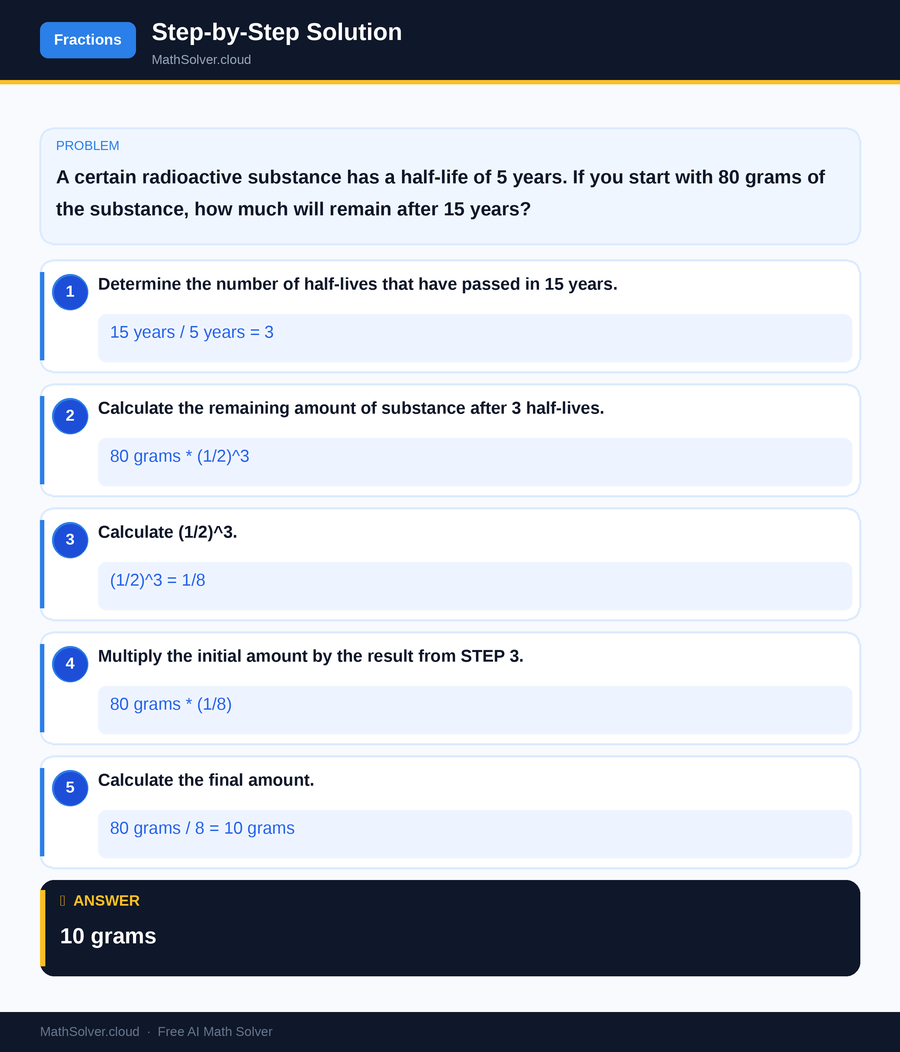
MathSolver Chrome extension solving this problem step-by-step
Example 2
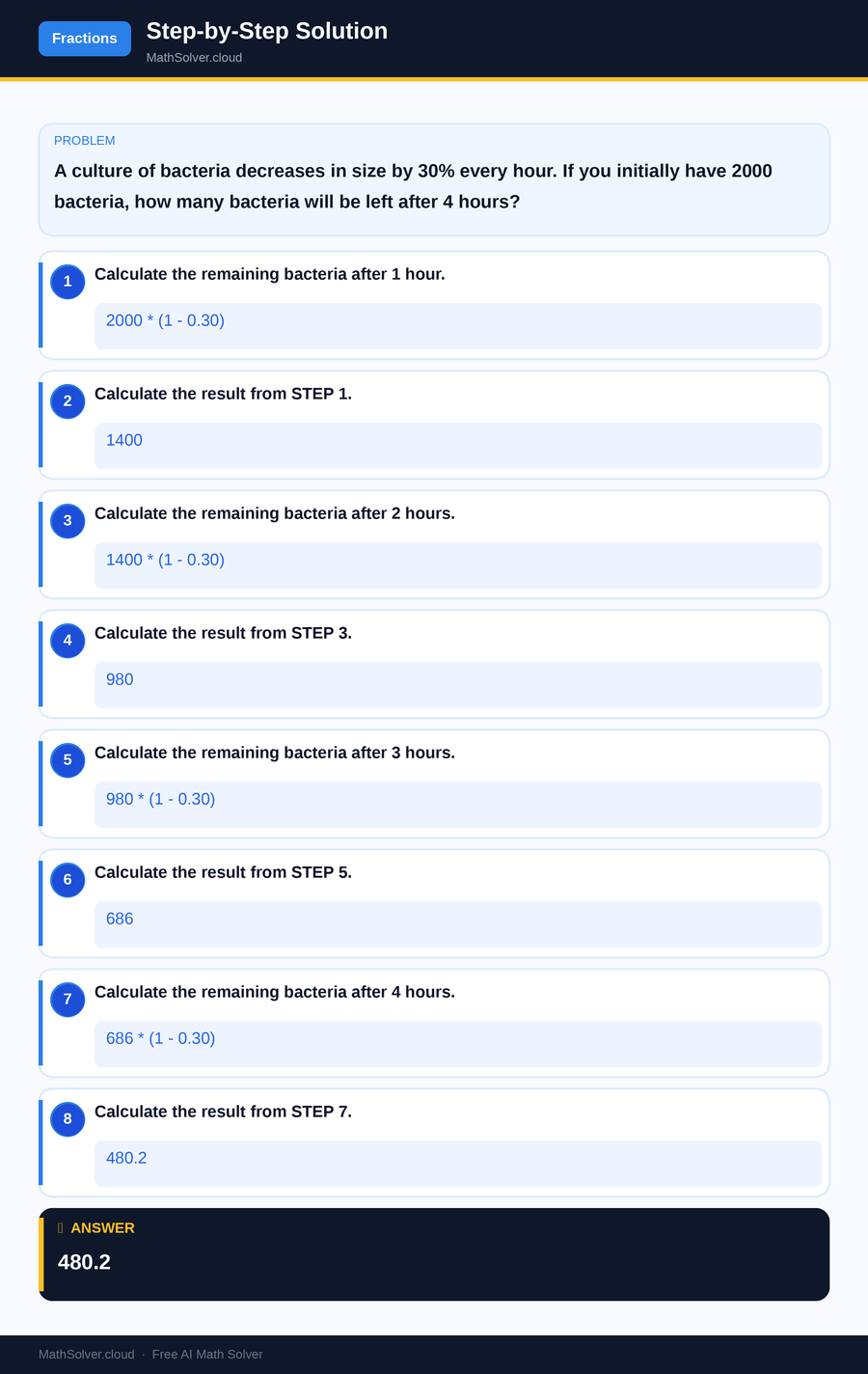
MathSolver Chrome extension solving this problem step-by-step
Common Mistakes to Avoid
One common mistake students make when working with the equation for exponential decay is confusing the decay constant (k) with the decay rate or percentage. It's crucial to remember that the decay constant is derived from the rate and is used in the exponential function. Another error is neglecting to ensure that the units for time and the decay constant are consistent, which can lead to incorrect results.
Additionally, students sometimes forget to apply the negative sign in the exponent of the decay formula, which is essential for modeling the decrease in quantity. When entering the equation into a calculator, it's important to carefully input the exponent to avoid miscalculations. Double-checking each step can help prevent these common pitfalls.
Real-World Applications
The equation for exponential decay is widely used in various scientific fields. One notable application is in radiocarbon dating, where scientists determine the age of ancient artifacts by measuring the remaining concentration of carbon-14. This process relies on understanding the exponential decay of radioactive isotopes over time.
Another practical use of exponential decay is in medicine, specifically in pharmacokinetics, where it helps in understanding how drugs are metabolized and eliminated from the body. By modeling the decay of drug concentration in the bloodstream, doctors can determine appropriate dosing schedules to maintain therapeutic levels.
Frequently Asked Questions
❓ What is the equation for exponential decay used for?
❓ Why is the decay constant important in the equation for exponential decay?
❓ How can AI help with solving the equation for exponential decay?
❓ Can you explain the difference between exponential decay and growth?
❓ How is exponential decay related to algebra equations?
🚀 Solve any math problem instantly
2,000+ students use MathSolver every day — join them for free
📥 Add to Chrome — It's Free