Mastering the Equation for Dot Product
📋 In this guide
The equation for dot product is a fundamental concept in mathematics, especially within vector algebra, and is pivotal for students to master in courses that involve linear algebra, physics, and engineering. The dot product, also known as the scalar product, is a way to multiply two vectors, returning a single scalar value. It is essential for determining the angle between vectors, projections, and in various applications like computer graphics and physics simulations. However, many students struggle with the equation for dot product due to its abstract nature and the need to visualize vectors beyond simple arithmetic operations.
Understanding the equation for dot product is crucial for progressing in any field that involves vectors, such as physics, computer science, and engineering. In this article, we will demystify the concept of the dot product, breaking it down into digestible steps and providing practical examples. By the end of this guide, you'll gain a comprehensive understanding of how to calculate the dot product, recognize common pitfalls, and appreciate its real-world applications.
Students often confuse the equation for dot product with other algebra equations, such as the quadratic equation or kinematic equations, due to their familiarity with numerical operations. This guide aims to bridge that gap by providing a clear, step-by-step tutorial, examples with detailed solutions, and insights into the real-world significance of the dot product. By the time you finish reading, you will have a solid foundation in understanding and applying the equation for dot product confidently.
Step-by-Step: How to Solve Equation For Dot Product
Step 1: Identifying the Components of the Vectors
To begin solving the equation for dot product, first identify the components of each vector involved. For instance, if you have vectors A = [a1, a2] and B = [b1, b2], note each component clearly. It's crucial to ensure that both vectors have the same number of components; otherwise, the dot product cannot be calculated. If you're working with vectors in three-dimensional space, make sure to include the third component as well.
Step 2: Multiply Corresponding Components
The next step involves multiplying the corresponding components of the two vectors. This means you will take the first element of vector A and multiply it by the first element of vector B, and so on. For vectors A = [a1, a2, ..., an] and B = [b1, b2, ..., bn], you will compute a1*b1, a2*b2, ..., an*bn. This step is straightforward but requires careful attention to ensure that each multiplication is done correctly.
Step 3: Sum the Products
After calculating the products of the corresponding components, sum these products to get the final result of the dot product. This sum represents the scalar value that is the result of the dot product operation. For example, if you have calculated the products as [p1, p2, ..., pn], then the dot product is the sum of these products, p1 + p2 + ... + pn. This step is crucial as it combines all the individual contributions from each component of the vectors.
Step 4: Interpret the Result
Once you have the scalar result from the dot product, interpret its significance. In geometric terms, the dot product can indicate the angle between two vectors; a dot product of zero suggests the vectors are perpendicular. This result can be used in various applications, such as calculating work done in physics, where force and displacement are involved. Understanding the result helps in applying the dot product to real-world problems effectively.
🤖 Stuck on a math problem?
Take a screenshot and let our AI solve it step-by-step in seconds
⚡ Try MathSolver Free →Worked Examples
Example 1
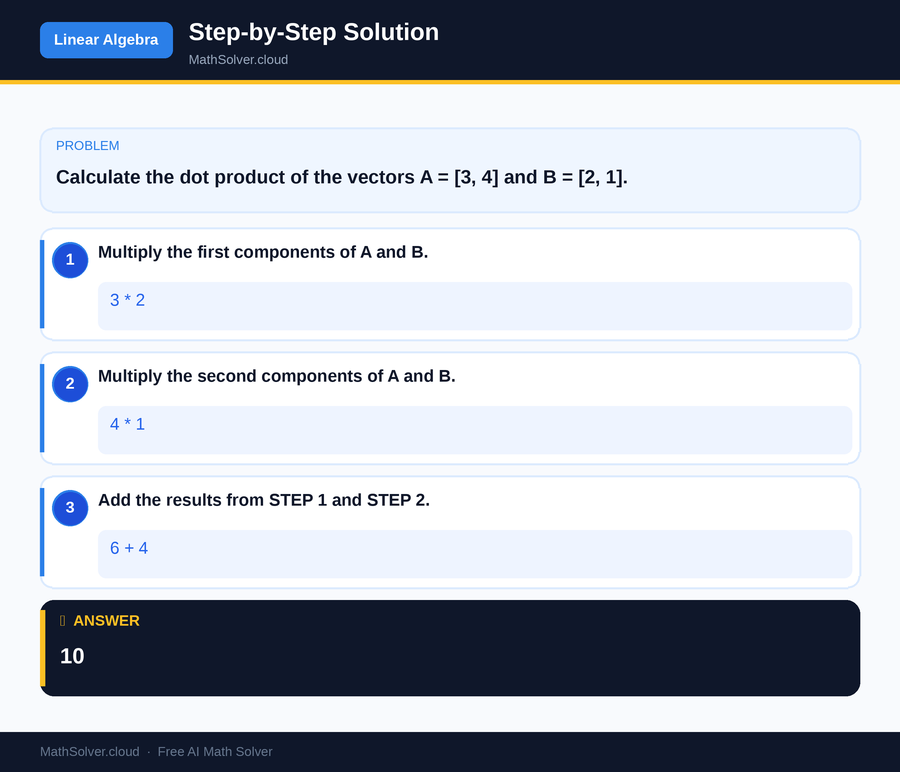
MathSolver Chrome extension solving this problem step-by-step
Example 2
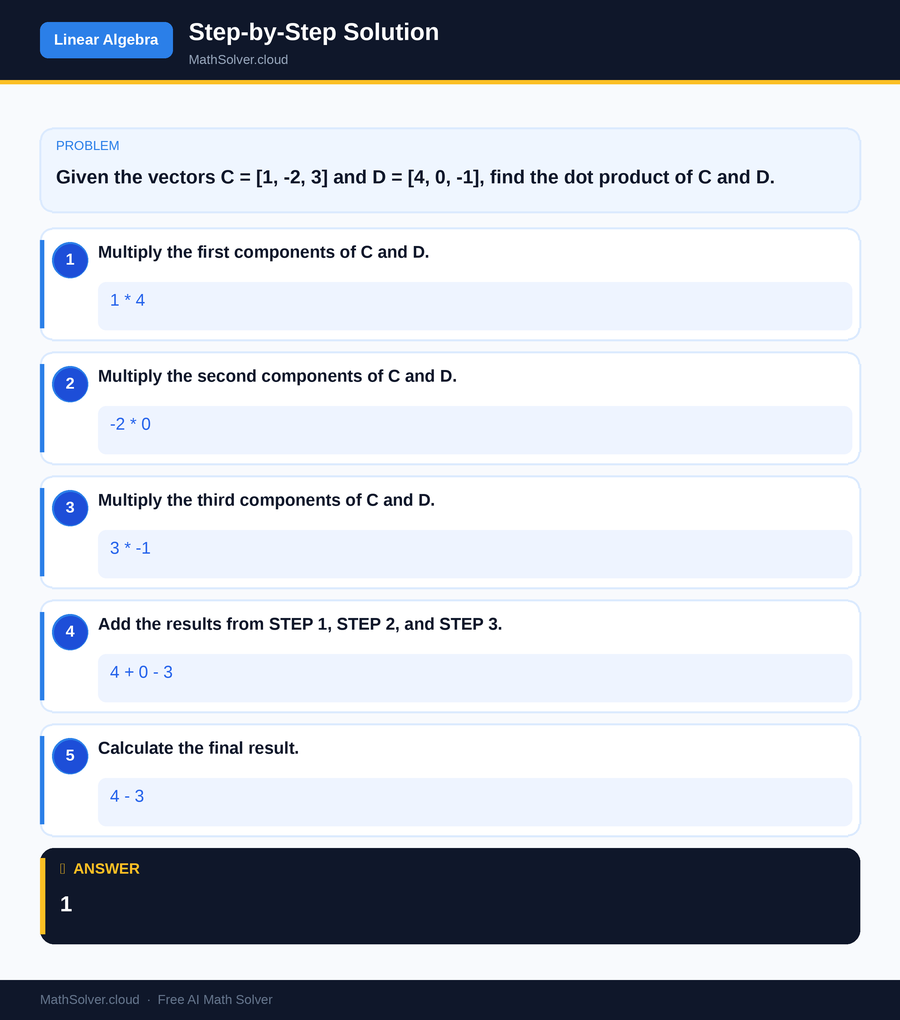
MathSolver Chrome extension solving this problem step-by-step
Common Mistakes to Avoid
One of the most common mistakes students make with the equation for dot product is mismatching the components of the vectors. It's essential to ensure both vectors have the same number of components; otherwise, the dot product cannot be computed. Double-checking vector dimensions before proceeding can prevent this error.
Another frequent error is forgetting to sum the individual products correctly. Students may sometimes skip adding all component products, leading to incorrect results. Carefully summing each product ensures accuracy and correctness in the final dot product calculation.
Real-World Applications
The equation for dot product has significant real-world applications across various fields. In physics, dot products are used to calculate work done when a force is applied to an object over a distance. This is crucial in understanding energy transfer and dynamics in mechanical systems.
In computer graphics, the dot product helps determine the angle between vectors, which is essential for lighting calculations, shading, and rendering scenes accurately. Understanding these applications shows the dot product's importance beyond theoretical exercises, highlighting its practicality in everyday technology and science.
Frequently Asked Questions
❓ What is the equation for dot product, and why is it important?
❓ How do vectors differ in the equation for dot product compared to other algebra equations?
❓ How can AI help with solving the equation for dot product?
❓ Can the dot product be used in matrix operations?
❓ How does the equation for dot product relate to unit vectors?
🚀 Solve any math problem instantly
2,000+ students use MathSolver every day — join them for free
📥 Add to Chrome — It's Free