Mastering the Equation for Determinant
📋 In this guide
The equation for determinant is a critical concept in linear algebra that often poses challenges for students. This mathematical tool is used to compute a scalar value from a square matrix, offering insights into the properties of the matrix, such as whether it is invertible. Students often struggle with the equation for determinant because it involves intricate calculations, especially as the size of the matrix increases. Moreover, understanding when and how to apply the determinant is not immediately intuitive, which can add to the complexity.
Within this article, you will learn how to calculate the determinant of matrices, why it's an essential part of your mathematical toolkit, and how to avoid common pitfalls. We'll break down the equation for determinant into digestible steps and provide real-world contexts where this concept is applied. By the end, you'll not only be able to solve determinant problems with confidence but also understand their applications in various fields.
Mathematics is filled with equations, from algebra equations to quadratic equations, and the equation for determinant is no different in its importance. Whether you're dealing with simple 2x2 matrices or more complex 3x3 matrices, the skills you acquire here will be applicable across various mathematical and scientific disciplines, including physics where kinematic equations often make use of these calculations.
Step-by-Step: How to Solve Equation For Determinant
Step 1: Understanding the Basics of Determinants
Before diving into calculations, it's crucial to understand what a determinant represents. The determinant is a scalar value that can be derived from a square matrix. It provides valuable information such as whether the matrix is invertible (a non-zero determinant indicates invertibility) and can also be used to determine the area or volume scaling factor for transformations described by the matrix. Grasping these fundamental concepts makes it easier to understand why and how the equation for determinant is applied.
Step 2: Applying the Formula to 2x2 Matrices
To calculate the determinant of a 2x2 matrix, use the formula det(A) = ad - bc. Start by identifying the elements a, b, c, and d in your matrix. Multiply a by d and b by c, then subtract the second product from the first. This simple subtraction gives you the determinant. Ensure that you perform these multiplications and the subtraction carefully to avoid common arithmetic errors.
Step 3: Calculating Determinants for 3x3 Matrices
For a 3x3 matrix, the calculation is more involved. Use the determinant formula: det(A) = a(ei - fh) - b(di - fg) + c(dh - eg). Begin by expanding the matrix using the first row's elements (a, b, c) and their corresponding minors. Each minor is the determinant of the 2x2 matrix that remains after removing the row and column of the element you're expanding by. Multiply these minors by the corresponding elements and alternate the signs as per the formula. Sum these values to find the determinant.
Step 4: Checking Your Work and Understanding Results
After calculating the determinant, it's vital to verify your work. Double-check each step, ensuring that all arithmetic operations are correctly executed. Understanding the result is equally important. A determinant of zero indicates that the matrix is singular and not invertible, while a non-zero determinant confirms invertibility. These results have significant implications, especially when solving systems of linear equations or transforming geometric figures.
🤖 Stuck on a math problem?
Take a screenshot and let our AI solve it step-by-step in seconds
⚡ Try MathSolver Free →Worked Examples
Example 1
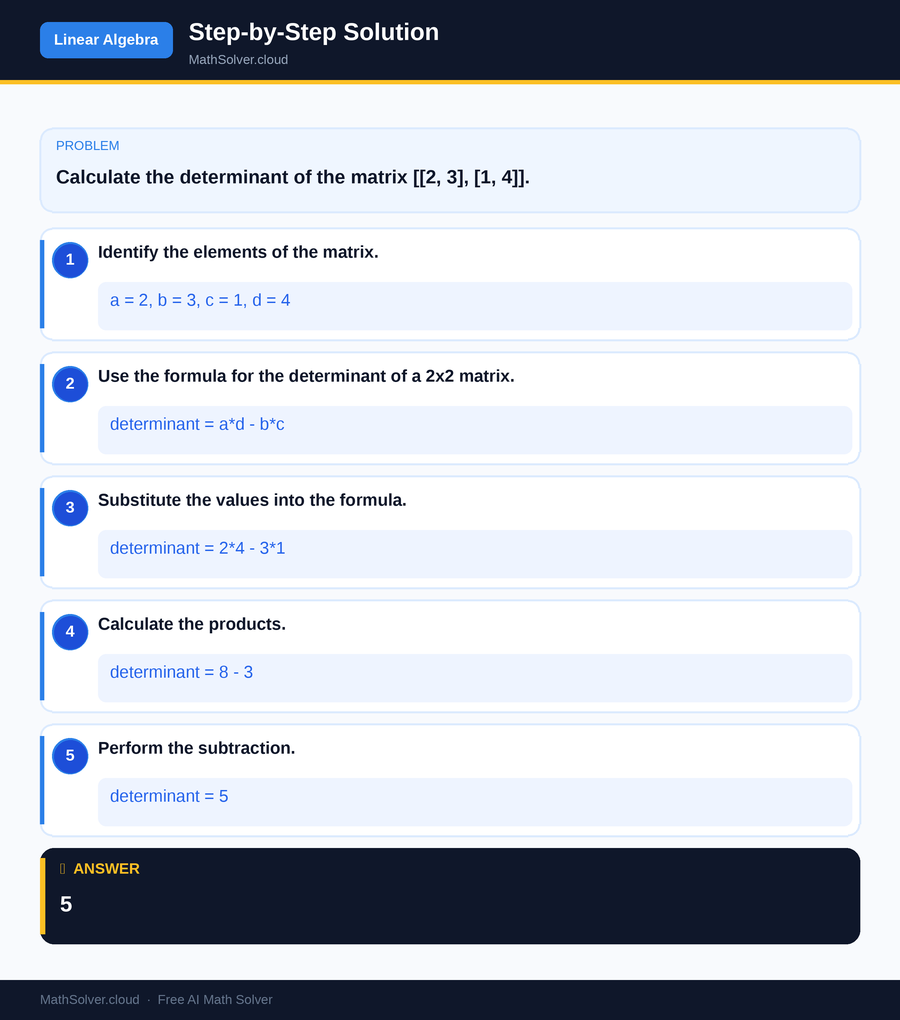
MathSolver Chrome extension solving this problem step-by-step
Example 2
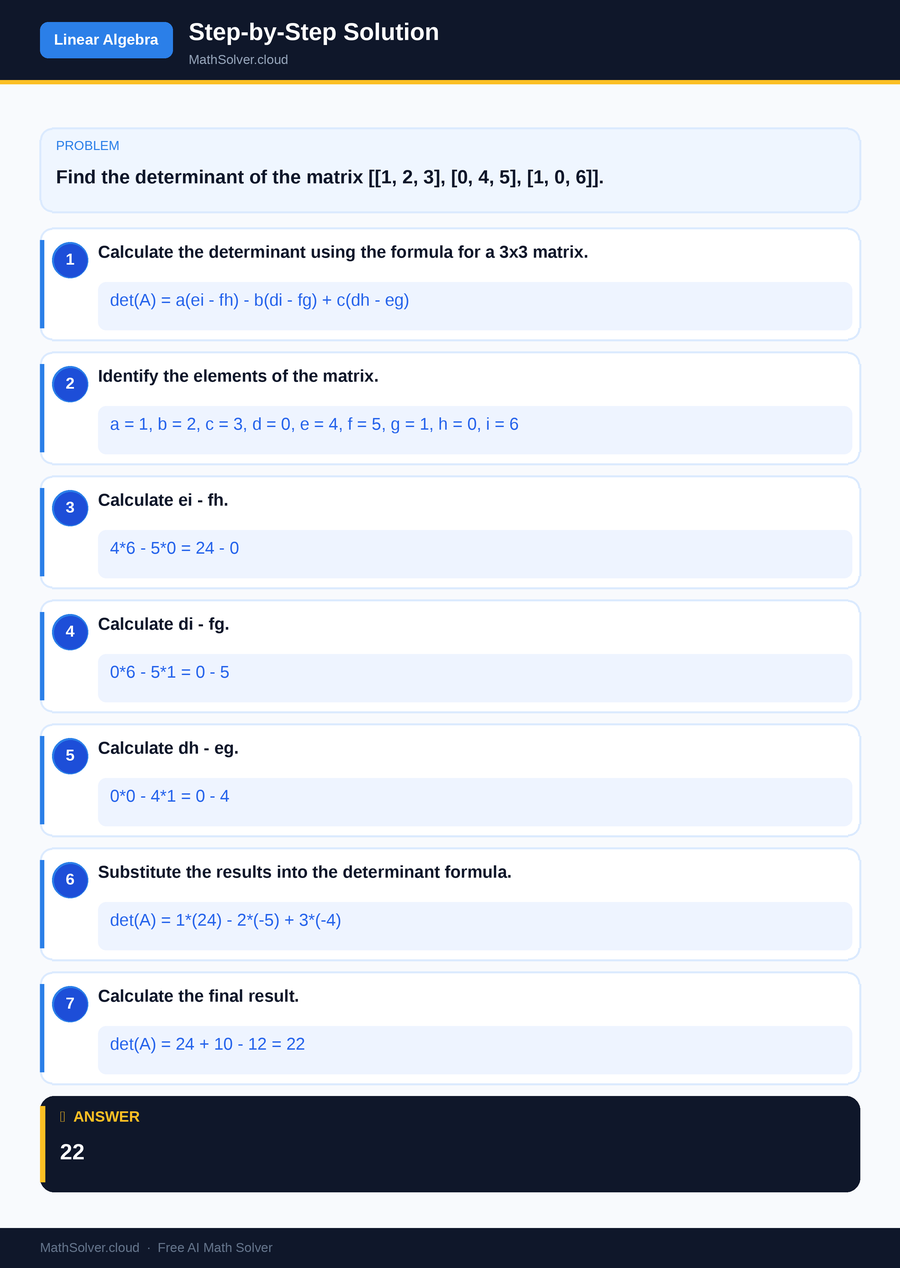
MathSolver Chrome extension solving this problem step-by-step
Common Mistakes to Avoid
One common mistake students make is incorrect arithmetic, especially when dealing with negative numbers in 3x3 matrices. It's easy to lose track of signs and miscalculate the final determinant. Always double-check arithmetic operations and remember to alternate signs when expanding a 3x3 matrix.
Another frequent error is misunderstanding the implications of a zero determinant. Students might overlook that a zero determinant means the matrix is singular and not invertible. This misunderstanding can lead to incorrect conclusions when analyzing matrices or solving systems of equations. Always interpret the result within the context of the problem.
Real-World Applications
The equation for determinant has numerous real-world applications, particularly in fields that require matrix computations. In physics, determinants are used in kinematic equations to solve problems involving motion and forces. The determinant helps in calculating areas and volumes, essential for understanding physical spaces and transformations.
In computer graphics, the equation for determinant is crucial for rendering images and simulations. It helps determine how shapes and figures transform under various operations, ensuring accurate representation and manipulation of objects within a digital space. Understanding these applications provides context for why mastering the determinant is valuable.
Frequently Asked Questions
❓ What is the equation for determinant in simple terms?
❓ Why is the determinant important in algebra equations?
❓ How can AI help with the equation for determinant?
❓ What are some related topics to the equation for determinant?
❓ Where can I find more resources on determinants and related topics?
🚀 Solve any math problem instantly
2,000+ students use MathSolver every day — join them for free
📥 Add to Chrome — It's Free