Mastering the Electric Force Equation
📋 In this guide
The electric force equation is a fundamental concept in physics that describes the force between two charged objects. This equation is crucial for understanding how charged particles interact, but many students find it challenging due to its abstract nature and the mathematical calculations involved. By mastering the electric force equation, students can gain a deeper comprehension of electric fields and forces, which are essential for various scientific and engineering applications.
Students often struggle with the electric force equation because it requires a solid grasp of both algebra and physics principles. It combines the mathematical concepts of proportionality and inverse square laws with physical concepts of charge and distance. This can be especially daunting for those who are still getting comfortable with algebra equations or those who are new to physics.
In this article, you will learn how to work with the electric force equation, step-by-step. We will explore the key formula, break down the process of solving problems, and provide worked examples to solidify your understanding. Additionally, we'll cover common mistakes to avoid, real-world applications, and answer frequently asked questions to ensure you have a comprehensive understanding of this critical topic.
Step-by-Step: How to Solve Electric Force Equation
Step 1: Understand the Components of the Equation
Before diving into calculations, it's important to understand what each component of the electric force equation represents. The term q1 and q2 are the charges of the two objects, which can be either positive or negative. The distance r is a crucial component because the force varies inversely with the square of the distance between the charges. The constant k, known as Coulomb's constant, provides the proportionality factor necessary to calculate the force in Newtons. By understanding these components, you can better grasp how changes in charge and distance affect the electric force.
Step 2: Identify the Charges and Distance
When solving problems using the electric force equation, the first step is to clearly identify the values of the charges and the distance between them. Determine the magnitudes of q1 and q2, ensuring that they are both in Coulombs. If the problem provides charges in microcoulombs (µC), you'll need to convert them to Coulombs by multiplying by 10^-6. Similarly, ensure that the distance r is given in meters, as this is the standard unit for distance in physics equations.
Step 3: Substitute Values into the Equation
Once you have identified the charges and distance, substitute these values into the electric force equation. Be sure to use the absolute values of the charges, as the equation calculates the magnitude of the force. Substitute k, q1, q2, and r into the equation: F = k * |q1 * q2| / r^2. This will allow you to calculate the electric force in Newtons.
Step 4: Solve and Interpret the Result
After substituting the values into the equation, perform the calculations to find the electric force. Pay attention to the units and ensure that your final answer is in Newtons. Once you have the result, interpret what it means in the context of the problem. Consider whether the force is attractive or repulsive, which depends on the signs of the charges: like charges repel, while opposite charges attract. By following these steps, you can confidently solve problems using the electric force equation.
🤖 Stuck on a math problem?
Take a screenshot and let our AI solve it step-by-step in seconds
⚡ Try MathSolver Free →Worked Examples
Example 1
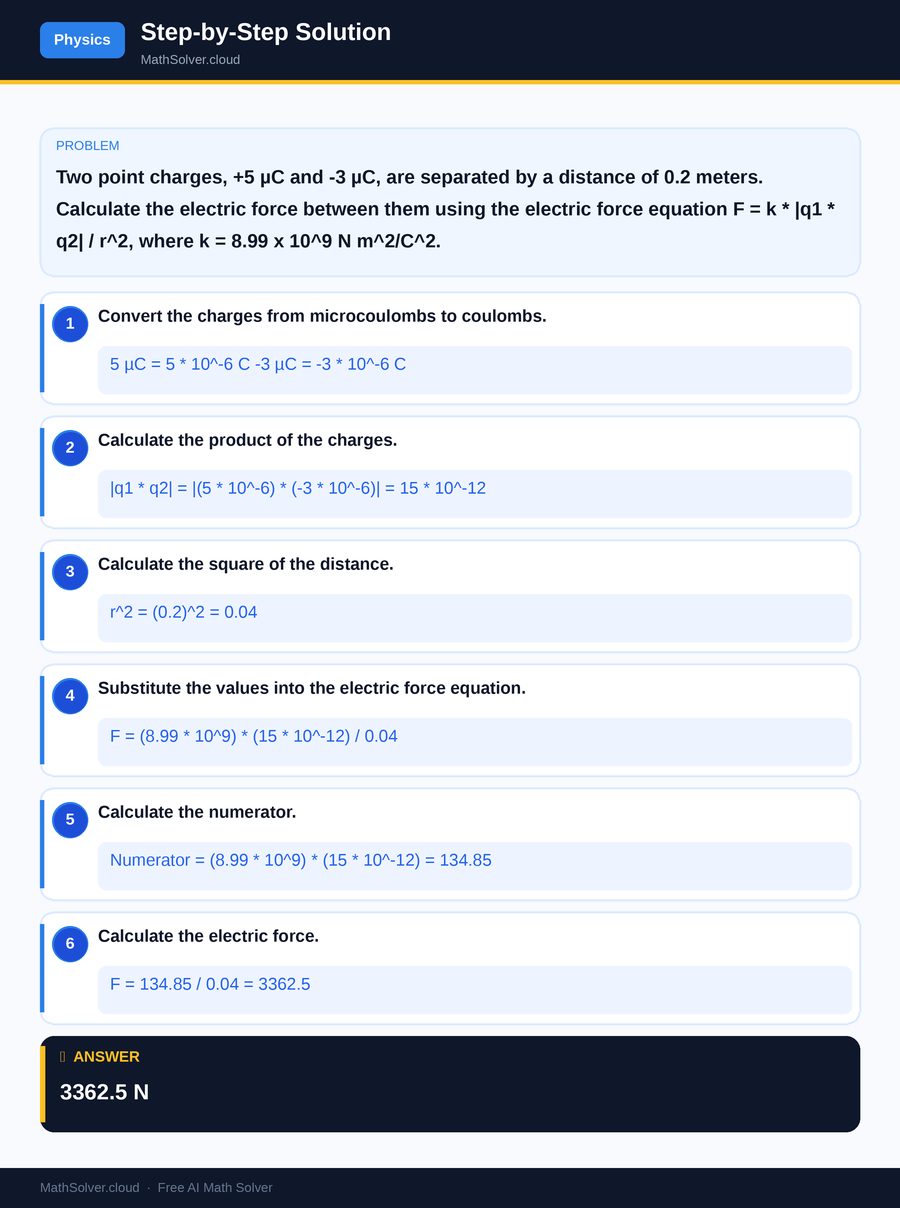
MathSolver Chrome extension solving this problem step-by-step
Example 2
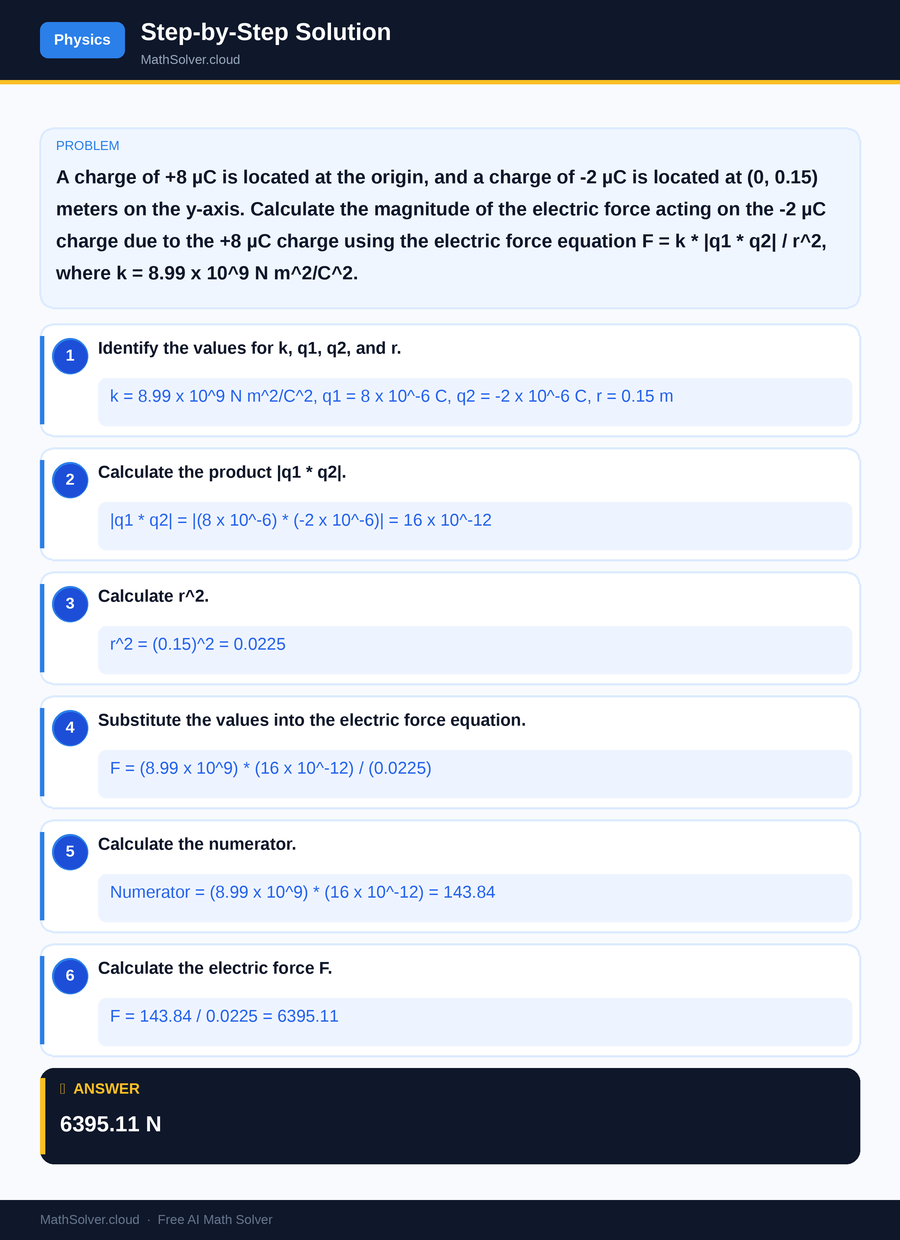
MathSolver Chrome extension solving this problem step-by-step
Common Mistakes to Avoid
One common mistake students make with the electric force equation is forgetting to convert units properly. Charges often need to be converted from microcoulombs to Coulombs, and distances must be in meters. Failing to do so can lead to incorrect calculations and results. Always double-check your units before substituting values into the equation.
Another frequent error is neglecting the absolute value when calculating the force. Since the electric force equation calculates the magnitude of the force, you must use the absolute values of the charges. This ensures that you obtain the correct magnitude of the force, regardless of whether the charges are positive or negative. Remember, the sign of the charge only determines the direction (attractive or repulsive) of the force, not the magnitude.
Real-World Applications
The electric force equation is not just a theoretical concept; it has significant real-world applications. One notable use is in the design and operation of capacitors, which store and release electrical energy in various electronic devices. Understanding the forces between charged plates in a capacitor is crucial for optimizing its performance and efficiency.
Another application is in the field of telecommunications, where electric forces play a role in the transmission of signals. Charged particles are manipulated to send and receive information over long distances, making the understanding of electric forces vital for the development of communication technologies. These examples highlight the importance of the electric force equation in practical applications that impact everyday life.
Frequently Asked Questions
❓ What is the electric force equation and how is it used?
❓ Why do students find the electric force equation challenging?
❓ How can AI help with the electric force equation?
❓ What are some related topics to the electric force equation?
❓ How is the electric force equation applied in engineering?
🚀 Solve any math problem instantly
2,000+ students use MathSolver every day — join them for free
📥 Add to Chrome — It's Free