Mastering the Ejection Fraction Equation
📋 In this guide
The ejection fraction equation is a crucial concept in both mathematics and medicine, often posing challenges for students and healthcare professionals alike. This equation is especially important in the realm of cardiology, where it is used to measure how well the heart is pumping blood. Many students find it difficult to grasp this concept because it involves understanding both mathematical calculations and physiological implications. In this guide, you will learn not only how to solve the ejection fraction equation but also its real-world applications, making the process much more intuitive and approachable.
Understanding the ejection fraction equation can be a game-changer for anyone studying algebra equations or working in medical fields. Calculating the ejection fraction helps in assessing heart health, which is critical for diagnosing various conditions. If you have ever struggled with quadratic equations or kinematic equations, you might find similarities in how these mathematical constructs can be applied to solve real-world problems. Here, we aim to demystify this equation, breaking it down into simple, digestible steps so that you can master it with confidence.
By the end of this article, you'll not only be able to solve the ejection fraction equation but also understand its significance in practical scenarios. We'll walk through step-by-step guides, work on real-life examples, and even explore some common mistakes to avoid. Whether you are preparing for an exam or need to apply this knowledge in a professional setting, this comprehensive guide will serve as an invaluable resource.
Step-by-Step: How to Solve Ejection Fraction Equation
Step 1: Understanding the Components
Before diving into calculations, it's essential to understand the components of the ejection fraction equation. The stroke volume is the amount of blood ejected by the heart in one beat. The total end-diastolic volume is the total volume of blood in the ventricles before contraction. Both of these components are measured in milliliters (mL). Familiarize yourself with these terms, as they are fundamental to solving the equation.
Step 2: Setting Up the Equation
Once you understand the components, the next step is to set up the ejection fraction equation. Write down the formula: Ejection Fraction = (Stroke Volume / Total End-Diastolic Volume) * 100. Substitute the known values into the equation. Ensure that the units for stroke volume and end-diastolic volume match, which in most cases will be milliliters. This step ensures that your calculations will be accurate.
Step 3: Performing the Calculation
Now that the equation is set up, perform the division of the stroke volume by the total end-diastolic volume. This division will give you a decimal number, which represents the fraction of blood ejected. Multiplying this result by 100 will convert the fraction into a percentage. This percentage is the ejection fraction, providing a clear indication of cardiac efficiency.
Step 4: Interpreting the Results
The final step is to interpret the results. Typically, a normal ejection fraction ranges from 55% to 70%. An ejection fraction below 40% may indicate heart failure or cardiomyopathy, while a percentage above 70% could suggest hypertrophic cardiomyopathy. Understanding these ranges is crucial for applying this equation in medical diagnostics or academic exercises.
🤖 Stuck on a math problem?
Take a screenshot and let our AI solve it step-by-step in seconds
⚡ Try MathSolver Free →Worked Examples
Example 1
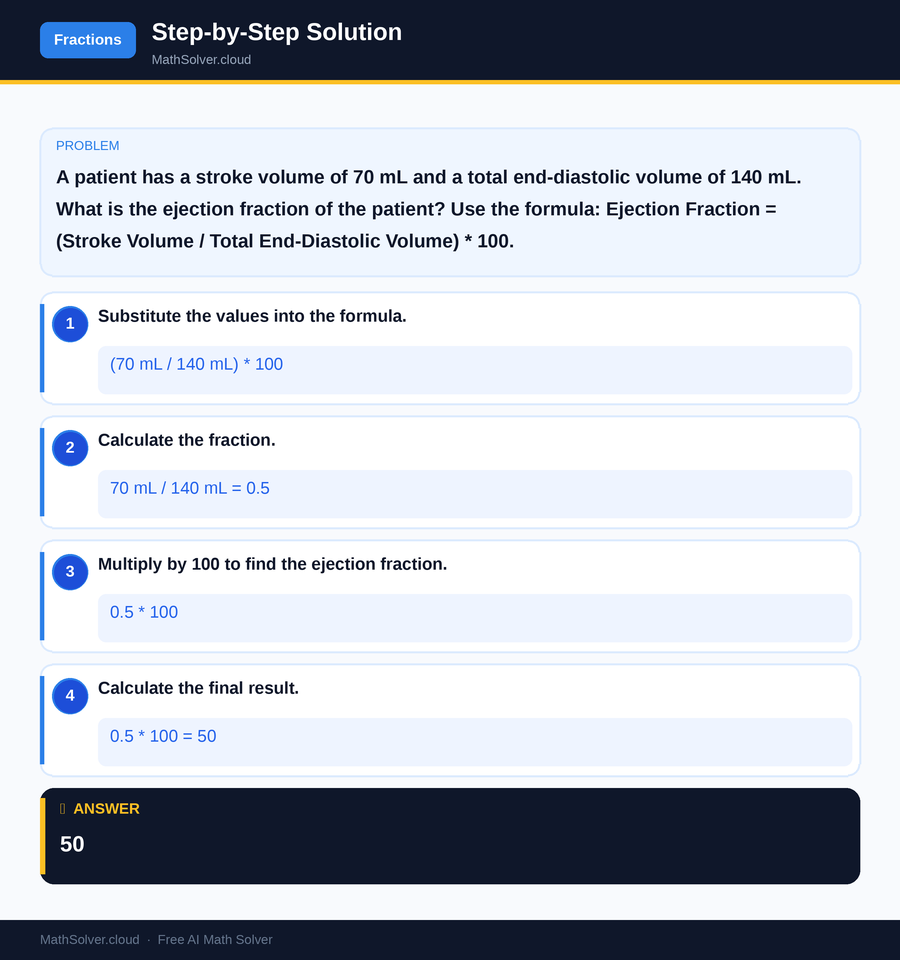
MathSolver Chrome extension solving this problem step-by-step
Example 2
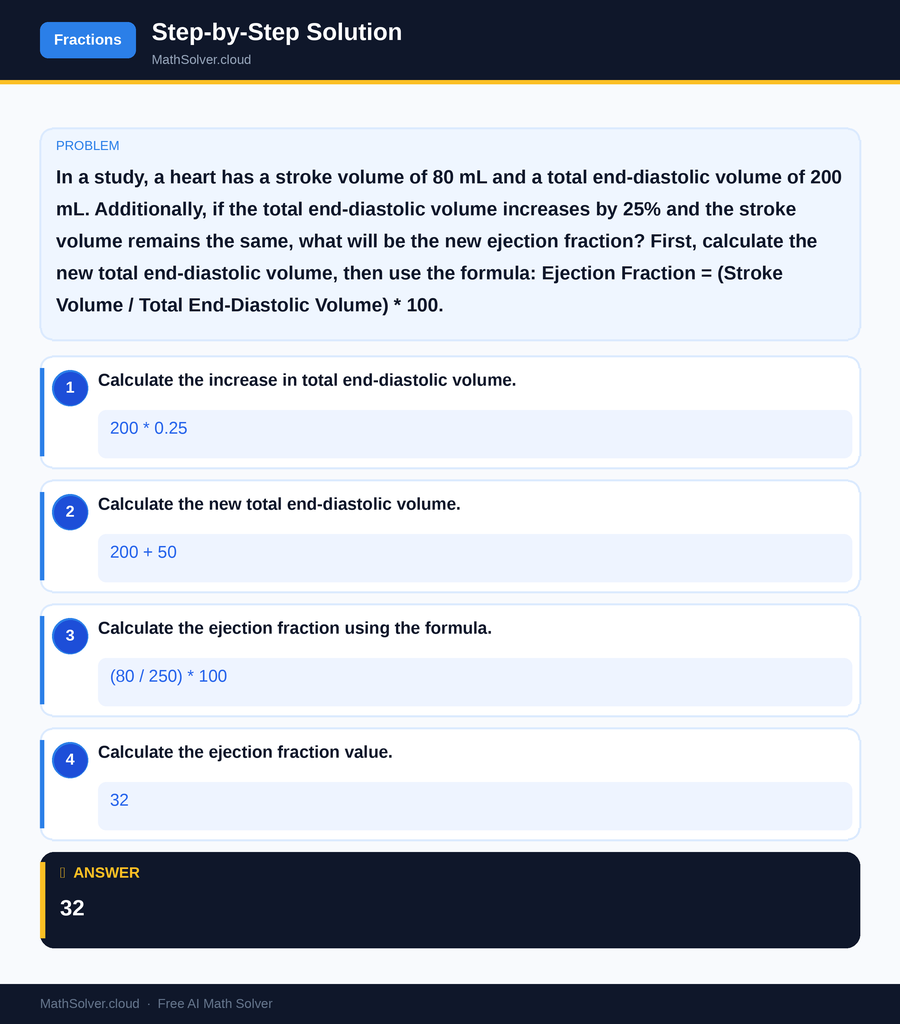
MathSolver Chrome extension solving this problem step-by-step
Common Mistakes to Avoid
A frequent mistake is failing to use consistent units for stroke volume and total end-diastolic volume. Always ensure these are in milliliters to avoid errors. Another common error is neglecting to multiply by 100 to convert the fraction into a percentage, which can lead to a misinterpretation of the heart's performance.
Additionally, students often confuse the ejection fraction equation with other types of equations, such as the quadratic equation or kinematic equations. Understanding the context and specific variables involved is crucial to avoid these pitfalls.
Real-World Applications
The ejection fraction equation is primarily used in cardiology to assess the heart's pumping efficiency. It helps in diagnosing conditions like heart failure and cardiomyopathy. For instance, a low ejection fraction may prompt further tests or treatments like medication adjustments or interventions.
Outside of medicine, understanding this equation can be helpful in academic settings, particularly when studying the relationship between mathematical concepts and their real-world applications. This equation serves as an excellent example of how algebraic calculations can provide insights into complex systems.
Frequently Asked Questions
❓ What is the ejection fraction equation used for?
❓ Why do students find the ejection fraction equation challenging?
❓ How can AI help with the ejection fraction equation?
❓ Are there any online resources to help with the ejection fraction equation?
❓ How is the ejection fraction equation applicable in everyday scenarios?
🚀 Solve any math problem instantly
2,000+ students use MathSolver every day — join them for free
📥 Add to Chrome — It's Free