Understanding the Eigenvalue Equation
📋 In this guide
The eigenvalue equation is a fundamental concept in linear algebra, crucial for students to grasp as they advance in mathematics and physics. This equation, often written as A * v = λ * v, where A is a matrix, v is a vector, and λ (lambda) represents the eigenvalue, is central to various applications, including stability analysis, quantum mechanics, and vibration analysis. Many students find the eigenvalue equation challenging because it requires a solid understanding of matrices and algebra equations, but with clear explanations and practice, it becomes manageable. In this article, you'll learn how to solve eigenvalue equations, see worked examples, and understand their real-world applications.
When students first encounter the eigenvalue equation, they often struggle with the abstract nature of matrices and eigenvalues. Unlike simple algebra equations, eigenvalue equations involve complex operations like matrix multiplication and finding determinants. These steps can seem daunting at first, but they are essential for solving the equation and finding the eigenvalues of a matrix. By breaking down the process into manageable steps, students can gain confidence and improve their problem-solving skills.
Throughout this article, we will explore the key formula of the eigenvalue equation, provide a step-by-step guide to solving it, and work through detailed examples. By the end, you'll understand what an eigenvalue equation is, how to solve it, and how it applies to real-world problems. We'll also address common mistakes and answer frequently asked questions to help you avoid pitfalls and deepen your comprehension.
Step-by-Step: How to Solve Eigenvalue Equation
Step 1: Understand the Matrix and Identity Matrix
The first step in solving an eigenvalue equation is to clearly understand the matrix A you are working with and the identity matrix I of the same size. The identity matrix is a square matrix with ones on the diagonal and zeros elsewhere. When you subtract λI from A, you are essentially scaling the identity matrix by the eigenvalue λ and subtracting it from the original matrix. This step sets the stage for finding the determinant in the next steps. Ensure you correctly construct the identity matrix to match the dimensions of matrix A.
Step 2: Subtract λI from A
Once you have your matrix A and the identity matrix I, subtract λI from A. This subtraction involves simple algebraic operations where you adjust the diagonal elements of A by subtracting λ from each. The resulting matrix, (A - λI), will be central to finding the eigenvalues. Performing this subtraction accurately is crucial, as mistakes here can lead to incorrect eigenvalues. Carefully execute the subtraction, ensuring each element of the resulting matrix is correct.
Step 3: Find the Determinant of (A - λI)
With the matrix (A - λI) in hand, the next step is to calculate its determinant. The determinant is a scalar value that can be computed for square matrices, and it plays a key role in the eigenvalue equation. For a 2x2 matrix, the determinant is calculated as ad - bc, where a, b, c, and d are the elements of the matrix. Finding the determinant of (A - λI) and setting it equal to zero is the crux of solving the eigenvalue equation. This step requires careful attention to detail to ensure accuracy.
Step 4: Solve the Resulting Equation
The final step is to solve the equation det(A - λI) = 0 for λ. The resulting equation is typically a polynomial, often quadratic, especially for 2x2 matrices. Solving this polynomial will yield the eigenvalues, which are the solutions λ. For a quadratic equation, use the quadratic formula λ = (-b ± sqrt(b^2 - 4ac))/(2a) or factor the polynomial if possible. Solving this equation correctly will provide the eigenvalues needed for further analysis.
🤖 Stuck on a math problem?
Take a screenshot and let our AI solve it step-by-step in seconds
⚡ Try MathSolver Free →Worked Examples
Example 1

MathSolver Chrome extension solving this problem step-by-step
Example 2
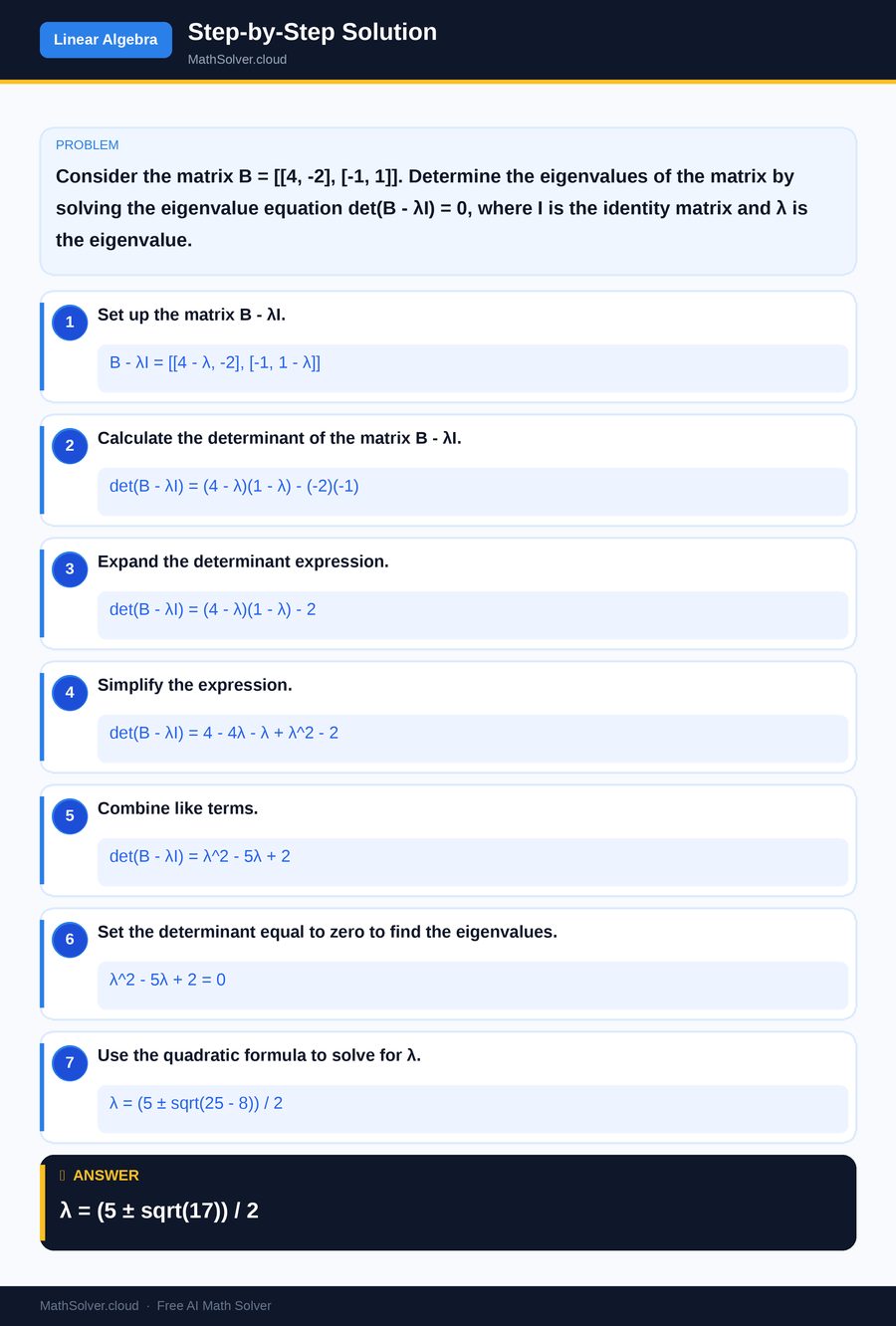
MathSolver Chrome extension solving this problem step-by-step
Common Mistakes to Avoid
One common mistake students make when solving eigenvalue equations is incorrectly setting up the matrix (A - λI). It's crucial to ensure that λ is subtracted only from the diagonal elements of A. Another frequent error occurs during determinant calculation, especially with sign errors or arithmetic mistakes. Double-check each step and verify your calculations to avoid these pitfalls.
Another error is misapplying the quadratic formula or incorrect factoring when solving the polynomial equation. Always recheck your solutions by substituting the eigenvalues back into the original determinant equation to confirm they satisfy det(A - λI) = 0. Practice and attention to detail are key to mastering these steps.
Real-World Applications
Eigenvalue equations are not just theoretical; they have numerous real-world applications. In physics, the energy eigenvalue equation is used in quantum mechanics to determine the energy levels of quantum systems. Engineers use eigenvalues to analyze mechanical vibrations and stability in structures, where different eigenvalues correspond to different modes of vibration.
In computer science, eigenvalues are instrumental in algorithms for facial recognition and data compression, where they help reduce dimensionality and improve computational efficiency. Understanding eigenvalue equations is crucial for interpreting results in these fields and designing effective solutions to complex problems.
Frequently Asked Questions
❓ What is an eigenvalue equation?
❓ Why do I need to learn about eigenvalue equations?
❓ How can AI help with eigenvalue equations?
❓ Can eigenvalue equations be solved for non-square matrices?
❓ How do eigenvalues relate to real-world systems?
🚀 Solve any math problem instantly
2,000+ students use MathSolver every day — join them for free
📥 Add to Chrome — It's Free