Mastering the Drag Force Equation
📋 In this guide
The drag force equation is a fundamental concept in fluid dynamics that quantifies the resistance experienced by an object moving through a fluid, such as air or water. Many students find the drag force equation challenging due to its reliance on various factors, including velocity, density of the fluid, and the object's shape and size. Understanding this equation is crucial for solving problems in physics and engineering, making it a vital topic for students who aim to excel in these fields.
In this article, you'll learn about the drag force equation, its components, and how to apply it through detailed examples. By breaking down the equation into manageable steps, you'll gain a clearer understanding of how to use it to solve real-world problems. This guide will also help you avoid common mistakes and explore practical applications of the drag force equation in everyday life.
Through a step-by-step approach, we'll cover everything you need to know about the drag force equation. From defining the key formula to providing worked examples, this article aims to make the concept accessible and understandable. By the end of this article, you'll be equipped with the knowledge to tackle problems involving the drag force equation confidently.
Step-by-Step: How to Solve Drag Force Equation
Step 1: Understanding the Components
The first step in mastering the drag force equation is to understand each component. The drag coefficient (C_d) is a dimensionless number that represents the object's shape's effect on drag. A streamlined shape will have a lower C_d compared to a blunt shape. The cross-sectional area (A) is the area of the object facing the fluid flow. The fluid density (rho) is the mass per unit volume of the fluid, such as air or water. Lastly, the velocity (v) is the speed of the object relative to the fluid. Recognizing how each component influences the drag force will help you apply the equation accurately.
Step 2: Setting Up the Equation
Once you understand the components, the next step is to set up the drag force equation. Identify the values provided in your problem, such as the drag coefficient, cross-sectional area, fluid density, and velocity. It's essential to ensure that all your units are consistent; typically, in the metric system, you'll use meters for length, kilograms for mass, and seconds for time. By setting up the equation with these values, you'll be ready to calculate the drag force acting on the object.
Step 3: Performing the Calculation
With the equation set up, perform the calculation by substituting the known values into the equation. Multiply the drag coefficient (C_d) by the cross-sectional area (A), the fluid density (rho), and the square of the velocity (v^2). Then, multiply the resulting value by 0.5 to find the drag force. This step requires careful arithmetic to ensure accuracy, especially when dealing with squared terms and decimal values.
Step 4: Analyzing the Results
After calculating the drag force, take a moment to analyze the results. Compare the magnitude of the drag force with the expected results based on the object's size, shape, and speed. Understanding the implications of the drag force value can provide insights into the object's motion through the fluid. For example, a higher drag force indicates greater resistance, affecting the object's acceleration and energy efficiency.
🤖 Stuck on a math problem?
Take a screenshot and let our AI solve it step-by-step in seconds
⚡ Try MathSolver Free →Worked Examples
Example 1
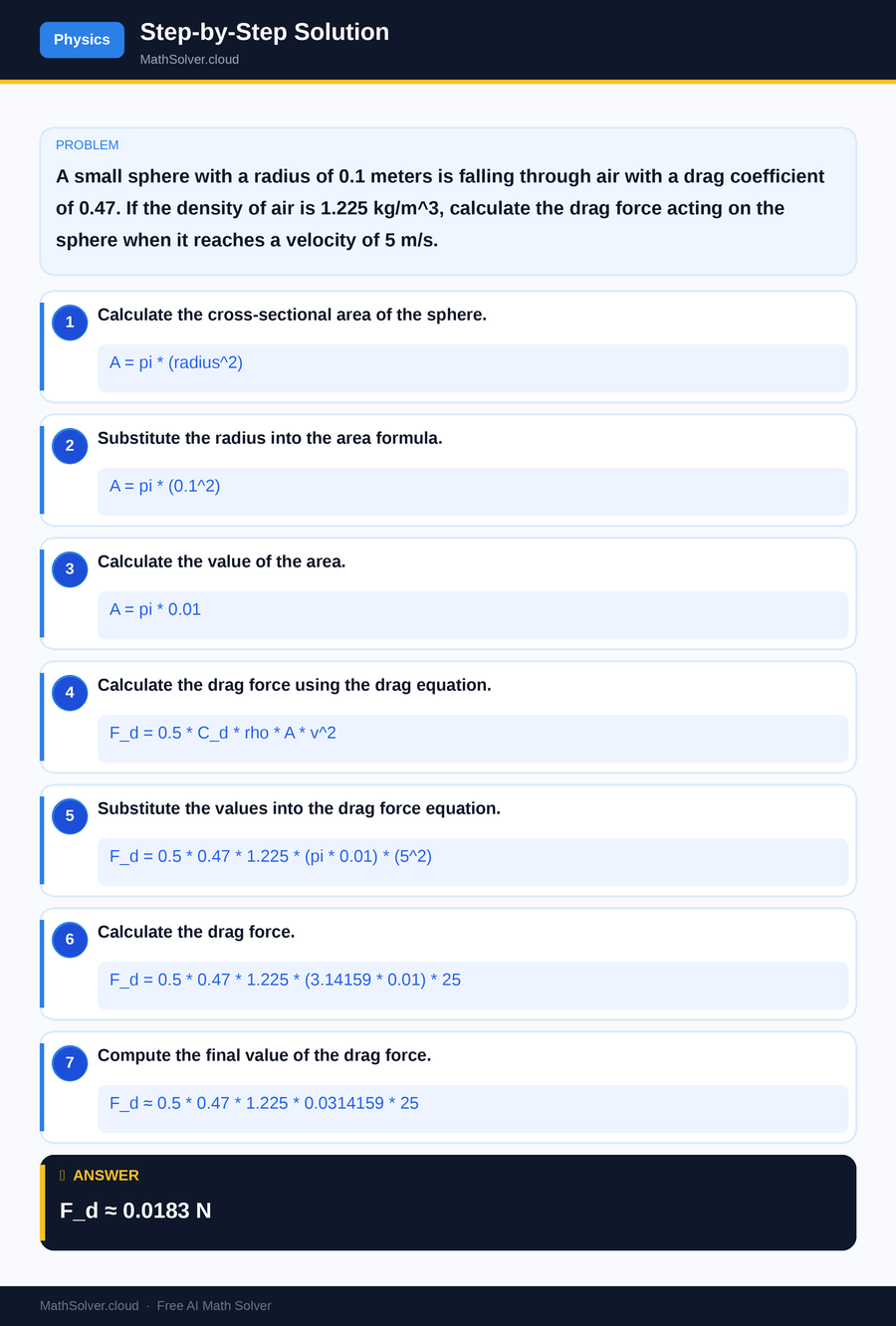
MathSolver Chrome extension solving this problem step-by-step
Example 2
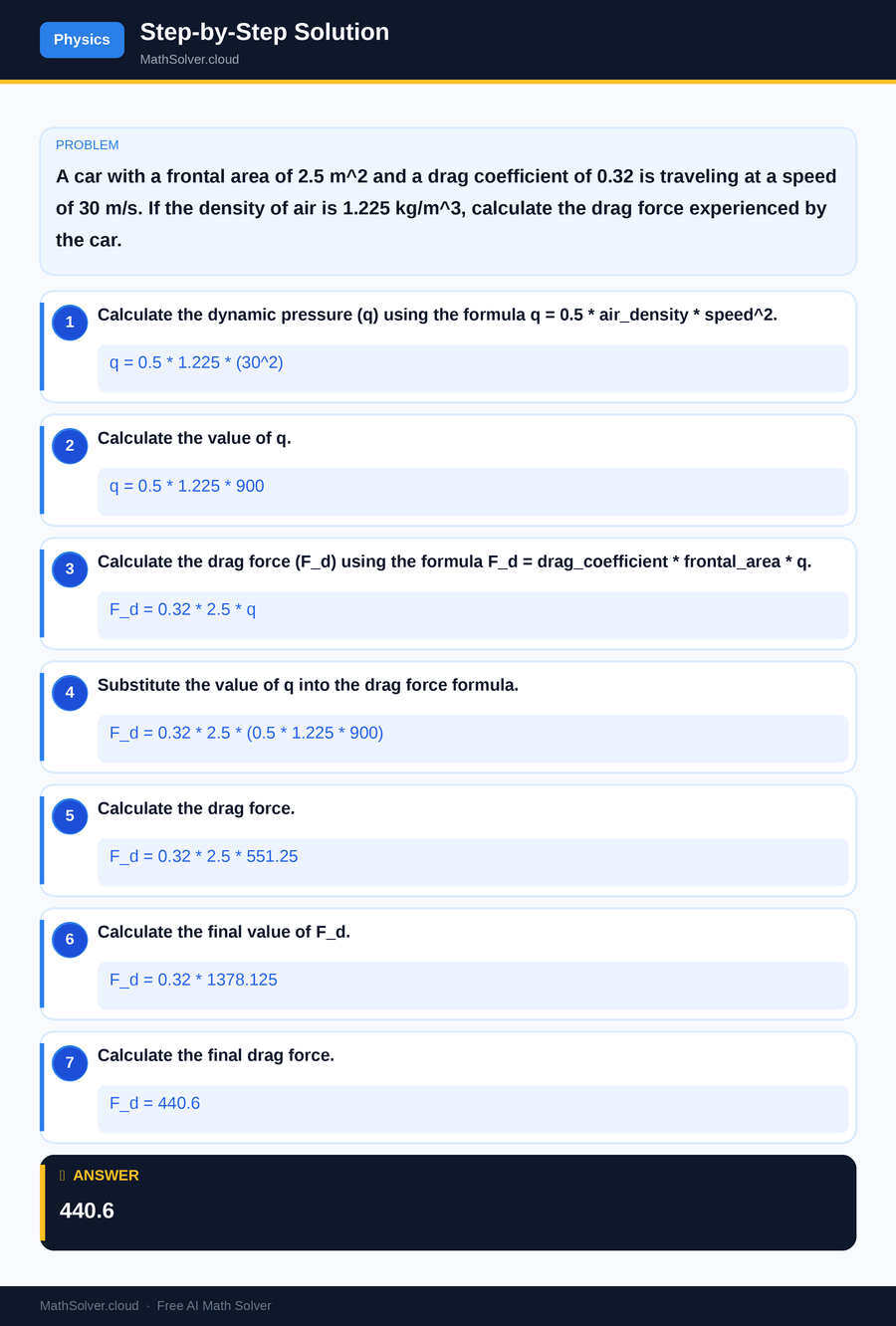
MathSolver Chrome extension solving this problem step-by-step
Common Mistakes to Avoid
One common mistake students make is incorrect unit conversions. Ensuring consistency in units is crucial; for example, if you're given a velocity in km/h, convert it to m/s before using it in the equation. Another frequent error is miscalculating the cross-sectional area. Always double-check calculations involving pi and square measurements to avoid these pitfalls.
Additionally, students often forget to square the velocity in the equation, leading to incorrect results. Remember that the velocity is squared in the drag force equation, significantly impacting the calculation outcome. Taking the time to carefully substitute and verify each value will help you avoid these common errors.
Real-World Applications
The drag force equation is widely used in various fields, particularly in engineering and physics. For instance, automotive engineers use it to design more aerodynamic vehicles, improving fuel efficiency and performance by minimizing drag. In aviation, understanding drag is essential for optimizing aircraft design to enhance lift and reduce fuel consumption.
Beyond transportation, the drag force equation plays a vital role in sports science. Athletes and equipment designers use it to enhance performance by reducing air resistance, such as in cycling or skiing. By applying the principles of the drag force equation, these industries can innovate and improve the efficiency and effectiveness of their designs and strategies.
Frequently Asked Questions
❓ What is the primary purpose of the drag force equation?
❓ Why is the drag coefficient important in the drag force equation?
❓ How can AI help with the drag force equation?
❓ How does viscosity affect the drag force equation?
❓ Can the drag force equation be applied to liquids as well as gases?
🚀 Solve any math problem instantly
2,000+ students use MathSolver every day — join them for free
📥 Add to Chrome — It's Free