Mastering the Dot Product Equation
📋 In this guide
The dot product equation is a fundamental concept in linear algebra that plays a crucial role in various mathematical and scientific applications. Students often find themselves grappling with the dot product equation because it can be challenging to grasp its geometric significance and computational steps. In this article, we'll break down the dot product equation into manageable parts, helping you understand its core principles and applications. By the end of this guide, you'll gain confidence in solving dot product equations and appreciate their relevance in real-world scenarios.
Understanding the dot product equation is essential for students, as it serves as a building block for more advanced topics in mathematics and physics. The concepts underpinning this equation are pivotal for solving problems in vector calculus, computer graphics, and engineering. Despite its importance, many students struggle to master the dot product equation due to its abstract nature and the precision required in calculations.
In this comprehensive guide, we'll walk you through the dot product equation step by step, provide worked examples, highlight common pitfalls, and explore its real-world applications. We'll also address frequently asked questions to deepen your understanding. So, let's dive right in and demystify the dot product equation for you.
Step-by-Step: How to Solve Dot Product Equation
Step 1: Understanding Vectors
Before diving into the dot product equation, it's crucial to understand what vectors are. Vectors are mathematical entities that have both magnitude and direction. They are often represented as arrows in space or as arrays of numbers. For example, a vector in a two-dimensional space can be represented as [x, y], where x and y are its components along the respective axes. Understanding vectors is the first step in grasping the dot product equation, as it involves operations on these mathematical objects.
Step 2: Components of Vectors
Each vector component represents a projection of the vector along a particular axis. In a three-dimensional space, a vector A can be represented as [a1, a2, a3], where a1, a2, and a3 are its components along the x, y, and z axes, respectively. Comprehending these components is vital for calculating the dot product equation because the equation essentially sums the products of corresponding components of the vectors involved.
Step 3: Calculating the Dot Product
To calculate the dot product of two vectors, multiply their corresponding components and sum the results. Given two vectors A = [a1, a2, a3] and B = [b1, b2, b3], the dot product equation is calculated as follows: a1*b1 + a2*b2 + a3*b3. This operation results in a scalar value, not a vector. This scalar product can tell us about the angle between the vectors and their relative orientation, which is crucial in various applications such as physics and computer graphics.
Step 4: Geometric Interpretation
The geometric interpretation of the dot product equation provides insight into the relationship between the vectors. The dot product can tell us whether two vectors are orthogonal (i.e., at right angles to each other) if the result is zero. Moreover, it can give information about the angle between the vectors: if the dot product is positive, the angle is acute; if negative, the angle is obtuse. Understanding this geometric perspective is essential for applying the dot product in real-world scenarios such as calculating work done by a force or determining the cosine of the angle between vectors.
🤖 Stuck on a math problem?
Take a screenshot and let our AI solve it step-by-step in seconds
⚡ Try MathSolver Free →Worked Examples
Example 1
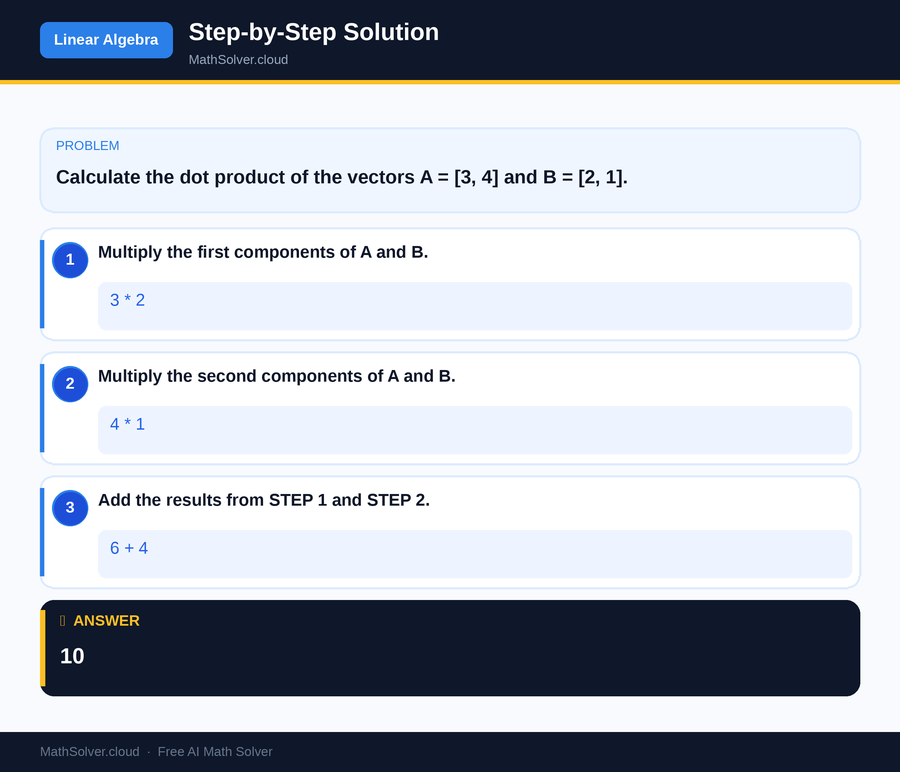
MathSolver Chrome extension solving this problem step-by-step
Example 2
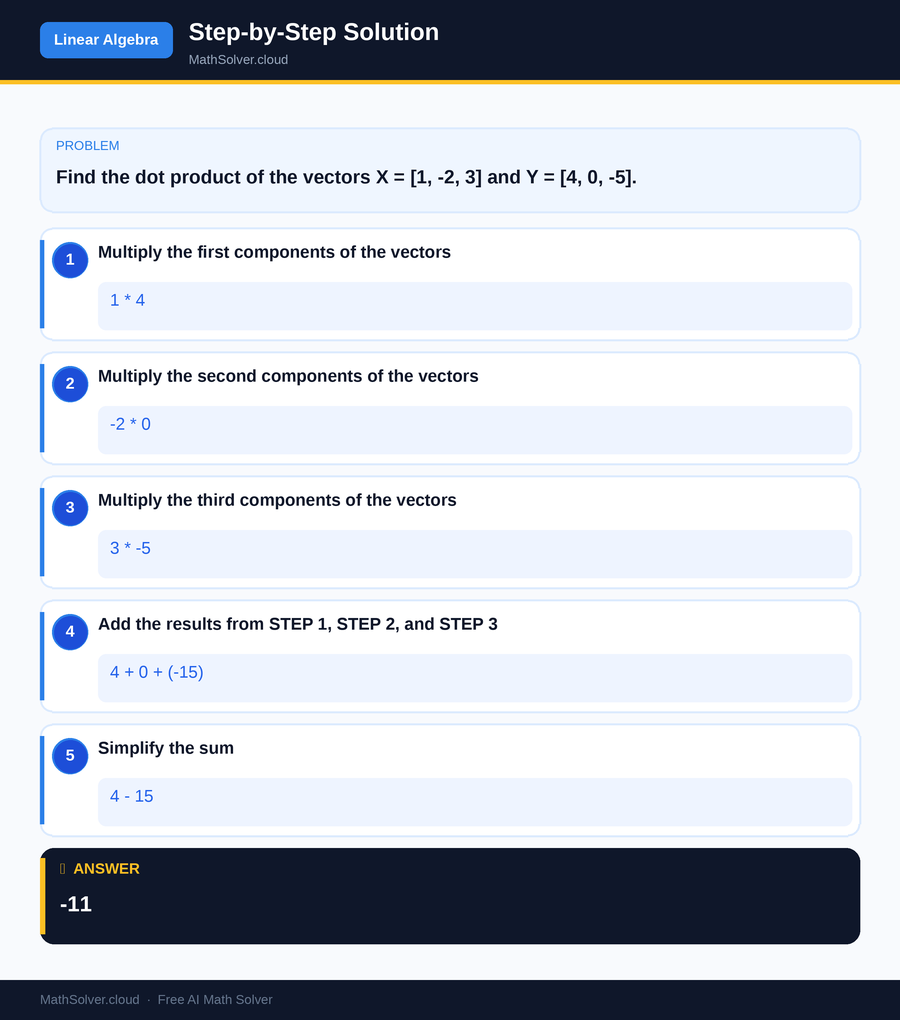
MathSolver Chrome extension solving this problem step-by-step
Common Mistakes to Avoid
One common mistake students make is confusing the dot product with vector addition. Remember, the dot product results in a scalar, not a vector. Ensure you multiply the corresponding components and sum them, rather than adding vectors component-wise. Another mistake is neglecting the sign of vector components, especially when dealing with negative numbers. Always pay attention to the signs during multiplication to avoid incorrect results.
Another error to be cautious of is mishandling dimensions. The dot product equation requires vectors to have the same number of components. Trying to calculate the dot product of vectors with different dimensions will lead to errors. Always check that both vectors are in the same space before proceeding with calculations.
Real-World Applications
The dot product equation is widely used in physics to determine the work done by a force. When a force acts on an object, the work done is calculated as the dot product of the force vector and the displacement vector. This application is fundamental in mechanics and helps in understanding energy transfer processes.
In computer graphics, the dot product equation is crucial for determining lighting and shading. Calculating the angle between the light source and the surface normal using the dot product allows for realistic rendering of objects. This application is vital for creating lifelike images in video games and simulations.
Frequently Asked Questions
❓ What is the importance of the dot product equation?
❓ How do I know when to use the dot product equation?
❓ How can AI help with the dot product equation?
❓ Can the dot product equation be used for vectors in three dimensions?
❓ How is the dot product equation related to unit vectors?
🚀 Solve any math problem instantly
2,000+ students use MathSolver every day — join them for free
📥 Add to Chrome — It's Free