Determinant Math Definition
📋 In this guide
The determinant math definition is a fundamental concept in linear algebra that plays a crucial role in various mathematical computations and applications. Students often find determinants challenging because they involve a combination of arithmetic operations and conceptual understanding, requiring attention to detail and a grasp of matrix properties. In this article, you will learn not only the determinant math definition but also how to compute determinants, common pitfalls to avoid, and their real-world applications. By the end of this guide, you'll have a clearer understanding of determinants and how they are used in mathematical problem-solving.
Determinants can be intimidating at first, especially when dealing with larger matrices. The determinant math definition involves calculating a scalar value from a square matrix, which can indicate certain properties of the matrix, such as whether it's invertible. This scalar value is essential in solving linear equations, understanding matrix transformations, and more. As we delve deeper, you'll gain insights into the step-by-step process of finding determinants, ensuring you can tackle these calculations with confidence.
Understanding the determinant math definition is crucial for anyone studying mathematics, engineering, or computer science, as it forms the backbone of many advanced topics. Whether you're using a math solver tool like Mathway or delving into the nuances of matrix multiplication, grasping the determinant is key. With the help of this guide, you'll be equipped to handle determinants with ease, whether you're working through problems manually or using advanced tools like a math calculator or photomath app.
Step-by-Step: How to Solve Determinant Math Definition
Step 1: Understanding the Matrix Structure
Before diving into calculations, it's essential to understand the structure of the matrix you're dealing with. A matrix is an array of numbers arranged in rows and columns. The determinant is only defined for square matrices, meaning the number of rows and columns must be equal. Begin by identifying the size of your matrix, as this will determine the method used to calculate the determinant. For example, a 2x2 matrix uses a straightforward formula, while a 3x3 matrix requires a more complex approach, such as cofactor expansion.
Step 2: Calculating the Determinant of a 2x2 Matrix
Calculating the determinant of a 2x2 matrix is relatively simple and serves as a good starting point. If your matrix is A = [[a, b], [c, d]], the determinant is found using the formula det(A) = ad - bc. This formula represents the area of a parallelogram formed by the vectors in the matrix. Substitute the values from your matrix into the formula and perform the arithmetic operations to find the determinant. This straightforward calculation is often the first step in understanding the broader determinant math definition.
Step 3: Calculating the Determinant of a 3x3 Matrix
For a 3x3 matrix, the determinant calculation is more involved. If you have a matrix A = [[a, b, c], [d, e, f], [g, h, i]], you can use the cofactor expansion method. This involves choosing a row or column and calculating the determinant of 2x2 submatrices obtained by removing the row and column of each element. The formula is det(A) = a(ei - fh) - b(di - fg) + c(dh - eg). By substituting the matrix elements into this formula and performing the multiplications and subtractions, you find the determinant.
Step 4: Using Tools for Larger Matrices
As matrices grow larger, calculating determinants manually becomes increasingly complex. In such cases, using a math AI tool or a determinant matrix solver can be invaluable. These tools, including photomath or a math calculator, can provide quick and accurate solutions, allowing you to focus on understanding the results rather than the computation itself. Many of these tools also offer step-by-step explanations, which can be a helpful learning aid, especially when dealing with intricate calculations.
🤖 Stuck on a math problem?
Take a screenshot and let our AI solve it step-by-step in seconds
⚡ Try MathSolver Free →Worked Examples
Example 1
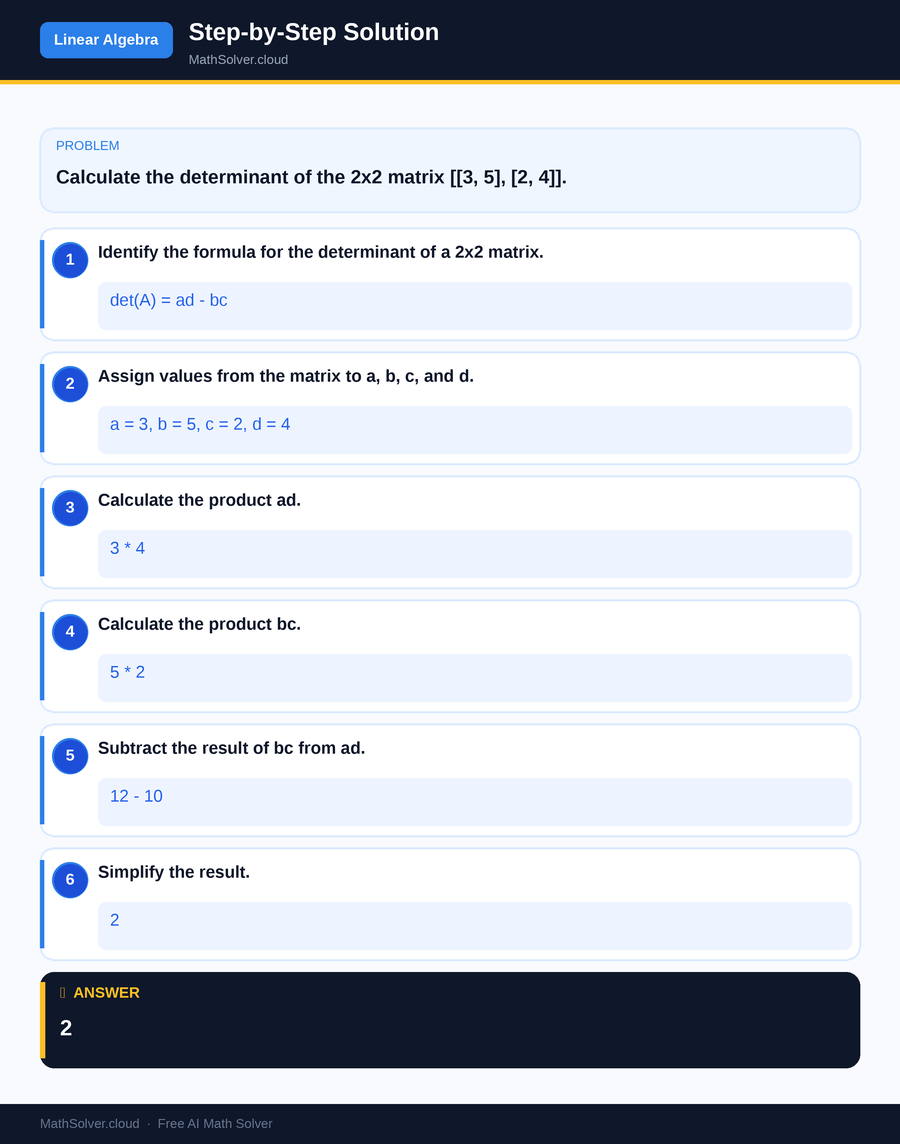
MathSolver Chrome extension solving this problem step-by-step
Example 2
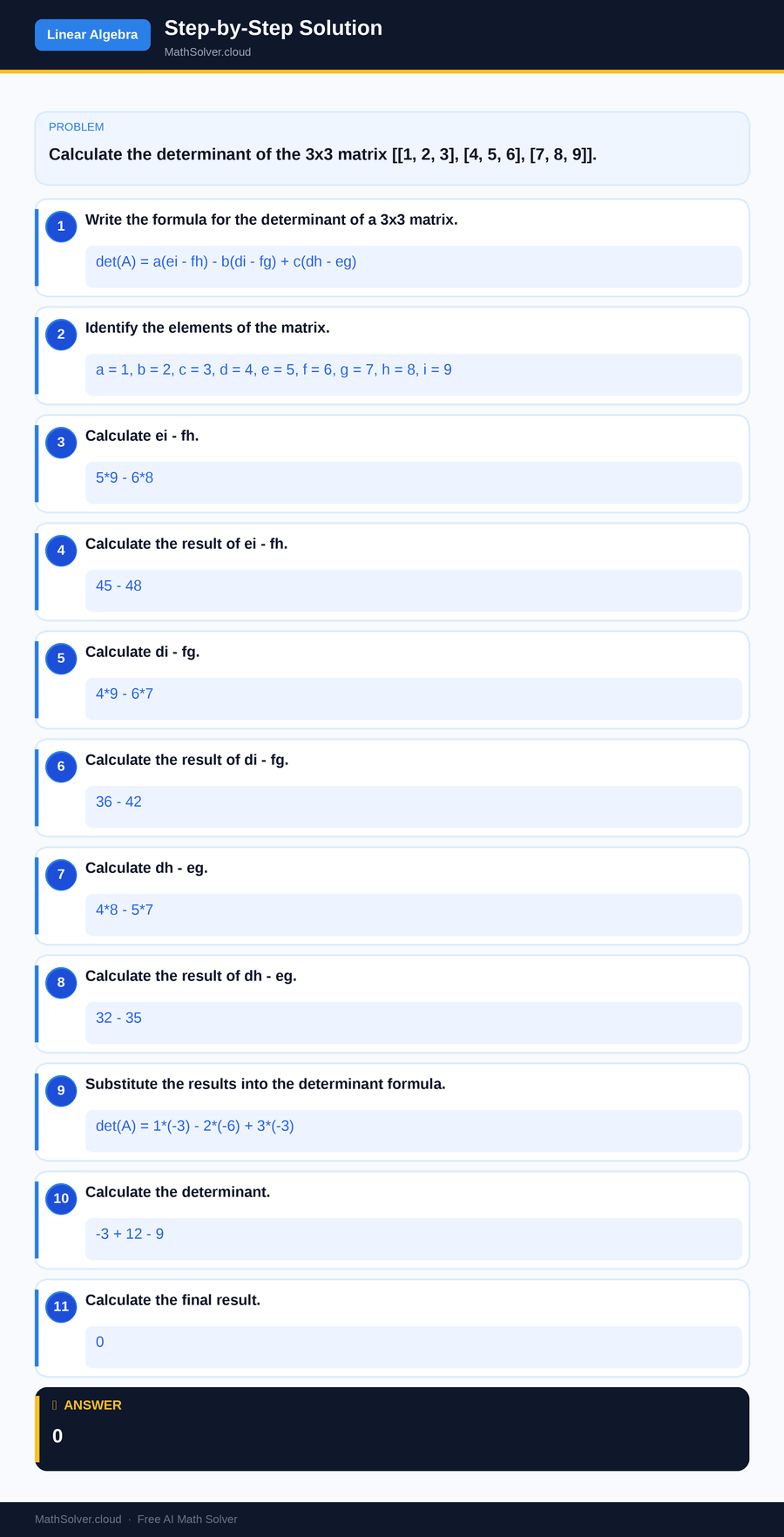
MathSolver Chrome extension solving this problem step-by-step
Common Mistakes to Avoid
One common mistake when calculating determinants is incorrectly applying the formula, especially with sign changes in cofactor expansions. Students may forget to alternate signs when expanding along a row or column, leading to incorrect results. To avoid this, double-check each step of your expansion process and ensure that you follow the correct sign pattern.
Another frequent error is miscalculating the elements of submatrices, particularly in larger matrices. It can be easy to confuse rows and columns when forming these submatrices, resulting in incorrect determinants. Practice forming submatrices carefully, and consider using tools like a mathway or a matrix multiplication solver to verify your work.
Real-World Applications
The determinant math definition has several real-world applications, especially in fields like engineering and physics. Determinants are used to determine the stability of systems, such as in control systems engineering, where they help analyze system behavior. They also play a role in calculating eigenvalues and eigenvectors, which are essential in quantum mechanics and other areas.
In computer graphics, determinants help with transformations and rendering of images. For example, they are used in calculating the orientation and scaling of objects in 3D space. Understanding determinants can also aid in solving systems of linear equations, which is crucial in optimizing various engineering problems. Our complete Matrix & Linear Algebra guide explores these applications in greater detail.
Frequently Asked Questions
❓ What is the determinant math definition, and why is it important?
❓ How do I calculate the determinant of a 4x4 matrix?
❓ How can AI help with determinant math definition?
❓ What is the significance of a zero determinant?
❓ Can determinants be used in real-world problem-solving?
🚀 Solve any math problem instantly
2,000+ students use MathSolver every day — join them for free
📥 Add to Chrome — It's Free