Unlocking the Secrets of Demon List Geometry Dash
📋 In this guide
Demon list geometry dash is an intriguing yet challenging concept that often puzzles students as they navigate through their geometry lessons. It’s a term that refers to a collection of the hardest levels in the popular game Geometry Dash, but here, we're going beyond the digital realm to explore the mathematical principles underlying the challenges. Students often struggle with demon list geometry dash because it requires a strong grasp of geometric concepts and problem-solving skills. The complexity can be daunting, but understanding these principles is crucial for mastering geometry as a whole.
In this article, we’ll delve deep into the key concepts of demon list geometry dash, exploring the formulas, definitions, and steps needed to solve these complex problems. You will learn how to effectively tackle these tough math challenges, gaining confidence in your abilities. Whether you’re preparing for an exam or just looking to improve your understanding, this comprehensive guide will provide the clarity you need.
By the end of this article, you’ll have a solid understanding of demon list geometry dash, complete with step-by-step guides and worked examples to cement your knowledge. We’ll also touch on common mistakes to avoid, real-world applications, and answer frequently asked questions to ensure you have all the tools you need to succeed. Let’s unlock the secrets of demon list geometry dash together!
Step-by-Step: How to Solve Demon List Geometry Dash
Step 1: Understand the Problem
The first step in tackling demon list geometry dash problems is to thoroughly understand what is being asked. Read the problem statement carefully and identify the key geometric figures involved, such as triangles, rhombuses, or any other shapes. Determine what specific values or measurements you need to find, such as a perimeter, area, or side length. Visualize the problem by sketching a diagram if necessary. This initial analysis will guide you in selecting the right formulas and methods to use.
Step 2: Choose the Right Formula
Once you have a clear understanding of the problem, the next step is to choose the appropriate formula or method to solve it. For example, if the problem involves finding the side length of a right triangle, the Pythagorean theorem will be your go-to formula. If you're working with a rhombus, you might need to use the formulas for diagonals or area. Make sure you understand why each formula is applicable to the given problem, as this will help you apply it correctly.
Step 3: Perform the Calculations
With the right formula in hand, proceed to perform the calculations. Substitute the known values into the formula and solve for the unknowns. Be meticulous with your arithmetic, and double-check each step to avoid simple errors. If the problem involves multiple steps, such as finding a semi-perimeter before calculating an area, take it one step at a time, and ensure each calculation is correct before moving on to the next.
Step 4: Validate Your Solution
After completing the calculations, the final step is to validate your solution. Check that your answer makes sense in the context of the problem and that all units are consistent. If possible, use a different method or formula to verify your results. This double-checking process is crucial in ensuring accuracy and building confidence in your problem-solving skills.
🤖 Stuck on a math problem?
Take a screenshot and let our AI solve it step-by-step in seconds
⚡ Try MathSolver Free →Worked Examples
Example 1
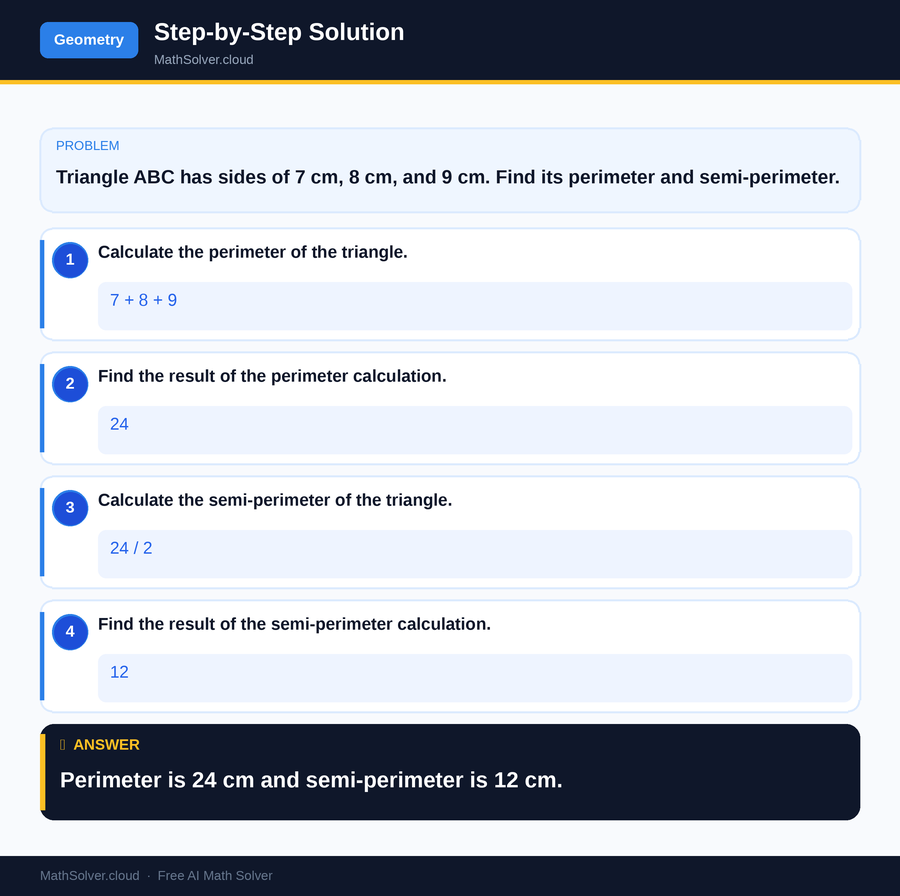
MathSolver Chrome extension solving this problem step-by-step
Example 2
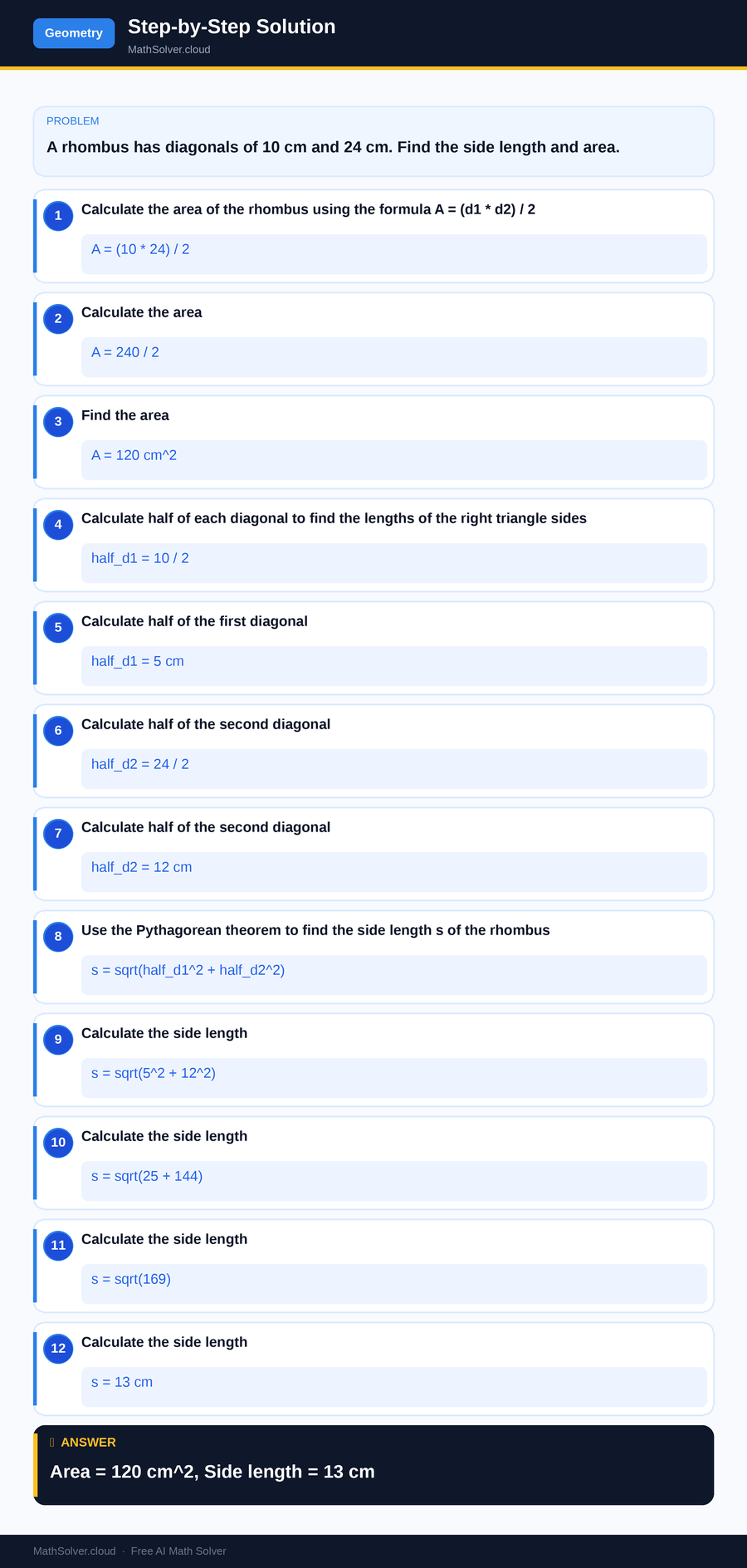
MathSolver Chrome extension solving this problem step-by-step
Common Mistakes to Avoid
One common mistake students make with demon list geometry dash problems is neglecting to double-check their calculations. Arithmetic errors can easily lead to incorrect answers, so it's crucial to verify each step. Another frequent error is misapplying formulas. Ensure that you’re using the correct formula for the given geometric figure and problem type. Misunderstanding the problem statement can also lead to errors, so take your time to fully comprehend what is being asked before diving into calculations.
Additionally, students often overlook the importance of units. Mixing units or omitting them entirely can result in inaccurate solutions. Always keep track of units throughout your calculations, and make sure your final answer is presented with the correct units. By being mindful of these potential pitfalls, you can avoid common mistakes and improve your problem-solving accuracy.
Real-World Applications
Demon list geometry dash, while a challenging concept in math, has practical applications in various real-world scenarios. For instance, architects and engineers use geometric principles to design and construct buildings, bridges, and other structures. Understanding how to calculate areas, perimeters, and angles is crucial in ensuring structural integrity and aesthetic appeal.
In technology, computer graphics and video game design rely heavily on geometry. The principles of demon list geometry dash can be applied in creating realistic environments and animations, optimizing the user experience in digital platforms. These real-world applications underscore the importance of mastering geometry and the value of understanding complex concepts like demon list geometry dash.
Frequently Asked Questions
❓ What is demon list geometry dash?
❓ Why is geometry challenging for students?
❓ How can AI help with demon list geometry dash?
❓ What are some strategies for mastering geometry?
❓ How is geometry used in everyday life?
🚀 Solve any math problem instantly
2,000+ students use MathSolver every day — join them for free
📥 Add to Chrome — It's Free