Mastering the Current Ratio Equation
📋 In this guide
The current ratio equation is a critical financial metric used to assess a company's ability to pay off its short-term liabilities with its short-term assets. This equation is particularly important for students studying accounting, finance, and business management. Despite its straightforward nature, students often struggle with the current ratio equation due to its contextual application in financial analysis. Understanding this equation is crucial for evaluating a company's liquidity and financial health. In this article, we will explore what the current ratio equation is, why it is significant, and how you can master it by following a step-by-step guide. By the end, you'll be able to calculate the current ratio with ease and understand its implications in real-world scenarios.
Students often face challenges with the current ratio equation because it involves interpreting financial statements and understanding the relationships between financial elements. The equation itself is simple, but the context in which it is used can be complex. Many learners find it difficult to discern which components of a company's financial statements are relevant and how they affect the overall liquidity picture. However, with practice and the right approach, anyone can become proficient in calculating and interpreting the current ratio.
In this guide, we will break down the current ratio equation into manageable steps, provide practical examples, and highlight common pitfalls to avoid. You will also gain insight into how the current ratio equation is applied in real-life scenarios, enhancing your understanding of its practical significance. Along the way, we'll touch on related topics, such as algebra equations and solving exponential equations, to broaden your mathematical proficiency and application skills.
Step-by-Step: How to Solve Current Ratio Equation
Step 1: Identify Current Assets
The first step in using the current ratio equation is to identify the company's current assets. Current assets are resources that are expected to be converted into cash or used up within one year. Common examples include cash, accounts receivable, and inventory. Review the company's balance sheet to pinpoint these assets. It's important to accurately categorize assets to ensure the ratio calculation reflects the company's true liquidity position.
Step 2: Identify Current Liabilities
Next, identify the company's current liabilities, which are obligations that must be settled within one year. These typically include accounts payable, short-term debt, and other accrued liabilities. Like current assets, current liabilities are found on the company's balance sheet. Ensuring the correct identification of these liabilities is crucial because they directly affect the company's ability to meet its financial commitments in the short term.
Step 3: Calculate the Current Ratio
With both current assets and current liabilities identified, you can now calculate the current ratio using the formula mentioned earlier. Divide the total current assets by the total current liabilities. This calculation will yield a numerical value that reflects the company's liquidity. A higher current ratio suggests a stronger ability to pay off short-term liabilities, whereas a lower ratio may indicate potential liquidity issues.
Step 4: Interpret the Results
Once you have calculated the current ratio, the next step is to interpret the results. A current ratio of 1 or higher is generally considered satisfactory, indicating that the company has enough assets to cover its liabilities. However, industry norms and company-specific factors can influence what is considered an ideal ratio. For example, a current ratio that is too high may suggest inefficient use of assets, whereas too low a ratio might indicate financial distress.
🤖 Stuck on a math problem?
Take a screenshot and let our AI solve it step-by-step in seconds
⚡ Try MathSolver Free →Worked Examples
Example 1
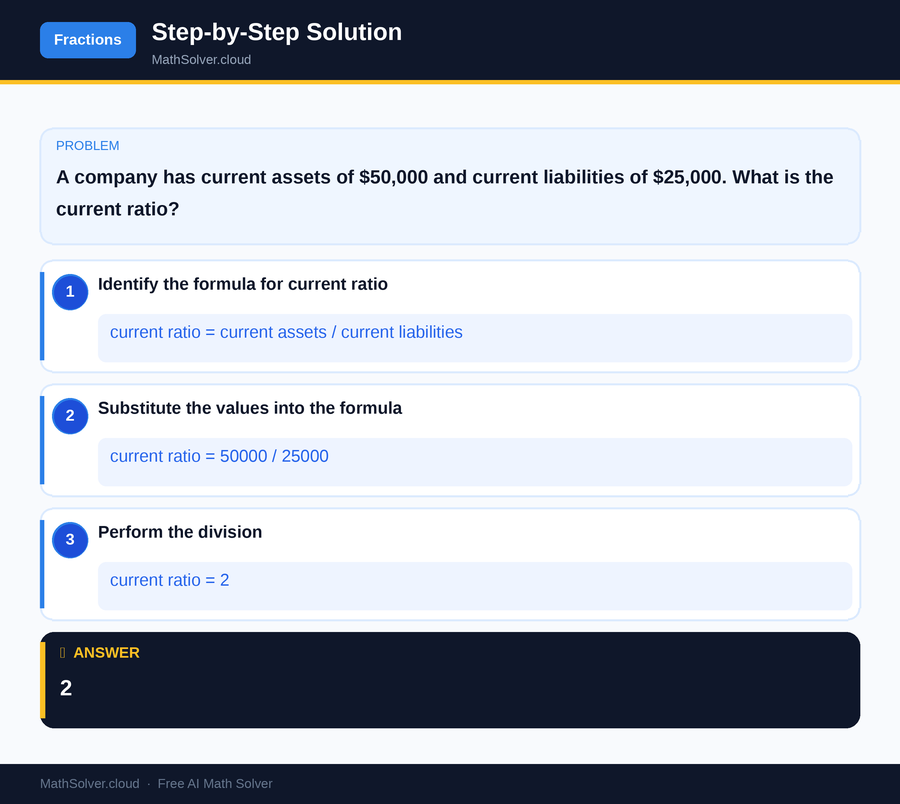
MathSolver Chrome extension solving this problem step-by-step
Example 2

MathSolver Chrome extension solving this problem step-by-step
Common Mistakes to Avoid
One common mistake students make when calculating the current ratio equation is misclassifying assets or liabilities. Confusing long-term assets with current assets or mixing long-term liabilities with current liabilities can lead to incorrect results. Always ensure that you are working with the right set of financial figures specific to the short-term period.
Another frequent error involves failing to interpret the ratio correctly. Students might focus solely on achieving a high ratio without understanding what it signifies for the company's operational efficiency. It's crucial to consider the industry context and the specific circumstances of the business when analyzing the current ratio.
Real-World Applications
The current ratio equation is extensively used in real-life financial analysis to assess a company's liquidity. Lenders and investors frequently use this metric to determine a company's risk level before extending credit or investing. For instance, a bank might analyze a borrower's current ratio to evaluate their ability to repay a loan.
Additionally, companies use the current ratio to monitor their financial health and make informed business decisions. A business might leverage this ratio to optimize inventory levels or adjust its credit policies, ensuring a balance between maintaining liquidity and maximizing operational efficiency.
Frequently Asked Questions
❓ What does the current ratio equation reveal about a company?
❓ Why might a current ratio be misleading?
❓ How can AI help with the current ratio equation?
❓ What should I do if a company's current ratio is below 1?
❓ How does the current ratio compare to other financial ratios?
🚀 Solve any math problem instantly
2,000+ students use MathSolver every day — join them for free
📥 Add to Chrome — It's Free