Understanding Constant Acceleration Equations
📋 In this guide
Constant acceleration equations are fundamental tools in physics that describe the motion of objects when the acceleration is uniform or constant. These equations are pivotal in understanding how objects move under the influence of steady forces, such as gravity or a constant engine thrust. Students often find these equations challenging because they involve multiple variables and require a good grasp of algebraic manipulation and conceptual understanding. By mastering constant acceleration equations, students can solve complex problems related to motion and predict how objects will behave under various conditions.
Many learners struggle with the application of these equations because they often get intimidated by the formulas and the algebra involved. However, understanding the underlying principles can make these equations much more intuitive. In this article, we will break down the constant acceleration equations into digestible parts, providing you with a clear understanding and the skills to tackle problems with confidence.
By the end of this guide, you will be equipped with the knowledge to apply constant acceleration equations effectively. You’ll learn to navigate through the algebra equations involved, recognize common pitfalls to avoid, and see how these equations apply to real-world situations. Whether you are diving into physics for the first time or preparing for an exam, this guide will be your companion in mastering motion at constant acceleration equations.
Step-by-Step: How to Solve Constant Acceleration Equations
Step 1: Identify the Known Variables
In any problem involving constant acceleration equations, start by clearly identifying the known variables. This includes the initial velocity (u), final velocity (v), acceleration (a), time (t), and displacement (s). Write these values down and determine which variables are unknown. This step is crucial as it sets the foundation for which equation to use.
Step 2: Select the Appropriate Equation
Once you have identified the known and unknown variables, choose the appropriate constant acceleration equation that allows you to solve for the unknown. For instance, if you know the initial velocity, acceleration, and time, and need to find the final velocity, use the equation v = u + at. Selecting the right equation is key to making the problem manageable.
Step 3: Solve the Equation
With the correct equation in hand, substitute the known values into the equation. Carefully perform the algebraic manipulations needed to solve for the unknown variable. Pay close attention to units and ensure that they are consistent, as mismatched units can lead to errors in your calculations. This step requires careful attention to detail and algebraic skills.
Step 4: Verify Your Answer
After solving the equation, take a moment to verify your answer. Check if it makes sense logically and mathematically. Consider the context of the problem—does the calculated displacement seem reasonable given the time and acceleration? Verification helps catch any errors and builds confidence in your solution.
🤖 Stuck on a math problem?
Take a screenshot and let our AI solve it step-by-step in seconds
⚡ Try MathSolver Free →Worked Examples
Example 1
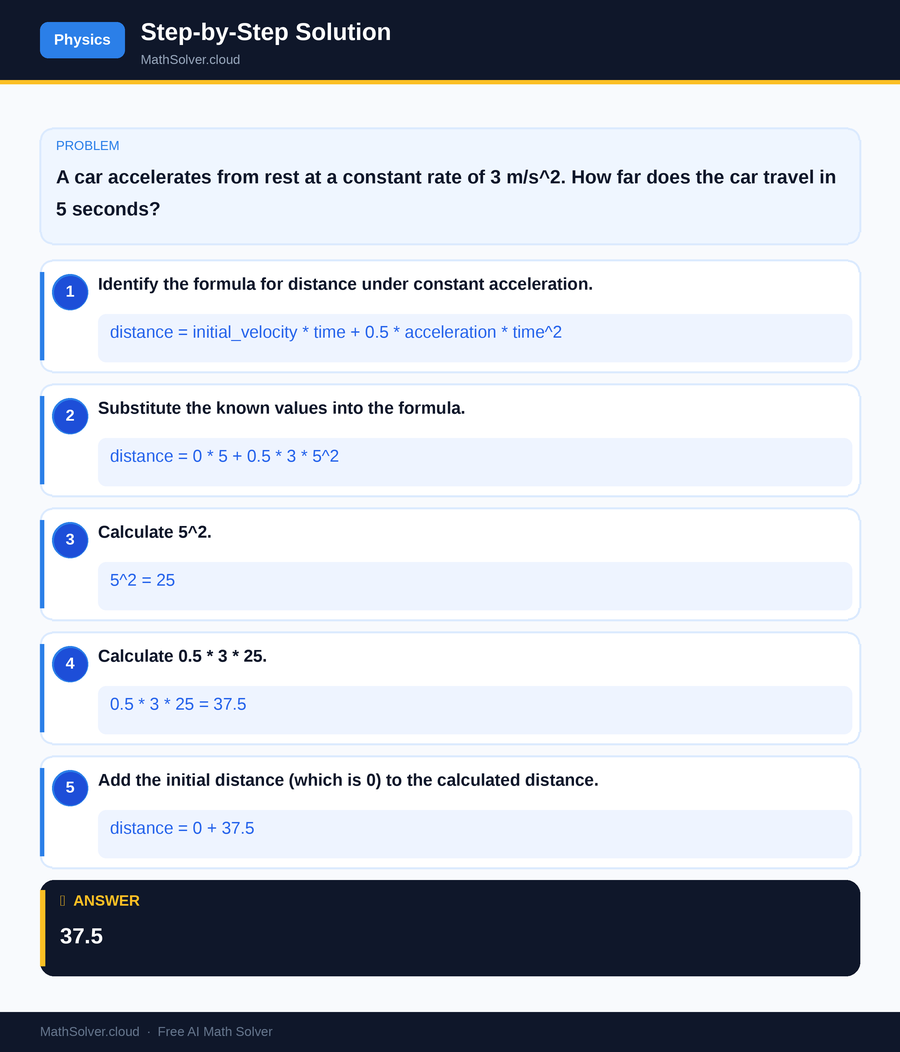
MathSolver Chrome extension solving this problem step-by-step
Example 2
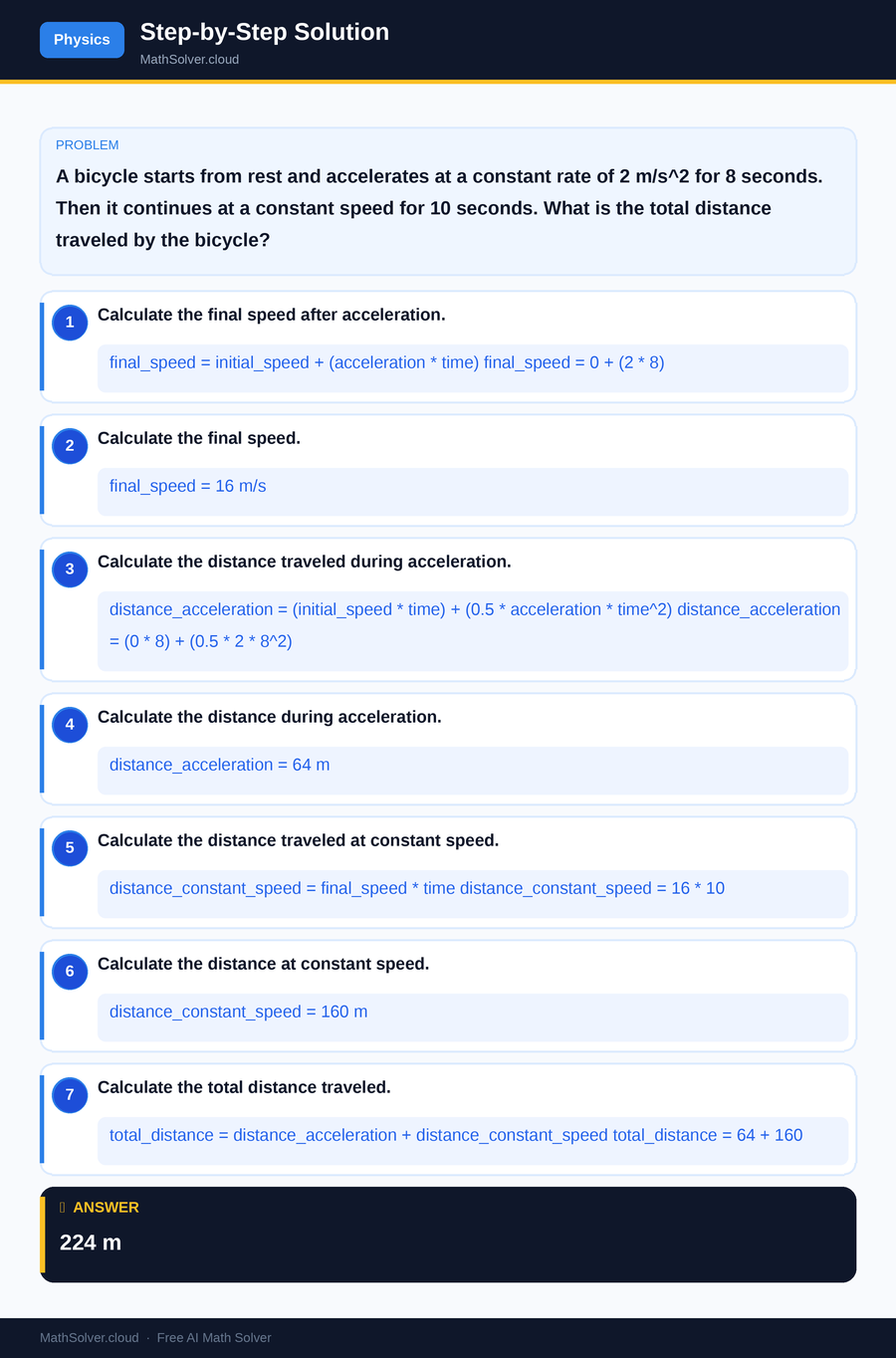
MathSolver Chrome extension solving this problem step-by-step
Common Mistakes to Avoid
One common mistake students make is neglecting to check the units of measurement. Always ensure that time, velocity, and acceleration are in compatible units before substituting them into the constant acceleration equations. Another frequent error is misidentifying the initial and final velocities, especially in multi-step problems. Carefully consider the context of each phase of motion.
Students sometimes apply the wrong equation, leading to incorrect solutions. To avoid this, always start by identifying the known variables and choose the equation that directly relates them to the unknowns. Double-check your selections and calculations to ensure accuracy.
Real-World Applications
Constant acceleration equations are not limited to classroom exercises. They are vital in the design of transportation systems, such as calculating the stopping distance of vehicles or the launch trajectory of rockets. Engineers use these equations to simulate and optimize performance and safety.
In sports, constant acceleration equations help analyze the performance of athletes, such as sprinters or cyclists, by evaluating their acceleration and speed. These equations provide insights that can enhance training strategies and equipment design.
Frequently Asked Questions
❓ What are constant acceleration equations used for?
❓ Why do students find constant acceleration equations difficult?
❓ How can AI help with constant acceleration equations?
❓ What is the difference between constant acceleration and variable acceleration?
❓ How are constant acceleration equations used in engineering?
🚀 Solve any math problem instantly
2,000+ students use MathSolver every day — join them for free
📥 Add to Chrome — It's Free