Understanding Circle Equations
📋 In this guide
The circle equation is a fundamental concept in geometry, often introducing students to the realm of analytical geometry and its applications. Students frequently find circle equations challenging due to their abstract nature and the necessity of incorporating both algebraic and geometric principles. In this article, you'll learn about the circle equation, how to derive it, and how to solve problems involving circle equations effectively.
Circle equations can initially seem complex because they require an understanding of how algebra and geometry intersect. Students may struggle with visualizing how the algebraic representation of a circle translates into a geometric shape on a coordinate plane. This article aims to demystify the circle equation by breaking it down into manageable steps and providing examples to illustrate each concept clearly.
By the end of this guide, you'll be familiar with the standard form of a circle equation, know how to derive it from given information, and understand common pitfalls to avoid. Additionally, we'll explore how circle equations apply in real-world scenarios and answer some frequently asked questions to solidify your understanding.
Step-by-Step: How to Solve Circle Equation
Step 1: Identifying the Circle's Center and Radius
The first step in working with a circle equation is to identify the circle's center and radius. These components are crucial for formulating the equation. In a standard equation like (x - h)^2 + (y - k)^2 = r^2, (h, k) represents the center of the circle. If you have a circle's center and a point on the circle, you can calculate the radius using the distance formula: sqrt((x2 - x1)^2 + (y2 - y1)^2).
Step 2: Rearrange the Equation
Once you have the circle’s center and radius, rearrange the equation to fit the standard form. This step involves substituting the values of h, k, and r into the formula. By doing so, you create an equation that represents the circle on the coordinate plane accurately.
Step 3: Solving for Unknowns
If the problem involves finding unknowns, such as determining the circle's radius when given its equation, isolate the variable of interest. For instance, if you have (x - 3)^2 + (y + 2)^2 = 16 and need to find the radius, realize that r^2 = 16, which implies r = sqrt(16) = 4.
Step 4: Verifying Your Solution
After solving the equation, it's important to verify your work. Check that the calculated radius and center make sense within the context of the problem. If possible, graph the circle to ensure the equation accurately represents the circle's geometry. This verification step helps catch any arithmetic errors or misinterpretations of the problem.
🤖 Stuck on a math problem?
Take a screenshot and let our AI solve it step-by-step in seconds
⚡ Try MathSolver Free →Worked Examples
Example 1

MathSolver Chrome extension solving this problem step-by-step
Example 2
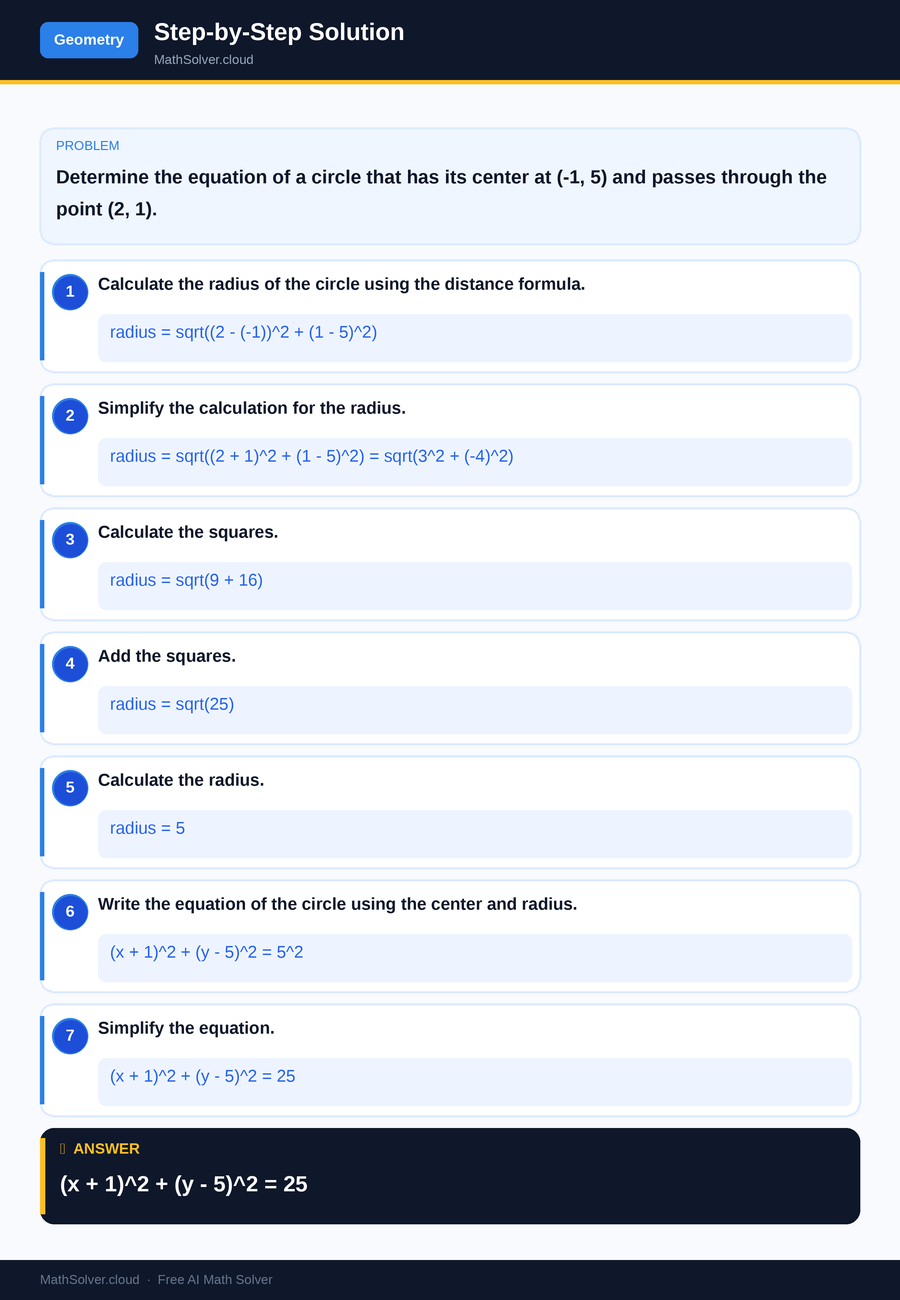
MathSolver Chrome extension solving this problem step-by-step
Common Mistakes to Avoid
One common mistake is confusing the coordinates of the center with generic points on the circle. Always remember that (h, k) represents the center, not a point on the circle. Another frequent error is incorrect application of the distance formula, especially when calculating the radius. Double-check your arithmetic to ensure accuracy.
Students also tend to forget to square the radius when substituting it into the circle equation formula. Make sure to square the radius to get r^2 on the right side of the equation. This small oversight can lead to incorrect calculations and results.
Real-World Applications
Circle equations find numerous applications in the real world. For example, engineers use them in designing circular components like gears and wheels. In architecture, circle equations help in planning structures that include circular elements, such as domes and arches.
In the field of computer graphics, circle equations are crucial for rendering circular shapes and animations. Video game developers, for instance, use these equations for creating elements like the "geometry dash wave," ensuring smooth and visually accurate designs.
Frequently Asked Questions
❓ What is the circle equation used for?
❓ Why do students struggle with circle equations?
❓ How can AI help with circle equations?
❓ What is the difference between the area of a circle equation and the circumference of a circle equation?
❓ How do you verify a circle equation on a graph?
🚀 Solve any math problem instantly
2,000+ students use MathSolver every day — join them for free
📥 Add to Chrome — It's Free