Understanding the Centripetal Force Equation
📋 In this guide
The centripetal force equation is a fundamental concept in physics that describes the force required to keep an object moving in a circular path. Many students find this equation challenging because it involves understanding multiple variables, such as mass, velocity, and radius, and how they interact within a circular motion context. In this article, we will demystify the centripetal force equation, providing a clear understanding of its components and practical applications. By the end, you'll be equipped with the knowledge to tackle related problems confidently.
Students often struggle with the centripetal force equation due to its abstract nature and the need to visualize circular motion. Unlike linear motion, which is straightforward and intuitive, circular motion requires comprehension of how forces act perpendicular to the motion's direction. This complexity can make it difficult for learners to grasp the principles behind the equation and apply them accurately in problem-solving scenarios.
In this guide, we will break down the centripetal force equation into manageable steps, providing a step-by-step approach to solving problems. We'll also explore common mistakes students make when dealing with this equation and offer practical tips to avoid them. Additionally, we'll delve into real-world applications of the centripetal force equation and answer frequently asked questions to enhance your understanding. Let's dive into the world of circular motion and discover how the centripetal force equation plays a vital role in it.
Step-by-Step: How to Solve Centripetal Force Equation
Step 1: Understanding the Components
The first step in mastering the centripetal force equation is to understand its components. The mass (m) represents the amount of matter in the object, which influences the gravitational pull and inertia. Velocity (v) is the speed of the object in a specified direction, and its square indicates how changes in speed affect the force. The radius (r) of the circular path is the distance from the center of the circle to the object. Grasping these components is crucial because they determine the overall force needed to maintain circular motion.
Step 2: Analyzing the Equation's Proportionality
Analyzing how each component affects the centripetal force is key to applying the equation effectively. Since the force is directly proportional to the square of the velocity, even small changes in speed can significantly impact the force required. Conversely, the inverse relationship with the radius means that a larger circle requires less force to maintain the same speed. Understanding these relationships helps in predicting how changes in one variable affect the overall motion, which is essential for solving complex problems.
Step 3: Setting Up the Problem
Before solving any problem involving the centripetal force equation, you must identify and organize the known variables. Start by listing the values given in the problem, such as mass, velocity, and radius. Ensure that all units are consistent; typically, mass should be in kilograms, velocity in meters per second, and radius in meters. This step is crucial because incorrect units can lead to errors in calculation. Organizing your data will streamline the problem-solving process and prevent confusion.
Step 4: Solving the Equation
With all variables clearly defined and organized, you can now solve the equation. Substitute the known values into the centripetal force equation: F = m*v^2/r. Carefully perform the calculations, paying attention to the order of operations and ensuring accuracy. Once you have calculated the force, double-check your work for any errors or inconsistencies. Solving the equation step-by-step ensures that you understand each component's role and helps reinforce your grasp of the concept.
🤖 Stuck on a math problem?
Take a screenshot and let our AI solve it step-by-step in seconds
⚡ Try MathSolver Free →Worked Examples
Example 1
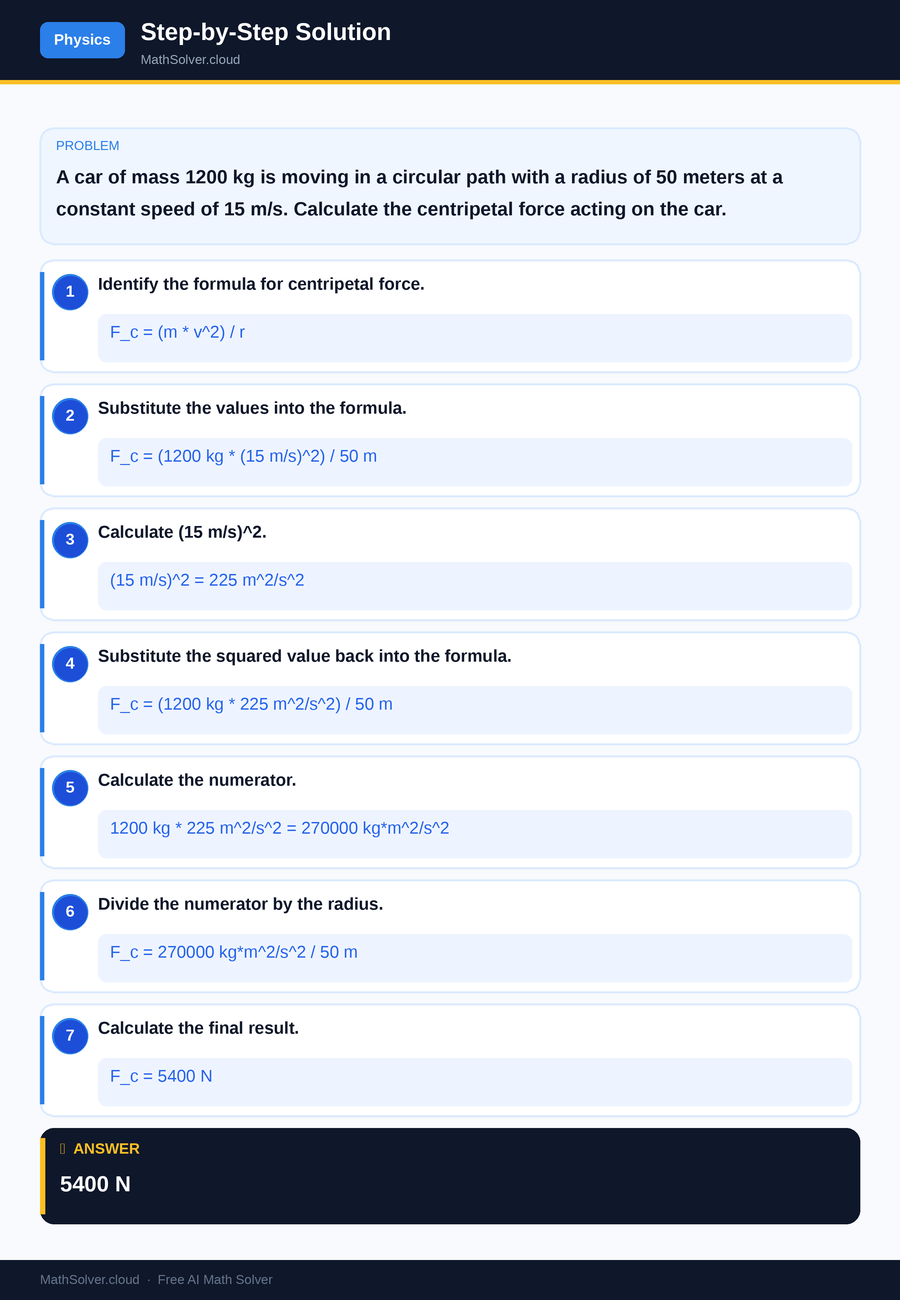
MathSolver Chrome extension solving this problem step-by-step
Example 2
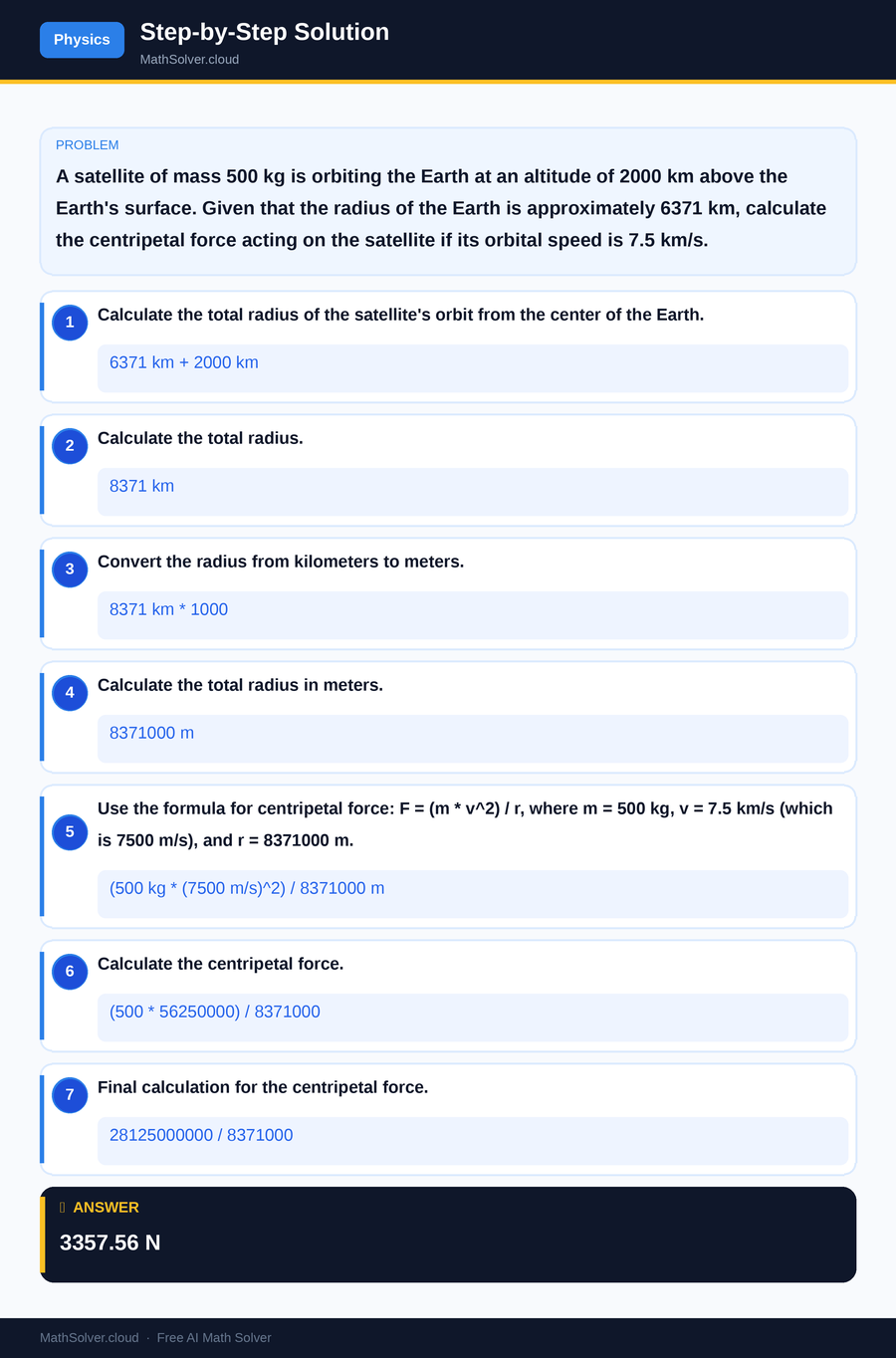
MathSolver Chrome extension solving this problem step-by-step
Common Mistakes to Avoid
One common mistake students make is neglecting to convert units, especially when dealing with distances in kilometers and speeds in kilometers per second. It's crucial to ensure all units are consistent with the SI system for accurate calculations. Another frequent error is misapplying the formula by forgetting to square the velocity. Since the force is proportional to the velocity squared, omitting this step can lead to significant discrepancies in results.
Students also tend to confuse centripetal force with centrifugal force. While centripetal force acts towards the center of the circular path, centrifugal force is the apparent force that seems to push objects outward. Understanding the distinction between these forces is important to avoid conceptual errors and apply the centripetal force equation correctly.
Real-World Applications
The centripetal force equation has numerous real-world applications. One notable example is in designing roller coasters. Engineers use the equation to calculate the necessary forces to ensure the safety and functionality of the ride, ensuring that the cars remain securely on the track during loops and turns.
Another application is in the automotive industry. The equation helps in understanding the dynamics of vehicles taking sharp turns at high speeds. By calculating the centripetal force, designers can optimize tire grip and suspension systems to enhance performance and safety. These practical applications demonstrate the crucial role of the centripetal force equation in various fields, from entertainment to transportation.
Frequently Asked Questions
❓ What is the centripetal force equation used for?
❓ Why is the centripetal force equation challenging for students?
❓ How can AI help with the centripetal force equation?
❓ What is the difference between centripetal and centrifugal force?
❓ How can the centripetal force equation be applied in sports?
🚀 Solve any math problem instantly
2,000+ students use MathSolver every day — join them for free
📥 Add to Chrome — It's Free