Mastering the Buoyant Force Equation
📋 In this guide
The buoyant force equation is a fundamental concept in physics, describing the upward force exerted on an object submerged in a fluid. This topic often presents challenges to students because it requires an understanding of fluid dynamics and the relationship between pressure and volume. In this article, you will delve into the intricacies of the buoyant force equation, learning how to apply it in various contexts and how to solve problems effectively.
Students frequently struggle with the buoyant force equation because it combines theoretical concepts with practical applications. It involves both algebra equations and physics principles, requiring students to think critically about how different forces interact with an object in a fluid. This article aims to simplify these concepts, providing a clear pathway for understanding and applying the buoyant force equation in problem-solving.
By the end of this article, you will have a comprehensive understanding of the buoyant force equation, its derivation, and its application in real-world scenarios. You will also explore common pitfalls and discover strategies to avoid them, ensuring that you can confidently tackle related physics problems. Additionally, you will see how tools like the MathSolver Chrome extension can provide instant solutions and aid in your learning process.
Step-by-Step: How to Solve Buoyant Force Equation
Step 1: Understand the Concept of Buoyancy
Before diving into calculations, it's crucial to grasp the concept of buoyancy. Buoyancy is the phenomenon where an object experiences an upward force when submerged in a fluid. This force allows objects to float or sink, depending on their density relative to the fluid. Understanding buoyancy helps you visualize how and why the buoyant force equation works and what each component represents in a physical context.
Step 2: Identify the Key Variables
When using the buoyant force equation, start by identifying the key variables: the density of the fluid (rho), the volume of the displaced fluid (V), and the acceleration due to gravity (g). These variables are crucial in determining the buoyant force. For instance, if the density of the fluid is high, the buoyant force will be greater, which explains why objects float more easily in saltwater than in freshwater.
Step 3: Apply the Buoyant Force Equation
Once you have identified the variables, substitute them into the buoyant force equation: F_b = rho * V * g. This step involves straightforward algebra, but attention to units is vital. Ensure that the density is in kg/m^3, the volume in m^3, and gravity in m/s^2. Consistent units will ensure that the final buoyant force is calculated accurately in newtons (N).
Step 4: Interpret the Results
After calculating the buoyant force, interpret the results to understand what they mean for the object in question. Compare the buoyant force to the object's weight to determine if it will float or sink. If the buoyant force is greater than the weight, the object will float; if less, it will sink. This interpretation is essential in applying the buoyant force equation to real-world scenarios, such as designing ships or understanding the behavior of submerged objects.
🤖 Stuck on a math problem?
Take a screenshot and let our AI solve it step-by-step in seconds
⚡ Try MathSolver Free →Worked Examples
Example 1
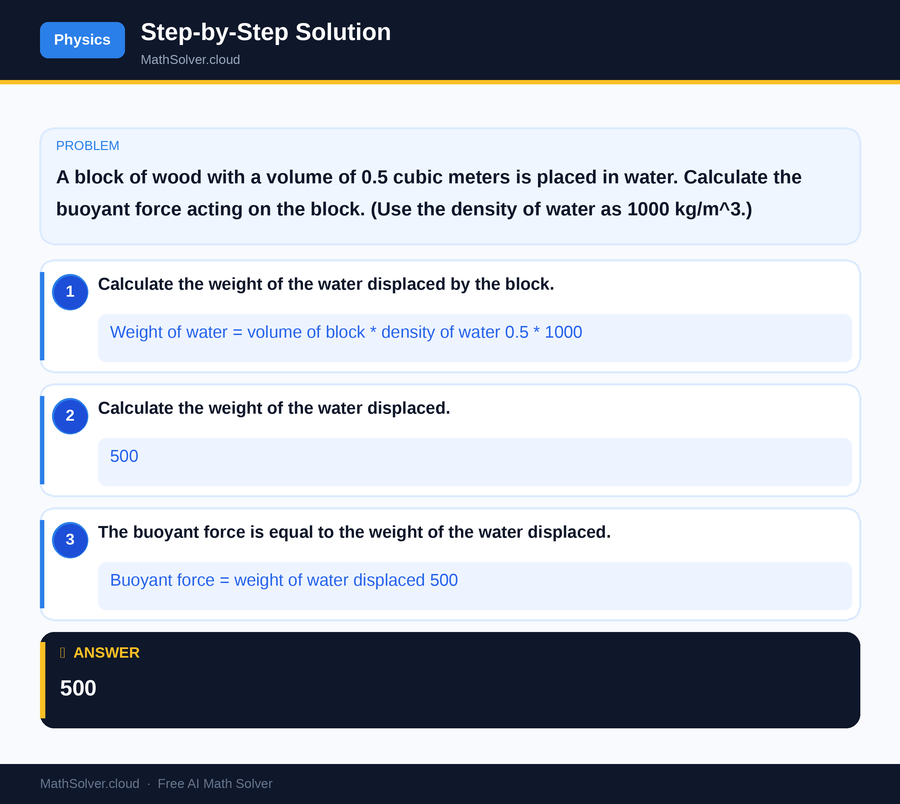
MathSolver Chrome extension solving this problem step-by-step
Example 2

MathSolver Chrome extension solving this problem step-by-step
Common Mistakes to Avoid
One common mistake students make is confusing the density of the object with the density of the fluid. It's essential to remember that the buoyant force equation requires the density of the fluid, not the object. Using the wrong density can lead to incorrect calculations and conclusions about whether an object will float or sink.
Another frequent error is neglecting the units when calculating the buoyant force. Consistency in units is vital; mixing units can result in erroneous answers. Always double-check that density is in kg/m^3, volume in m^3, and gravitational acceleration in m/s^2 to ensure accurate results.
Real-World Applications
The buoyant force equation is crucial in understanding and designing ships and submarines. Engineers use this principle to ensure that vessels have the appropriate buoyancy to float on water and maintain stability even in rough conditions. This equation also plays a role in designing hot air balloons, where the buoyant force must counteract the weight of the balloon for it to rise.
In the medical field, the buoyant force equation helps in the design of flotation devices used in hydrotherapy. These devices aid patients with mobility issues, allowing them to perform exercises in water with reduced weight and stress on their joints. Such real-world applications demonstrate the versatility and importance of mastering the buoyant force equation.
Frequently Asked Questions
❓ What is the buoyant force equation and how is it used?
❓ How does the buoyant force equation relate to other physics equations?
❓ How can AI help with the buoyant force equation?
❓ How do you differentiate between the buoyant force equation and other math formulas?
❓ Is the buoyant force equation included in the AP Physics equation sheet?
🚀 Solve any math problem instantly
2,000+ students use MathSolver every day — join them for free
📥 Add to Chrome — It's Free