Comprehensive Guide to the Average Velocity Equation
📋 In this guide
The average velocity equation is a fundamental concept in physics and mathematics that describes how to determine the average speed of an object over a certain period of time. Students often find the average velocity equation challenging because it requires a solid understanding of both mathematical principles and the real-world scenarios to which these principles apply. This article will provide a comprehensive guide to mastering the average velocity equation. By the end, you'll understand how to apply this equation in various contexts, overcome common pitfalls, and see its relevance in everyday life.
The average velocity equation is crucial because it helps bridge the gap between abstract mathematical concepts and tangible physical phenomena. Students often struggle with this equation because it involves grasping the idea of motion over time, which can be tricky if one is not comfortable with algebraic manipulation and the interpretation of units. Additionally, the equation is an integral part of more advanced topics in physics and calculus, making it essential for students pursuing these fields to master it early on.
In this article, we will break down the average velocity equation into manageable steps, providing clear explanations and examples to help you understand its practical applications. We'll also cover common mistakes to avoid and explore real-world scenarios where the average velocity equation is used. With this knowledge, you'll be better prepared to tackle related topics, such as the angular velocity equation and other math formulas that appear on the AP Physics equation sheet.
Step-by-Step: How to Solve Average Velocity Equation
Step 1: Understanding Displacement
Before we dive into the average velocity equation, it's important to understand what displacement means. Displacement is the difference between the final position and the initial position of an object. It is a vector quantity, which means it has both magnitude and direction. In the context of the average velocity equation, displacement helps us understand how far an object has moved in a straight line, regardless of the actual path taken.
Step 2: Measuring Time
Time is a crucial component of the average velocity equation. To calculate average velocity, you need to know the total time over which the motion occurred. This is typically measured in seconds, minutes, hours, or other relevant units, depending on the context of the problem. Make sure to use consistent units of time when applying the average velocity equation to avoid errors in your calculations.
Step 3: Applying the Average Velocity Equation
Once you have the displacement and the time, you can apply the average velocity equation: V_avg = Δx / Δt. It’s important to pay attention to the units of both displacement and time to ensure that the resulting average velocity is expressed in the correct units, such as meters per second (m/s) or kilometers per hour (km/h). This step involves simple division but requires careful consideration of units and signs, especially when dealing with vector quantities.
Step 4: Interpreting the Result
After calculating the average velocity, it's crucial to interpret the result correctly. The sign of the average velocity indicates the direction of motion, while the magnitude tells you how fast the object is moving on average. Understanding this will help you contextualize the motion of the object within a real-world scenario. Remember, average velocity is not the same as average speed, as the former takes direction into account while the latter does not.
🤖 Stuck on a math problem?
Take a screenshot and let our AI solve it step-by-step in seconds
⚡ Try MathSolver Free →Worked Examples
Example 1
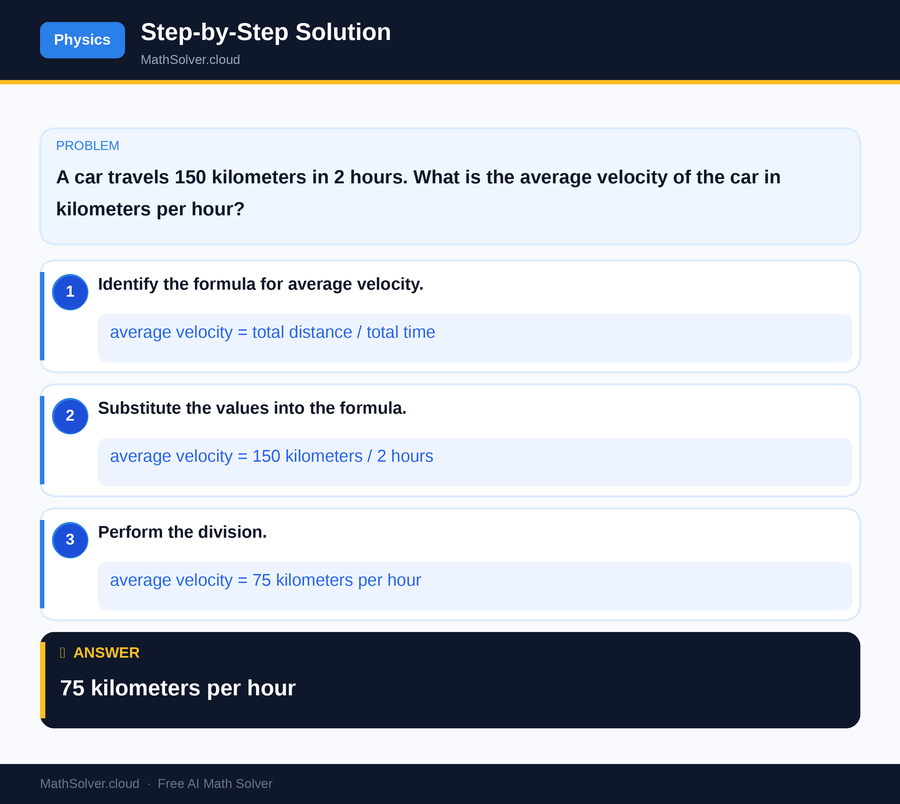
MathSolver Chrome extension solving this problem step-by-step
Example 2
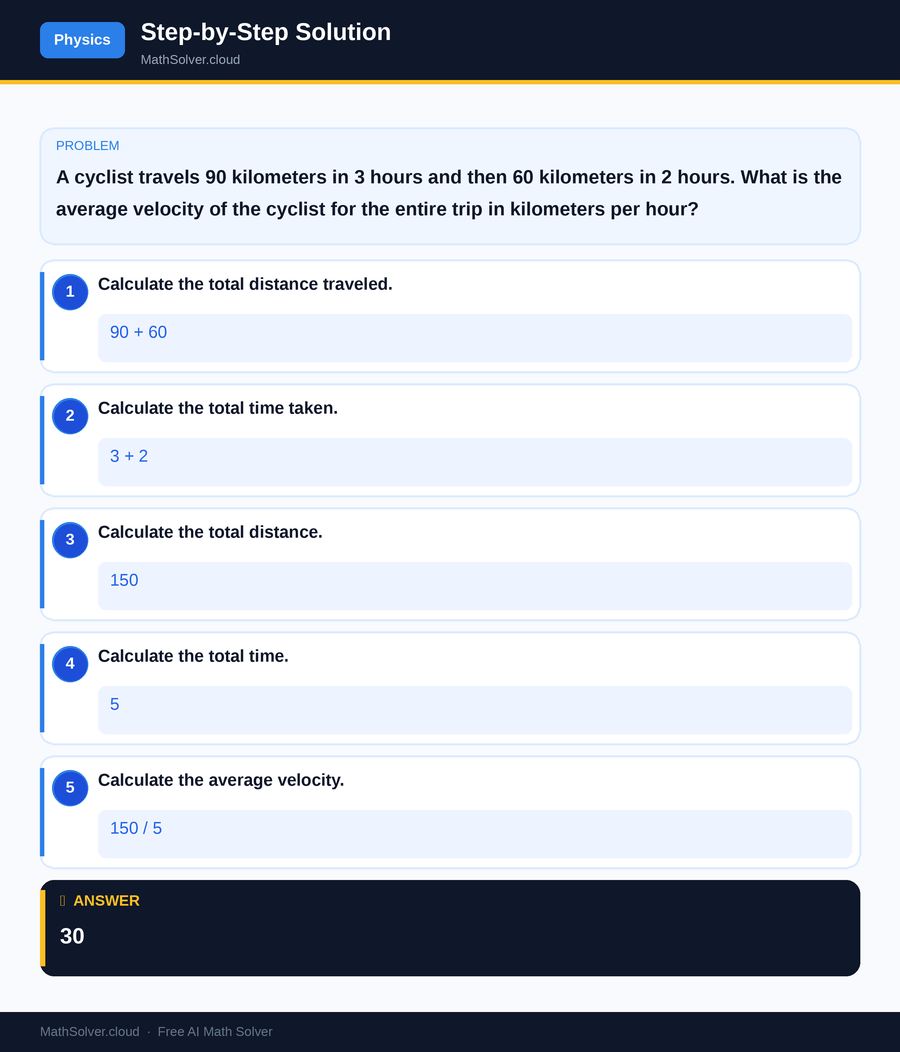
MathSolver Chrome extension solving this problem step-by-step
Common Mistakes to Avoid
One common mistake students make is confusing average velocity with average speed. While average speed is the total distance traveled divided by the total time, average velocity considers the displacement, which is the net change in position. This distinction is crucial, especially in problems involving direction and vector quantities.
Another error is neglecting to use consistent units when calculating average velocity. Mixing units, such as kilometers with meters or hours with seconds, can lead to incorrect results. Always ensure that your displacement and time are in compatible units before applying the average velocity equation.
Real-World Applications
The average velocity equation is widely used in fields such as transportation, where understanding the average speed of vehicles is crucial for planning and logistics. For example, logistics companies use it to estimate delivery times, while urban planners use it to design efficient traffic systems.
In sports, the average velocity equation helps athletes and coaches analyze performance. For instance, a long-distance runner might use it to evaluate their pace over a race, adjusting their strategy to improve performance. These applications highlight the practical importance of mastering the average velocity equation.
Frequently Asked Questions
❓ What is the average velocity equation used for?
❓ Why is understanding average velocity important in physics?
❓ How can AI help with the average velocity equation?
❓ How is the average velocity equation different from the angular velocity equation?
❓ Can the average velocity equation be used in non-physical contexts?
🚀 Solve any math problem instantly
2,000+ students use MathSolver every day — join them for free
📥 Add to Chrome — It's Free