Understanding the Angular Acceleration Equation
📋 In this guide
The angular acceleration equation is a fundamental concept in physics and engineering, describing how the angular velocity of an object changes over time. Unlike linear acceleration, which deals with the change in velocity in a straight line, angular acceleration focuses on rotational motion. This topic often poses challenges for students because it involves understanding rotational dynamics, which can be less intuitive compared to linear motion. In this article, we'll break down the complexities of the angular acceleration equation and equip you with the knowledge to tackle related problems with confidence.
Students often struggle with angular acceleration equations due to their abstract nature and the necessity to visualize rotational motion. Unlike algebra equations, which many students encounter early in their education, angular equations require a shift in thinking. They involve concepts like radians, torque, and moment of inertia, which are not as commonly encountered. By the end of this article, you'll have a solid understanding of these concepts and be ready to apply them in both academic and real-world scenarios.
Our journey will cover the core angular acceleration equation, provide step-by-step guidance for solving related problems, and explore how this equation applies in various real-life contexts. Whether you're preparing for an exam, tackling homework, or simply curious about rotational dynamics, this guide is designed to clarify and demystify the topic.
Step-by-Step: How to Solve Angular Acceleration Equation
Step 1: Understanding the Basic Variables
To effectively use the angular acceleration equation, it's crucial to understand its components. Angular velocity, represented by the Greek letter omega, is a measure of how fast an object rotates or revolves relative to another point. The initial angular velocity (omega_i) is the speed at the start of the observation period, while the final angular velocity (omega_f) is the speed at the end. Time (t) is the duration over which the change in velocity occurs. Familiarity with these variables is essential for solving any problem involving the angular acceleration equation.
Step 2: Identifying the Type of Motion
Before applying the formula, determine whether the motion involves constant angular acceleration. If the acceleration is constant, you can use the primary angular acceleration equation directly. In cases where the acceleration is not constant, you may need to use more complex kinematic equations. Always start by identifying the nature of the motion, as this will guide your approach and the equations you choose to apply.
Step 3: Applying the Angular Acceleration Equation
Once you've identified the type of motion, apply the angular acceleration equation by substituting the known values for omega_f, omega_i, and t. Rearrange the equation if necessary to solve for the unknown variable. Ensure that your units are consistent; angular velocity is typically measured in radians per second, and time in seconds. This step requires careful attention to detail to avoid calculation errors.
Step 4: Analyzing the Results
After calculating angular acceleration, interpret the results in the context of the problem. Consider whether the calculated acceleration is reasonable based on the given conditions. If the problem involves additional calculations, such as finding the angular displacement, use other relevant kinematic equations. Your goal is to not only arrive at the correct numerical answer but also to understand its significance in the scenario being analyzed.
🤖 Stuck on a math problem?
Take a screenshot and let our AI solve it step-by-step in seconds
⚡ Try MathSolver Free →Worked Examples
Example 1
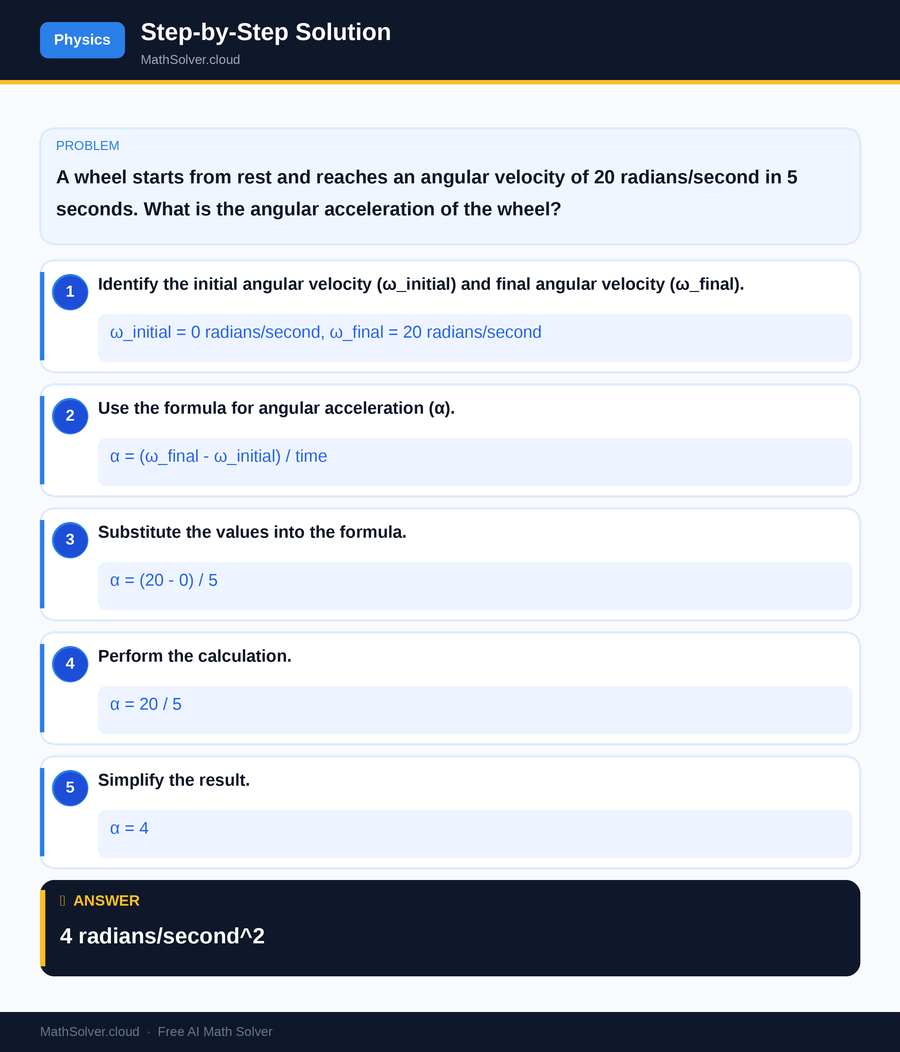
MathSolver Chrome extension solving this problem step-by-step
Example 2
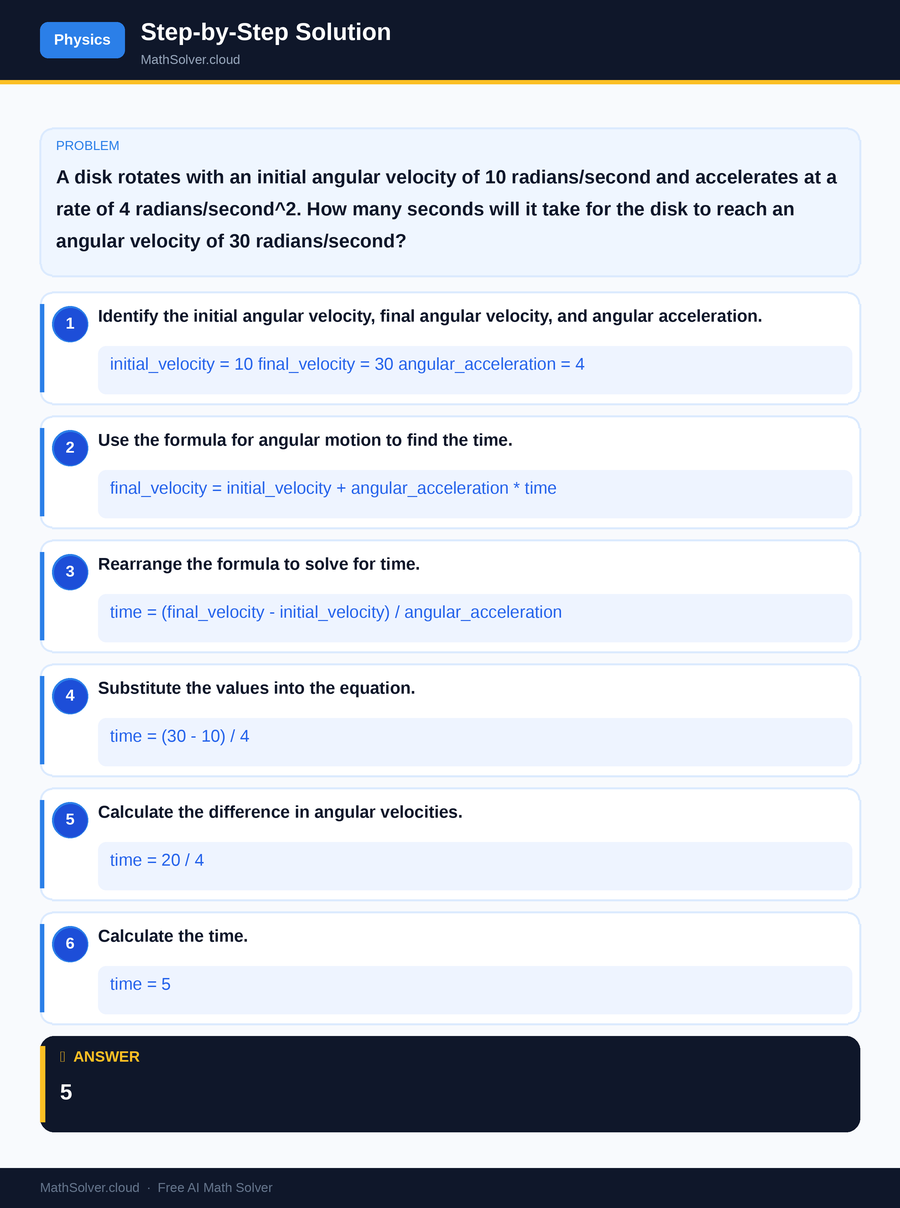
MathSolver Chrome extension solving this problem step-by-step
Common Mistakes to Avoid
A common mistake students make when using the angular acceleration equation is neglecting to convert units consistently. Always ensure that angular velocities are in radians per second and time in seconds before performing calculations. Another frequent error is misidentifying initial and final velocities, especially when the object starts from rest or when the final velocity is zero. Careful reading of the problem and understanding the context can help prevent these errors.
Another pitfall is failing to recognize when acceleration is not constant. In such cases, using the constant angular acceleration equation can lead to incorrect results. Instead, students should turn to more comprehensive kinematic equations or calculus-based approaches when dealing with non-constant accelerations. Always verify the nature of the motion before selecting the appropriate equation to use.
Real-World Applications
The angular acceleration equation is widely used in various real-world applications. One example is in the design of automotive engines, where engineers must understand the rotational dynamics of engine components to optimize performance and efficiency. The equation helps in calculating the necessary torque to achieve desired acceleration rates.
In the field of robotics, angular acceleration equations are crucial for programming the movement of robotic arms. Precise calculations ensure that the arms move smoothly and efficiently, avoiding abrupt motions that could lead to mechanical stress or damage. Understanding these equations is also essential in designing control systems for drones and other autonomous vehicles, where precise rotational control is vital for stability and navigation.
Frequently Asked Questions
❓ What is the angular acceleration equation, and how is it used?
❓ Why do students often struggle with angular acceleration equations?
❓ How can AI help with angular acceleration equation problems?
❓ What is the difference between angular velocity and angular acceleration?
❓ How is the angular acceleration equation relevant in engineering?
🚀 Solve any math problem instantly
2,000+ students use MathSolver every day — join them for free
📥 Add to Chrome — It's Free