Mastering the Acceleration Equation
📋 In this guide
The acceleration equation is a cornerstone of physics, representing the rate at which an object's velocity changes over time. Students often find this concept challenging because it involves understanding both the mathematical and conceptual aspects of motion. Grasping the acceleration equation is crucial for solving various physics problems, especially those related to motion dynamics. In this article, you will learn how to master the acceleration equation, explore its different forms, and apply it in real-world scenarios.
Understanding the acceleration equation is key to unraveling more complex physics topics, such as angular motion and projectile dynamics. Many students struggle with this equation because it requires a solid grasp of algebra and an ability to interpret physical situations mathematically. However, with guided practice and a step-by-step approach, you'll find that this equation becomes a useful tool for solving problems related to speed and velocity changes.
By the end of this article, you'll not only understand the basic acceleration equation but also gain insights into related concepts like constant acceleration equations and the angular acceleration equation. We'll provide you with clear definitions, step-by-step instructions, and examples to help you see how this fundamental equation is applied in various contexts. So, let's dive in and make sense of the acceleration equation together.
Step-by-Step: How to Solve Acceleration Equation
Step 1: Understanding the Concept of Velocity and Time
Before diving into the acceleration equation, it's essential to understand what velocity and time represent. Velocity is the speed of an object in a specified direction, a vector quantity that can change over time. Time, in this context, refers to the duration over which the change in velocity occurs. By grasping these concepts, you can better appreciate how acceleration describes the rate of change in velocity.
Step 2: Identifying the Initial and Final Velocities
To use the acceleration equation effectively, you need to identify the initial velocity (v_i) and the final velocity (v_f) of the object in question. The initial velocity is the speed at which the object starts, while the final velocity is the speed at which it ends after a period. This distinction is crucial for calculating the change in velocity, which is essential for finding acceleration.
Step 3: Calculating the Change in Velocity
Once you've identified the initial and final velocities, the next step is to calculate the change in velocity. This is done by subtracting the initial velocity from the final velocity: delta v = v_f - v_i. This value represents how much the object's speed has increased or decreased over the given time period, which is necessary for determining acceleration.
Step 4: Using the Acceleration Equation
With the change in velocity and the time duration in hand, you can apply the acceleration equation: a = (v_f - v_i) / t. This step involves dividing the change in velocity by the time period to find the acceleration. The result will tell you how quickly the object's speed is changing, indicating whether it's accelerating or decelerating.
🤖 Stuck on a math problem?
Take a screenshot and let our AI solve it step-by-step in seconds
⚡ Try MathSolver Free →Worked Examples
Example 1
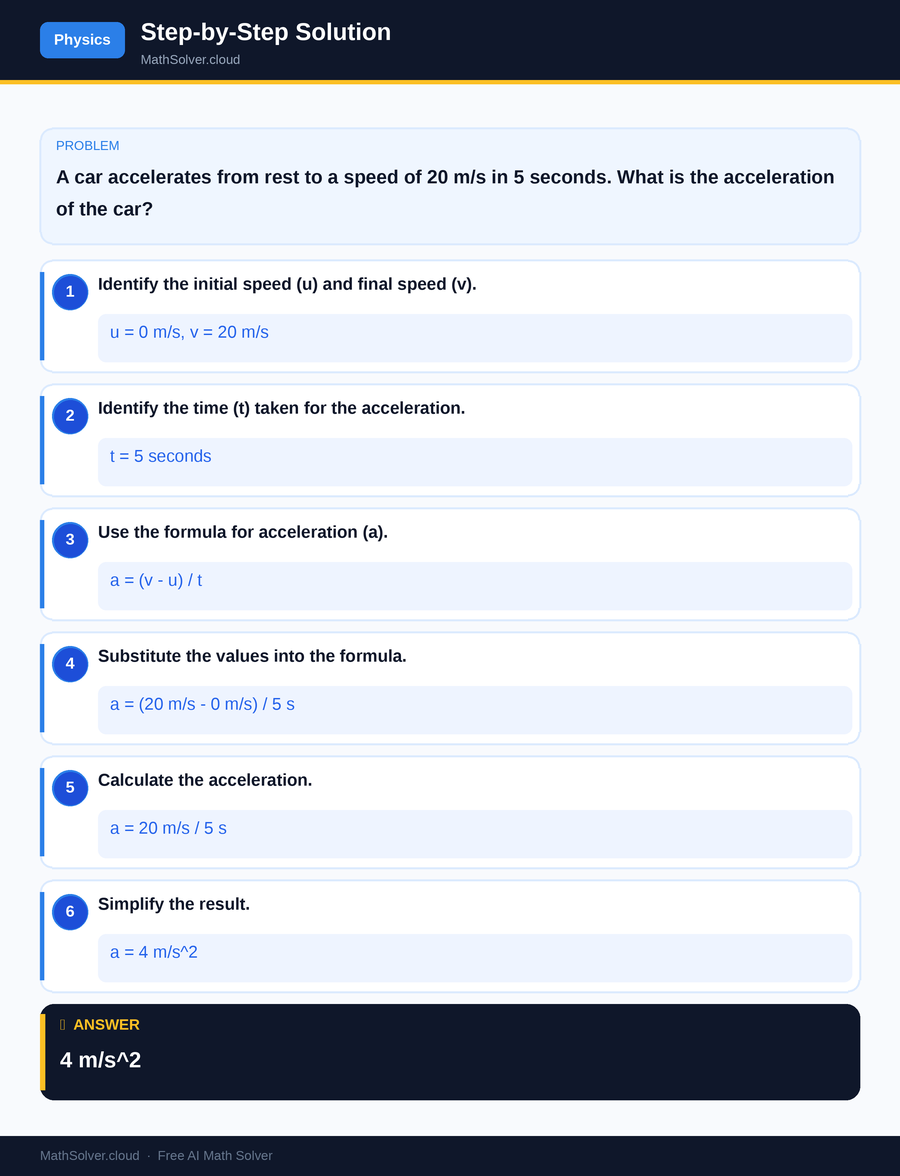
MathSolver Chrome extension solving this problem step-by-step
Example 2
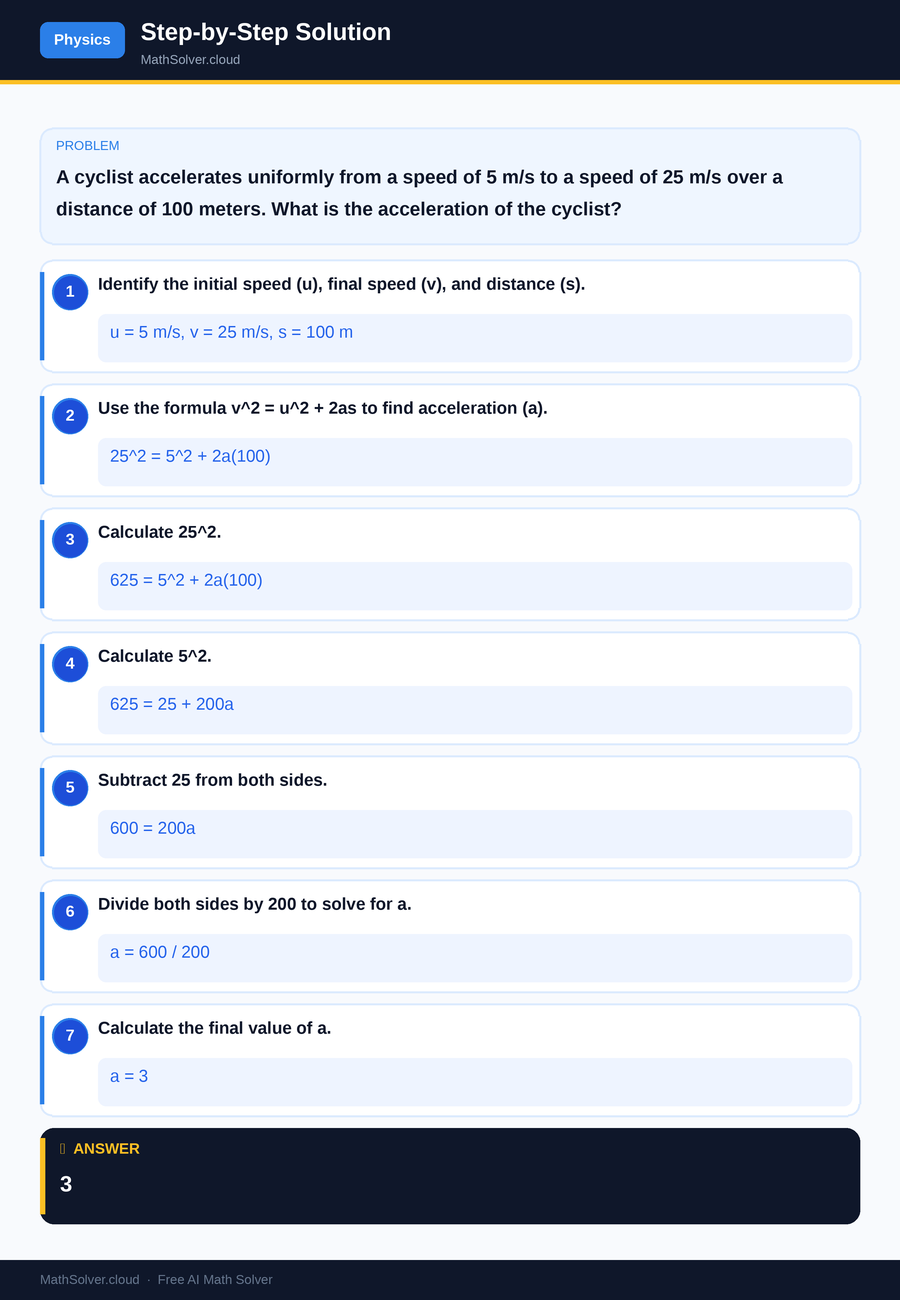
MathSolver Chrome extension solving this problem step-by-step
Common Mistakes to Avoid
One common mistake students make when using the acceleration equation is confusing velocity with speed. Remember, velocity is a vector quantity that includes direction, while speed is a scalar quantity. Mixing these up can lead to incorrect calculations. Always ensure you're working with velocities, especially when direction is relevant to the problem.
Another frequent error is misinterpreting the time period over which acceleration occurs. It's crucial to use the correct time interval for calculating acceleration. Double-check the problem statement to ensure you're using the appropriate start and end times. This attention to detail will help you avoid miscalculations and arrive at the right answer.
Real-World Applications
The acceleration equation is not just an academic exercise; it has numerous real-world applications. For example, engineers use it to design safety systems in vehicles, such as airbags and seatbelts, which rely on understanding how quickly a car can decelerate during a crash. By applying the acceleration equation, they can create systems that minimize injury.
In sports, coaches and athletes use the acceleration equation to enhance performance. Understanding how quickly a runner or cyclist can accelerate helps optimize training programs and improve race times. Whether on the track or in the lab, the acceleration equation plays a vital role in pushing the limits of human and machine capabilities.
Frequently Asked Questions
❓ What is the acceleration equation used for?
❓ Why do students find the acceleration equation challenging?
❓ How can AI help with the acceleration equation?
❓ What is the difference between angular acceleration and linear acceleration?
❓ How does the acceleration equation relate to other physics formulas?
🚀 Solve any math problem instantly
2,000+ students use MathSolver every day — join them for free
📥 Add to Chrome — It's Free