Mastering a Circle Equation
📋 In this guide
A circle equation is a mathematical expression that represents the set of all points in a plane that are equidistant from a given point known as the center. Many students find themselves puzzled by a circle equation, often due to its abstract nature and the multiple components involved. Understanding a circle equation is crucial as it forms the foundation for more advanced topics in geometry and calculus. In this article, we will break down the components of a circle equation, explore its key formula, and provide step-by-step guidance to mastering it. Through this journey, you will gain clarity on the concept, learn how to avoid common pitfalls, and discover its real-world applications.
Students often struggle with a circle equation because it involves multiple variables and requires spatial reasoning to understand how these components relate to one another. The terms "radius" and "center" might seem straightforward, but adding algebraic expressions into the mix can complicate matters. By the end of this article, you will not only be able to write and interpret a circle equation but also apply it to solve various geometry problems.
The goal of this article is to demystify a circle equation and provide you with the tools you need to approach it with confidence. Whether you're preparing for a test or just seeking to deepen your understanding of geometry, this comprehensive guide will equip you with the knowledge you need to succeed. So, let's dive in and explore the fascinating world of circles, equations, and geometry.
Step-by-Step: How to Solve A Circle Equation
Step 1: Identify the Circle's Center and Radius
The first step in working with a circle equation is to identify the circle's center and radius. The center is denoted by the coordinates (h, k), and the radius is the distance from the center to any point on the circle. These components are essential as they form the basis for writing the circle's equation. For example, if you're given a center at (2, 3) and a radius of 4, you can immediately write down these values for use in the formula.
Step 2: Substitute Values into the Standard Form
Once you have the center and radius, the next step is to substitute these values into the standard form of the circle equation: (x - h)^2 + (y - k)^2 = r^2. This substitution is straightforward; simply replace h and k with the coordinates of the center, and r with the radius. Continuing with our example, substituting the values gives (x - 2)^2 + (y - 3)^2 = 4^2.
Step 3: Simplify the Equation
After substituting the values, simplify the equation if necessary. In most cases, this involves expanding the squared terms and simplifying any constants. For instance, in the example (x - 2)^2 + (y - 3)^2 = 16, you can expand it to get x^2 - 4x + 4 + y^2 - 6y + 9 = 16, and then further simplify to x^2 + y^2 - 4x - 6y - 3 = 0 by combining like terms.
Step 4: Analyze and Interpret the Result
The final step is to interpret the resulting equation and ensure that it accurately represents the circle in question. Check that the center and radius match the original problem statement. This verification step is crucial to avoid errors and ensure the equation is correct. Additionally, understanding this equation allows you to calculate other properties, such as the area of a circle equation and the circumference of a circle equation.
🤖 Stuck on a math problem?
Take a screenshot and let our AI solve it step-by-step in seconds
⚡ Try MathSolver Free →Worked Examples
Example 1

MathSolver Chrome extension solving this problem step-by-step
Example 2
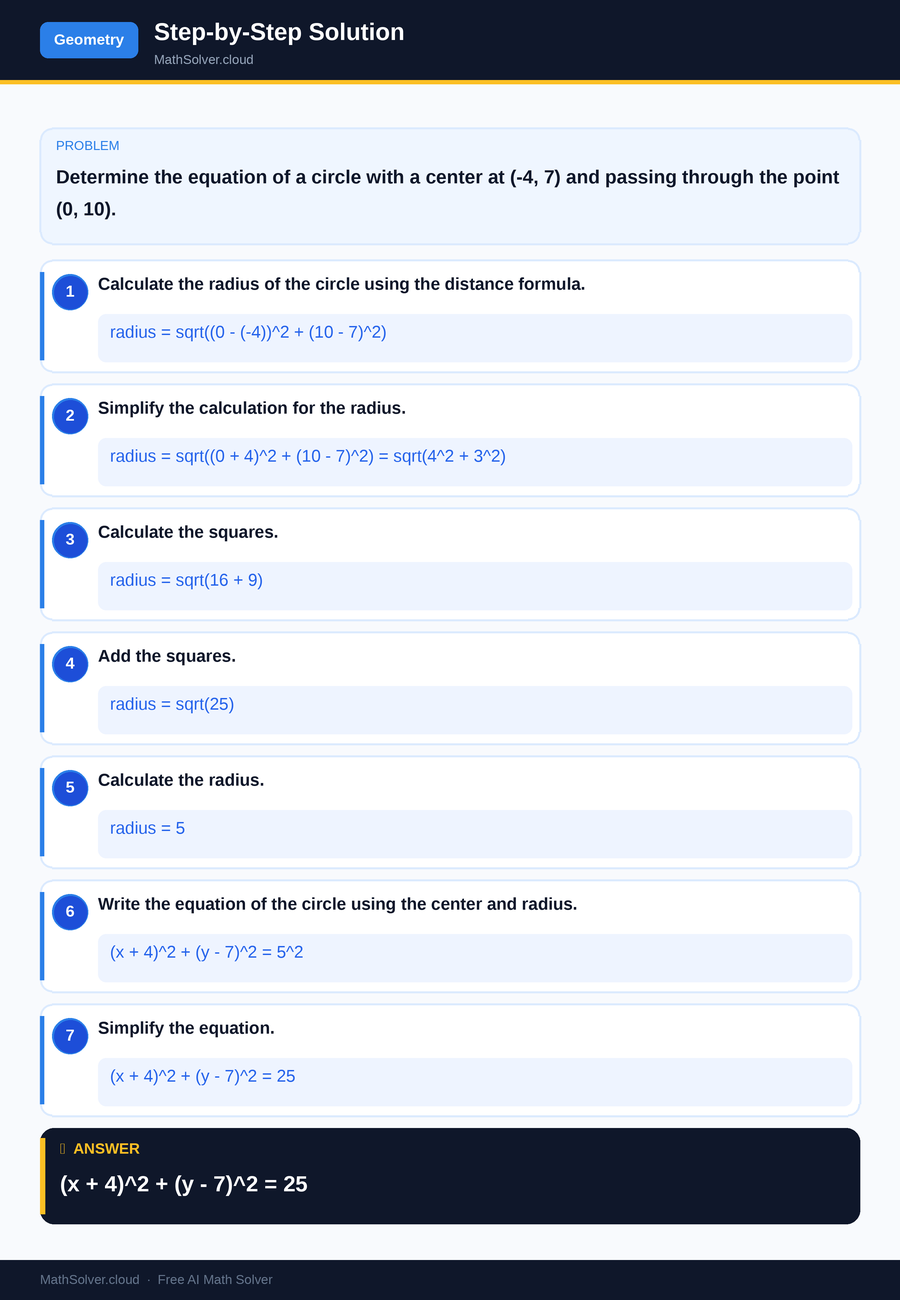
MathSolver Chrome extension solving this problem step-by-step
Common Mistakes to Avoid
One common mistake students make when working with a circle equation is incorrectly identifying the center and radius. It is crucial to remember that the center is always given as (h, k), and any errors in these values will lead to an incorrect equation. Carefully read the problem statement and double-check your values before proceeding.
Another frequent error is failing to simplify the equation properly. Students might forget to expand the squared terms or incorrectly combine like terms. Always take your time to expand and simplify the equation step by step, ensuring that each part is correctly calculated and combined.
Real-World Applications
A circle equation is not just a theoretical concept; it has numerous real-world applications. For instance, in engineering, circular equations are used to design wheels, gears, and other components that require precise circular shapes. This ensures they function correctly and fit together as intended.
Another practical application is in computer graphics, where circle equations help render circular objects in video games and simulations. The geometry of circles is foundational in creating realistic environments, as seen in games like Geometry Dash, where understanding waves and other shapes is critical for designing engaging levels. For a deeper dive into such geometry concepts, you can refer to our complete Geometry guide at MathSolver.cloud.
Frequently Asked Questions
❓ What is a circle equation?
❓ How do you find the radius in a circle equation?
❓ How can AI help with a circle equation?
❓ What is the area of a circle equation?
❓ How is the circumference of a circle equation used in real life?
🚀 Solve any math problem instantly
2,000+ students use MathSolver every day — join them for free
📥 Add to Chrome — It's Free