Comprehensive Guide to the va math calculator
📋 In this guide
The va math calculator is a crucial tool for students and professionals alike, offering a streamlined approach to solving various mathematical problems. Many students often struggle with math due to its abstract nature and the complexity of calculations involved. The va math calculator simplifies these processes, making it easier to understand and solve even the most challenging problems. In this guide, you'll learn how this calculator works, the key formulas it employs, and how to use it to your advantage.
Understanding the va math calculator is essential for anyone looking to navigate the world of mathematics with ease. This tool can tackle everything from basic arithmetic to more advanced calculations, such as those involving algebraic expressions and geometric figures. Whether you're a student trying to complete your homework or a professional needing quick computations, this calculator can be your go-to resource.
In this comprehensive article, we'll explore the various features of the va math calculator, provide step-by-step instructions on its use, and solve common problems to illustrate its capabilities. You'll also learn about common mistakes to avoid, real-world applications, and answers to frequently asked questions. By the end, you'll be equipped with the knowledge to use the va math calculator confidently and effectively.
Step-by-Step: How to Solve Va Math Calculator
Step 1: Understanding the Interface
Before diving into calculations, familiarize yourself with the va math calculator's interface. The display typically shows input and results clearly, with buttons labeled for numbers, operations, and functions. Make sure you know where to find the basic arithmetic operations (addition, subtraction, multiplication, and division) and any additional features like square roots or exponents. This understanding is crucial for efficient use of the calculator, as you'll be entering and interpreting data quickly.
Step 2: Inputting Basic Calculations
Start with simple calculations to get a feel for the calculator's functionality. To perform a basic operation, such as addition or multiplication, input the first number, select the desired operation, and then input the second number. Press the equals button to see the result. For example, to calculate 8 + 5, press 8, then the addition button, followed by 5, and finally the equals button. Practicing these fundamental operations will build a strong foundation for more complex calculations later on.
Step 3: Utilizing Advanced Functions
The va math calculator also includes functions for more advanced calculations, such as exponents and square roots. To calculate an exponent, input the base number, select the exponent function, and enter the exponent value. For square roots, simply press the square root button followed by the number you wish to find the root of. Understanding these advanced functions allows you to solve more complex problems, which is particularly useful for algebra and geometry.
Step 4: Checking Your Work
One of the most important steps in using the va math calculator is verifying your results. After performing a calculation, review the steps and the result to ensure accuracy. This is especially important for longer or more complex equations where errors are more likely to occur. If your result seems off, go back through the calculation process to identify and correct any mistakes. This habit not only ensures correct answers but also reinforces your understanding of the underlying mathematical concepts.
🤖 Stuck on a math problem?
Take a screenshot and let our AI solve it step-by-step in seconds
⚡ Try MathSolver Free →Worked Examples
Example 1
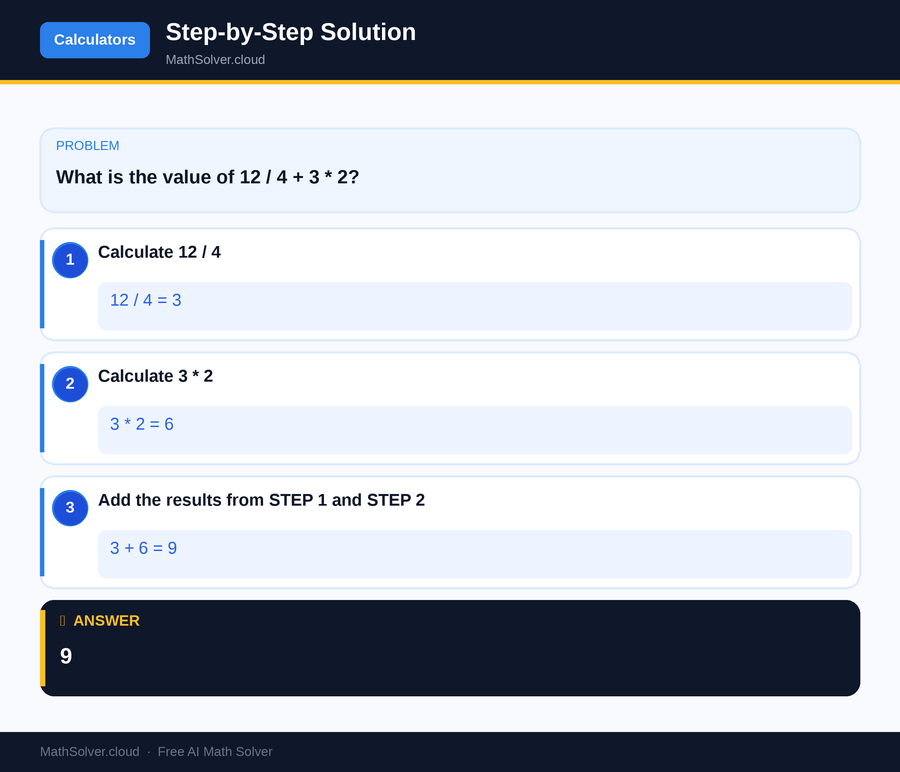
MathSolver Chrome extension solving this problem step-by-step
Example 2
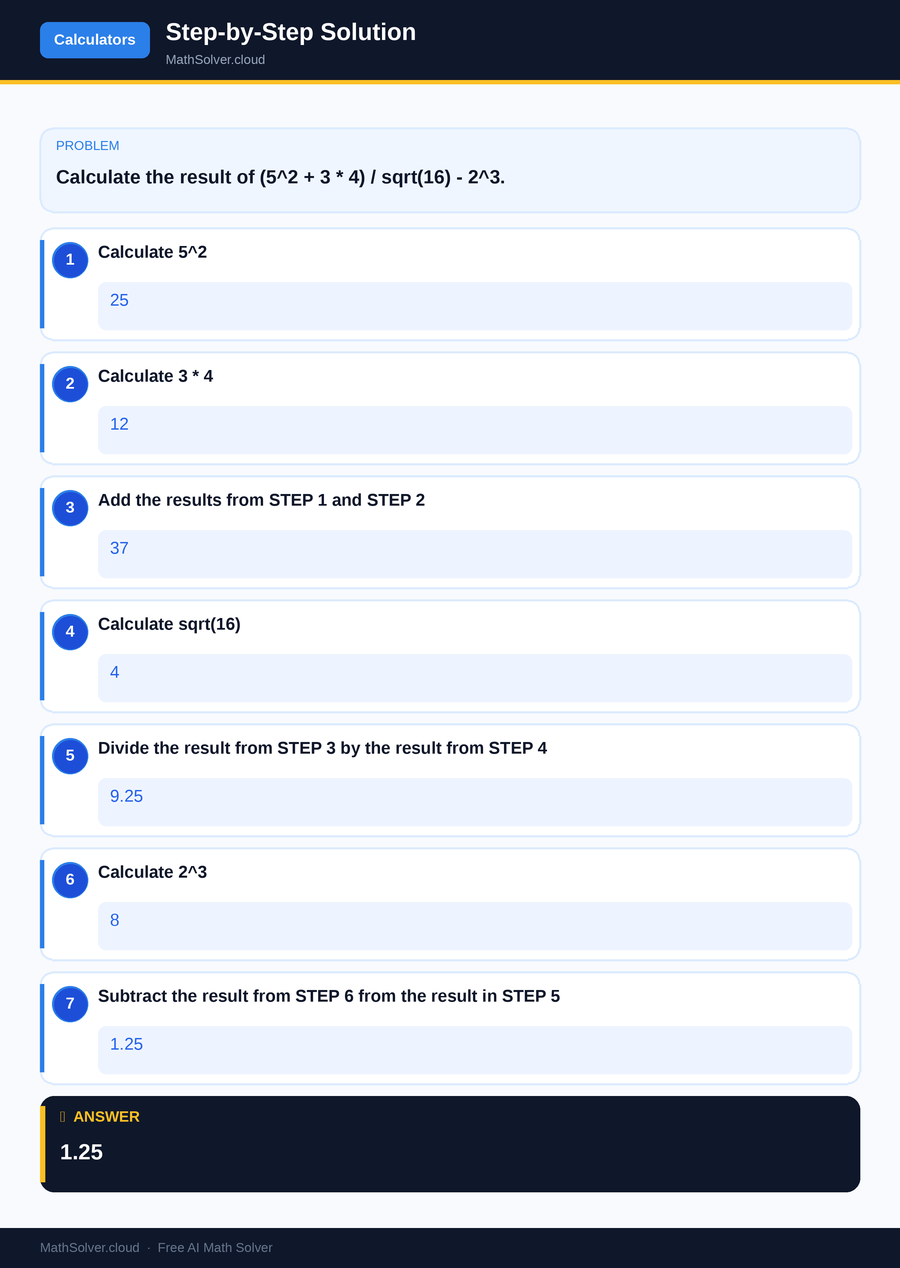
MathSolver Chrome extension solving this problem step-by-step
Common Mistakes to Avoid
One common mistake students make when using the va math calculator is neglecting the order of operations. It's crucial to remember PEMDAS and apply it consistently to avoid incorrect results. Another frequent error is miskeying inputs or operations, especially in longer calculations. Double-checking each step and reviewing your inputs before finalizing them can help prevent these types of errors.
Another pitfall is over-reliance on the calculator for basic arithmetic without understanding the underlying concepts. This can lead to difficulties when solving problems without the aid of a calculator. It's important to use the va math calculator as a tool to enhance your understanding, not as a crutch that replaces fundamental math skills.
Real-World Applications
The va math calculator is used in various real-world scenarios, making it indispensable in educational and professional settings. In the classroom, students use it to complete assignments and prepare for exams, gaining a deeper understanding of mathematical concepts. It helps demystify subjects like algebra and calculus, making them more accessible.
In professional environments, the va math calculator aids in fields such as engineering, finance, and data analysis. For instance, engineers use it to perform complex calculations when designing structures, while financial analysts rely on it to model financial scenarios. Its versatility and ease of use make it a valuable tool across different industries.
Frequently Asked Questions
❓ What is the va math calculator?
❓ What is a common issue students face with the va math calculator?
❓ How can AI help with va math calculator?
❓ How does the va math calculator differ from other calculators like the texas instruments 30xiis scientific/math calculator - orange?
❓ Can the va math calculator solve cubic equations?
🚀 Solve any math problem instantly
2,000+ students use MathSolver every day — join them for free
📥 Add to Chrome — It's Free