Mastering the Delta Math Calculator
📋 In this guide
The delta math calculator is a powerful tool that simplifies complex mathematical problems, making it easier for students to find solutions quickly and accurately. Many students struggle with math due to the abstract nature of numbers and equations. The delta math calculator bridges this gap by providing step-by-step solutions that help students understand the process behind the calculations. In this article, you'll learn how to effectively use the delta math calculator, navigate its features, and apply it to solve a range of mathematical problems.
Understanding how to use the delta math calculator can significantly enhance your math-solving abilities. It offers students the opportunity to explore different types of problems, from basic arithmetic to more advanced algebra or calculus. For students who find math challenging, this calculator serves as an invaluable resource by breaking down problems into manageable steps. By the end of this article, you'll be equipped with the knowledge to utilize this tool effectively, gain confidence in your math skills, and perhaps even develop a newfound appreciation for math.
As we delve into the specifics of the delta math calculator, we'll cover essential topics such as key formulas, step-by-step usage guides, and common errors to avoid. We'll also explore real-world applications of the calculator, demonstrating how the skills you gain can be applied beyond the classroom. Whether you're tackling homework, preparing for exams, or simply looking to improve your math proficiency, the delta math calculator can serve as a reliable companion on your mathematical journey.
Step-by-Step: How to Solve Delta Math Calculator
Step 1: Understanding the Interface
To effectively use the delta math calculator, the first step is to familiarize yourself with its interface. The calculator typically features an input box where you can type in your equations and a series of buttons representing different mathematical operations. Look for options such as addition (+), subtraction (-), multiplication (*), and division (/), along with more advanced functions like square root (sqrt) and exponentiation (^). Understanding where each function is located will streamline your calculation process.
Step 2: Inputting the Equation
Once you're comfortable with the interface, the next step is to input your equation into the calculator. Carefully type out your entire equation, ensuring that all numbers and symbols are correctly placed. For instance, if you want to calculate 5 / (2 + 3) + sqrt(16) - 4, make sure the parentheses are accurately positioned to dictate the correct order of operations. This step is crucial, as even a minor mistake in input can lead to incorrect results.
Step 3: Executing the Calculation
After inputting the equation, execute the calculation by pressing the 'equals' button or a similar command. The delta math calculator will process the equation according to the order of operations, which prioritizes calculations within parentheses first, followed by exponents, multiplication and division, and finally addition and subtraction. The calculator will then display the result, allowing you to review the answer and ensure it aligns with your expectations.
Step 4: Analyzing the Result
Finally, take a moment to analyze the result provided by the delta math calculator. Compare the answer with your initial expectations, and consider re-evaluating any steps if the result seems off. This reflection process helps solidify your understanding and ensures you're not solely relying on the calculator without grasping the underlying math concepts. If you're using the calculator for more complex problems, reviewing each step can highlight areas where you may need further study or practice.
🤖 Stuck on a math problem?
Take a screenshot and let our AI solve it step-by-step in seconds
⚡ Try MathSolver Free →Worked Examples
Example 1
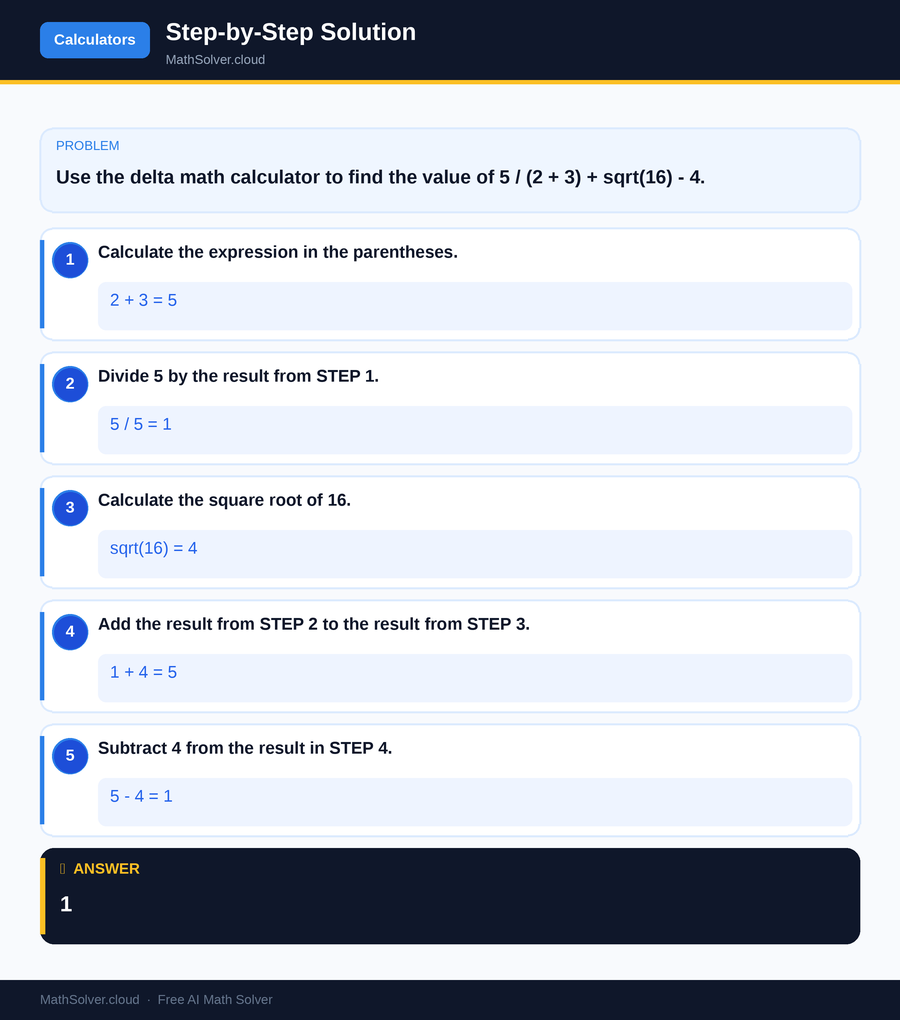
MathSolver Chrome extension solving this problem step-by-step
Example 2
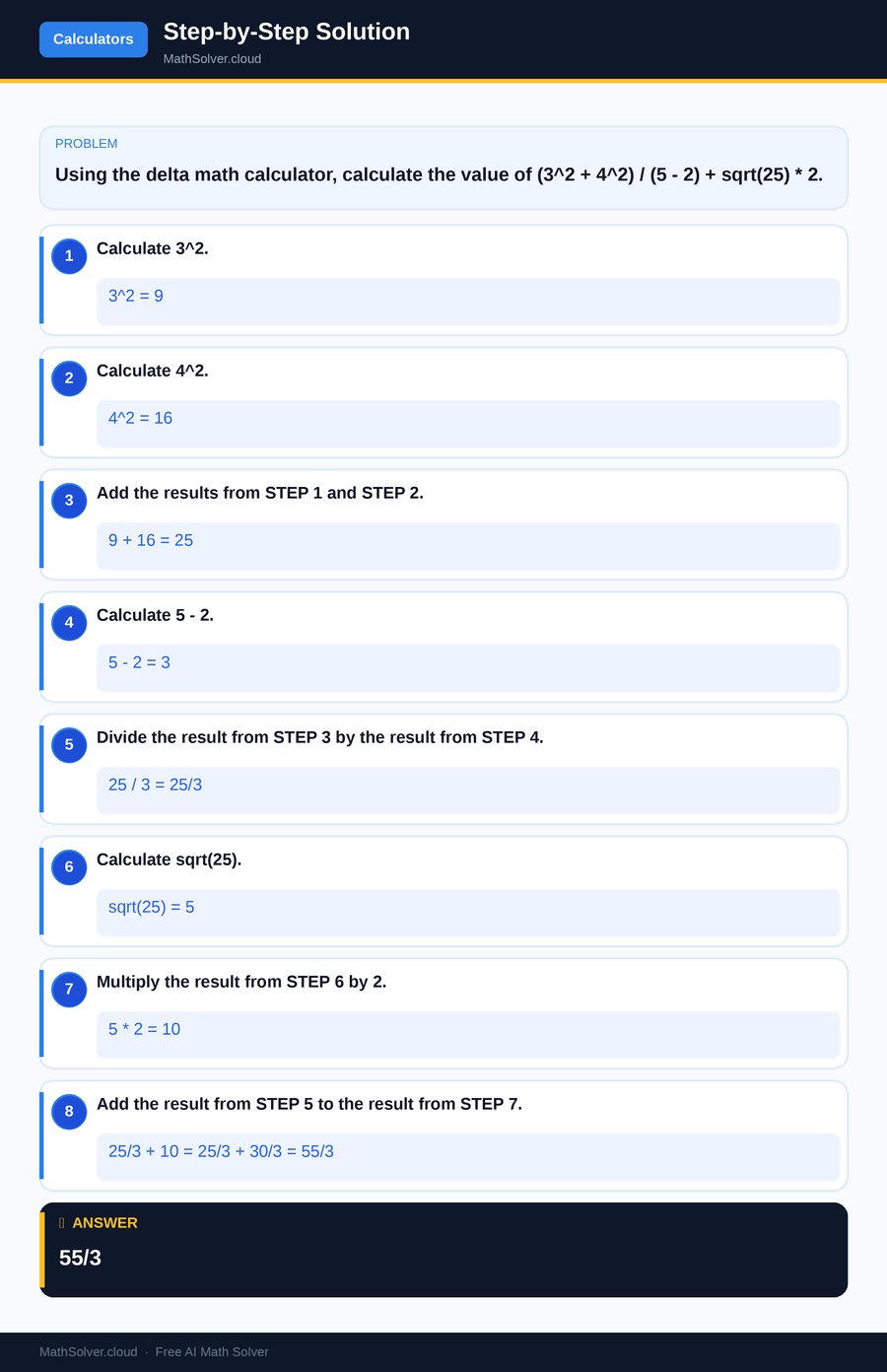
MathSolver Chrome extension solving this problem step-by-step
Common Mistakes to Avoid
One common mistake students make when using the delta math calculator is failing to properly use parentheses, which can lead to incorrect order of operations. Always ensure parentheses are used to group terms correctly, especially in complex equations. Another frequent error is inputting incorrect numbers or symbols, which can completely alter the outcome. Double-check your entries before executing the calculation to avoid these pitfalls.
Additionally, relying solely on the calculator without understanding the steps can hinder learning. While the delta math calculator is a helpful tool, it's crucial to grasp the underlying math concepts to ensure long-term retention and the ability to solve problems independently. Always take time to review and understand each step in the solution process.
Real-World Applications
The delta math calculator is not just a classroom tool; it has practical applications in various real-world scenarios. Engineers, for example, use similar calculators to determine structural loads or material stresses, ensuring safety and efficiency in construction projects. Financial analysts also benefit from such tools, using them to quickly calculate interest rates or investment returns, enabling timely and informed decision-making.
In the realm of technology, programmers and data scientists frequently employ math calculators to troubleshoot algorithms or analyze data sets. The ability to swiftly perform calculations ensures that projects remain on schedule and that analyses yield accurate insights. Whether in science, finance, or technology, the delta math calculator is a versatile instrument that supports precision and efficiency across multiple fields.
Frequently Asked Questions
❓ What is a delta math calculator?
❓ How do I ensure I'm using the delta math calculator correctly?
❓ How can AI help with the delta math calculator?
❓ What are some features of the delta math calculator graph?
❓ Can the delta math calculator provide answers for all types of math problems?
🚀 Solve any math problem instantly
2,000+ students use MathSolver every day — join them for free
📥 Add to Chrome — It's Free