Texas Instruments 30XIIS Scientific/Math Calculator - Orange
📋 In this guide
The Texas Instruments 30XIIS scientific/math calculator - orange is a popular tool among students and professionals alike, known for its reliability and functionality in performing a wide range of mathematical operations. This particular model, with its vibrant orange color, is a favorite for its ease of use and visibility in classroom settings. Many students, however, find themselves overwhelmed by the array of functions available on the calculator, unsure of how to leverage its full potential. In this article, we'll explore the features of the Texas Instruments 30XIIS scientific/math calculator - orange, helping you understand its capabilities and how to use it effectively.
For students tackling subjects like algebra, physics, or any math-related course, the Texas Instruments 30XIIS scientific/math calculator - orange can be an invaluable ally. It is designed to handle complex calculations, including algebraic functions, trigonometry, and statistical analysis. Yet, without proper guidance, students might struggle to use it efficiently, leading to errors in their calculations. This guide aims to demystify the calculator, providing you with clear instructions and practical examples to help you navigate its features with confidence.
By the end of this article, you'll have a comprehensive understanding of how to operate the Texas Instruments 30XIIS scientific/math calculator - orange. We'll walk you through key formulas, offer step-by-step instructions, solve typical problems, and highlight common mistakes to avoid. Whether you're using it as an algebra calculator or for other mathematical functions, this guide will help you master your calculator skills and boost your confidence in handling math challenges.
Step-by-Step: How to Solve Texas Instruments 30Xiis Scientific/Math Calculator - Orange
Step 1: Familiarize Yourself with the Calculator Layout
To begin using the Texas Instruments 30XIIS scientific/math calculator - orange, start by familiarizing yourself with its layout. The calculator has a two-line display which allows you to view both the input and the result simultaneously. The function keys are clearly labeled, making it easier to access different operations. Spend some time exploring the keys for basic operations, such as addition, subtraction, multiplication, and division, as well as more complex functions like exponents, square roots, and trigonometry.
Step 2: Setting Up Your Calculator for Calculations
Before diving into calculations, ensure your calculator is set up correctly. Press the "Mode" button to access various settings. You can choose between degrees or radians for angle measurements, select the number of decimal places for results, and switch between normal or scientific notation. Understanding these settings will help you obtain results in the desired format, particularly when dealing with calculations involving trigonometry or scientific data.
Step 3: Performing Basic Calculations
Once your calculator is set up, you can start performing basic calculations. For arithmetic operations, enter the numbers and operators in sequence. For example, to calculate 5 + 3, press "5", "+", "3", and then "=" to see the result. For operations involving multiple steps, remember to follow the order of operations (PEMDAS). Use parentheses to group calculations and ensure accuracy, especially when working with complex expressions.
Step 4: Utilizing Advanced Functions
The Texas Instruments 30XIIS scientific/math calculator - orange is equipped with advanced functions that cater to higher-level math. To calculate exponents, use the "^" key. For square roots, press the "sqrt" key followed by the number. The calculator also supports trigonometric functions such as sine, cosine, and tangent. Simply press the corresponding function key and enter the angle value, ensuring your calculator is set to the correct mode (degrees or radians).
🤖 Stuck on a math problem?
Take a screenshot and let our AI solve it step-by-step in seconds
⚡ Try MathSolver Free →Worked Examples
Example 1

MathSolver Chrome extension solving this problem step-by-step
Example 2
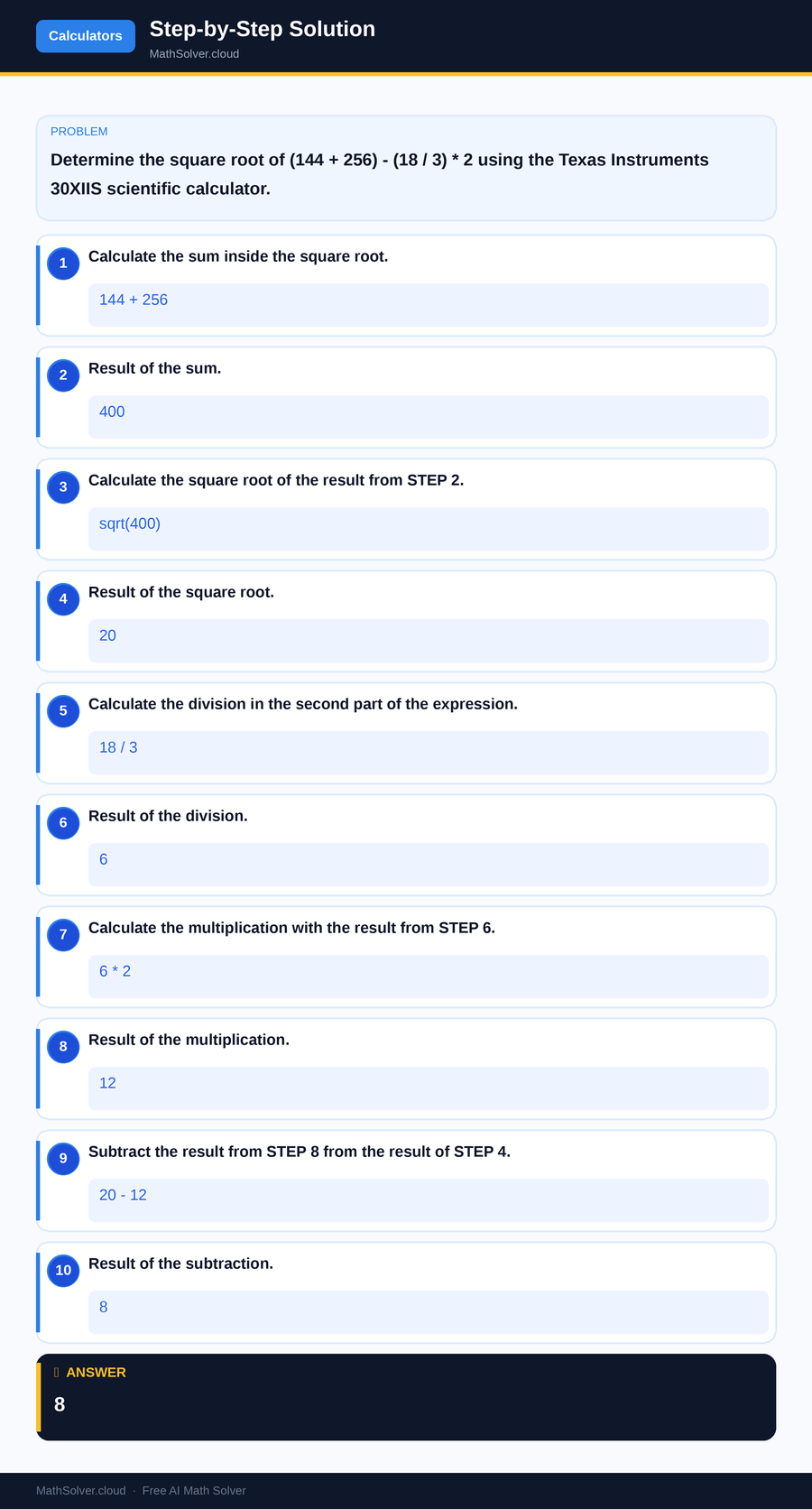
MathSolver Chrome extension solving this problem step-by-step
Common Mistakes to Avoid
One common mistake students make when using the Texas Instruments 30XIIS scientific/math calculator - orange is neglecting the order of operations. Misplacing parentheses or performing operations out of sequence can lead to incorrect results. Always remember to prioritize calculations inside parentheses and follow the PEMDAS rule to ensure accuracy.
Another frequent error is incorrect mode settings, especially when dealing with trigonometric functions. If your calculator is set to radians instead of degrees, or vice versa, the results will be inaccurate. Always double-check your mode settings before performing calculations involving angles.
Real-World Applications
The Texas Instruments 30XIIS scientific/math calculator - orange is widely used in educational settings, particularly in math and science classes. It helps students perform complex calculations efficiently, enabling them to focus on understanding the concepts rather than being bogged down by arithmetic.
In professional environments, this calculator is used by engineers, architects, and scientists who require precise calculations for design and analysis. For example, engineers may use it to solve system of equations or calculate load distributions, while scientists might use it for statistical analysis and data interpretation.
Frequently Asked Questions
❓ What makes the Texas Instruments 30XIIS scientific/math calculator - orange unique?
❓ Can I use this calculator for algebra?
❓ How can AI help with the Texas Instruments 30XIIS scientific/math calculator - orange?
❓ How do I change the angle mode on my calculator?
❓ What should I do if my calculator displays an error message?
🚀 Solve any math problem instantly
2,000+ students use MathSolver every day — join them for free
📥 Add to Chrome — It's Free