Mastering Trigonometric Equations
📋 In this guide
Trigonometric equations are mathematical expressions that involve trigonometric functions such as sine, cosine, tangent, and their inverses. These equations can range from simple to complex and are a fundamental part of algebra and calculus. Many students find trigonometric equations challenging because they require a strong understanding of both algebraic manipulation and the properties of trigonometric functions. However, with practice and the right strategies, solving these equations can become a manageable and even enjoyable task.
Understanding trigonometric equations is crucial for students as they often appear in various branches of mathematics and its applications. Whether it's analyzing wave patterns, modeling periodic phenomena, or solving problems related to angles and distances, trigonometry plays a vital role. In this article, we'll explore how to solve trigonometric equations, providing you with the necessary tools and techniques to tackle them with confidence.
By the end of this article, you'll have a clearer understanding of what trigonometric equations are, the common pitfalls to avoid, and how they can be applied in real-world situations. We’ll start by breaking down the key formulas, guide you through a step-by-step process for solving these equations, and provide detailed worked examples. Additionally, we'll delve into some frequently asked questions and highlight how tools like the trigonometric equations calculator can assist you in your learning journey.
Step-by-Step: How to Solve Trigonometric Equations
Step 1: Identify the Trigonometric Function
The first step in solving trigonometric equations is to identify the trigonometric function involved. Determine whether the equation involves sine, cosine, tangent, or another trigonometric function. This recognition is pivotal because each function has distinct properties and cycles that influence how you approach finding the solution. For example, if you have an equation like sin(x) = 0.5, you know you’re dealing with the sine function, which oscillates between -1 and 1 and has specific angles where it reaches 0.5.
Step 2: Isolate the Trigonometric Function
Once you've identified the trigonometric function, the next step is to isolate it. This involves rearranging the equation so that the trigonometric function is on one side of the equation, and all other terms are on the other side. For example, if your equation is 2sin(x) + 1 = 3, subtract 1 from both sides and then divide by 2 to get sin(x) = 1. Isolating the function simplifies the problem and makes it easier to apply inverse trigonometric functions.
Step 3: Determine the General Solution
After isolating the trigonometric function, use the appropriate inverse trigonometric function to find the general solution. The general solution includes all possible angles that satisfy the equation. For instance, if you have sin(x) = 0.5, you’d use the inverse sine function to find that x = 30 degrees or x = 150 degrees in one cycle. Remember, trigonometric functions are periodic, so you will need to account for additional solutions by adding the period of the function (for sine and cosine, this is 360 degrees) multiplied by an integer k.
Step 4: Apply the Domain Constraints
Finally, apply any domain constraints to find the specific solutions within the given interval. If the problem specifies that 0 <= x <= 360 degrees, you will substitute values of k to find all solutions within this range. For example, if the general solution for sin(x) = 0.5 is x = 30 + 360k and x = 150 + 360k, you check values of k (such as k = 0, 1, -1) to find which solutions fall within the 0 to 360-degree interval.
🤖 Stuck on a math problem?
Take a screenshot and let our AI solve it step-by-step in seconds
⚡ Try MathSolver Free →Worked Examples
Example 1
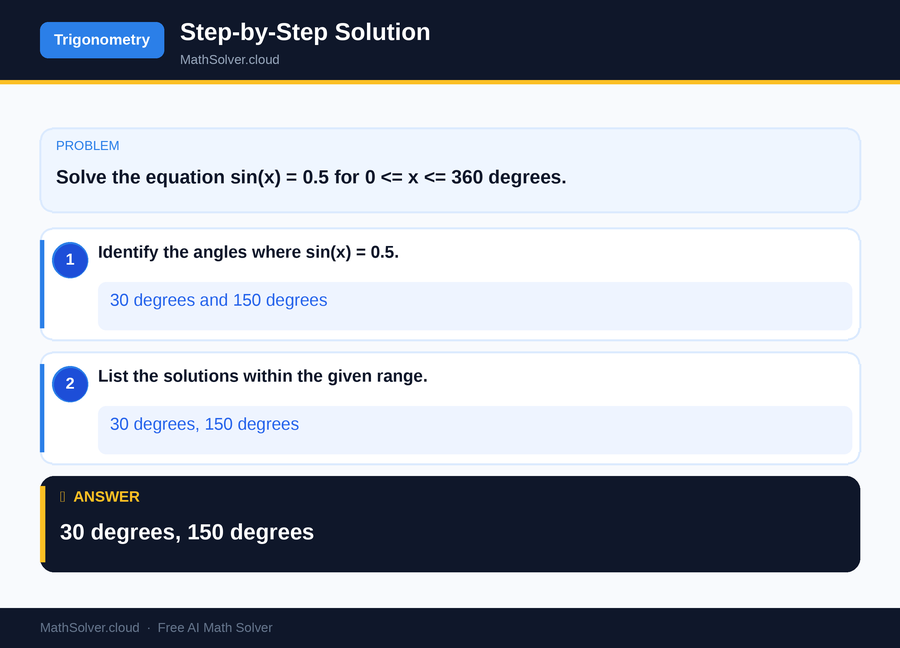
MathSolver Chrome extension solving this problem step-by-step
Example 2
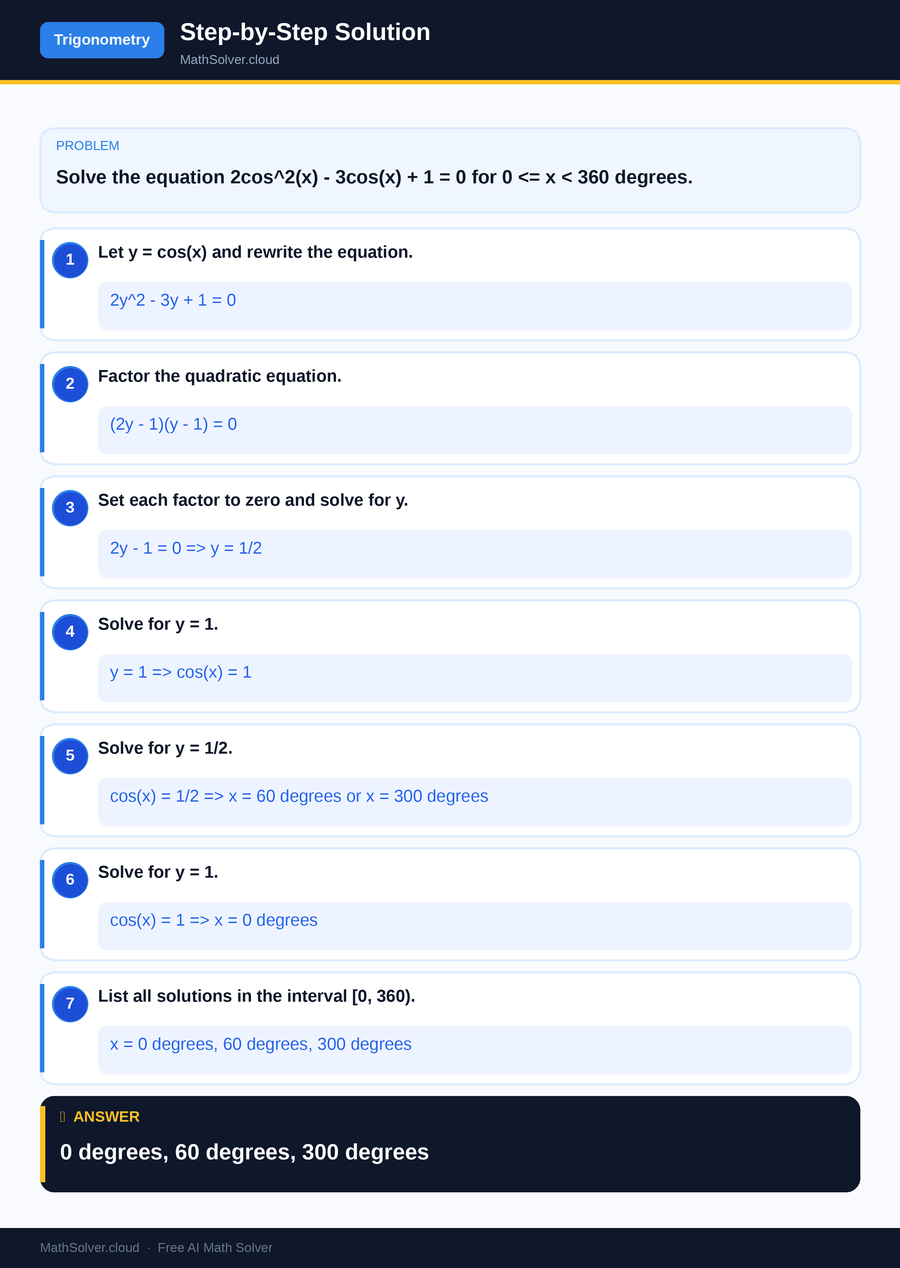
MathSolver Chrome extension solving this problem step-by-step
Common Mistakes to Avoid
A common mistake students make when solving trigonometric equations is failing to consider all possible solutions within the given domain. Due to the periodic nature of trigonometric functions, there can be multiple solutions, and it's crucial to consider them all by adding multiples of the function's period. Always double-check your solutions against the original equation to ensure they are correct.
Another frequent error is incorrect use of inverse trigonometric functions. Remember that these functions can have multiple outputs, especially when considering different quadrants on the unit circle. Ensure that you understand which angles correspond to your solutions and that they fit within the specified range.
Real-World Applications
Trigonometric equations are not just abstract mathematical concepts; they have practical applications across various fields. In engineering, they are used to model oscillations and waves, which is essential for understanding sound and light waves, as well as alternating current in electrical circuits. The repetitive nature of these equations makes them ideal for describing phenomena that occur in cycles.
In the realm of architecture, trigonometric equations help in designing buildings and structures by calculating angles and ensuring stability. They are also crucial in navigation and geography for calculating distances and plotting courses based on the curvature of the Earth. These real-world applications demonstrate the importance of mastering trigonometric equations.
Frequently Asked Questions
❓ What are trigonometric equations?
❓ Why do students struggle with solving trigonometric equations?
❓ How can AI help with trigonometric equations?
❓ What is the equation for diagonal to the right sine curve?
❓ How do trigonometric equations relate to the equation of tangent plane?
🚀 Solve any math problem instantly
2,000+ students use MathSolver every day — join them for free
📥 Add to Chrome — It's Free