Mastering the Tangent Equation
📋 In this guide
The tangent equation is a crucial concept in calculus that represents the line which just touches a curve at a given point without crossing it. This line is important because it provides the best linear approximation of the curve near that point. Many students find themselves grappling with the tangent equation because it involves both algebraic manipulation and an understanding of derivatives, two areas that can be challenging.
Understanding the tangent equation is essential for anyone studying calculus or related fields, as it is fundamental in understanding rates of change and slopes of curves. In this guide, we'll unravel the complexities of the tangent equation, breaking down the essential steps and providing clear examples. By the end, you'll know not only how to find the tangent equation but also how to apply it in various contexts.
Students often struggle with the tangent equation due to the intricacies of calculus and the precision required in calculations. Here, we'll focus on demystifying this topic, providing you with a solid grasp of how to find the tangent equation using a step-by-step approach. You'll also discover how tools like a tangent equation calculator can simplify your work, along with exploring common pitfalls and real-world applications.
Step-by-Step: How to Solve Tangent Equation
Step 1: Find the Derivative
The first step in determining the tangent equation is to find the derivative of the function, as this represents the slope of the tangent line. The derivative, denoted as f'(x), tells us how the function y = f(x) changes at any point x. To compute this, apply the rules of differentiation to your function. For example, if y = tan(x), then the derivative is f'(x) = sec^2(x).
Step 2: Evaluate the Derivative at the Point of Interest
Once you have the derivative, evaluate it at the specific point where you need the tangent line. This gives you the slope of the tangent line at that point. If you're working with y = f(x) and want the tangent at x = a, compute f'(a). For instance, if x = pi/4 and f'(x) = sec^2(x), then f'(pi/4) = sec^2(pi/4) = 2.
Step 3: Use the Point-Slope Formula
With the slope determined, use the point-slope formula to find the tangent equation. The point-slope formula is y - f(a) = f'(a)(x - a), where (a, f(a)) is the point of tangency, and f'(a) is the slope found in Step 2. Substitute the values into this formula to get the equation of the tangent line.
Step 4: Simplify the Equation
Finally, simplify the equation to make it presentable and easier to understand or use in further calculations. This usually involves basic algebraic manipulation to solve for y in terms of x, or to put the equation in a more straightforward form. Ensure your final equation is clear and simplified to avoid any confusion in interpretation or application.
🤖 Stuck on a math problem?
Take a screenshot and let our AI solve it step-by-step in seconds
⚡ Try MathSolver Free →Worked Examples
Example 1
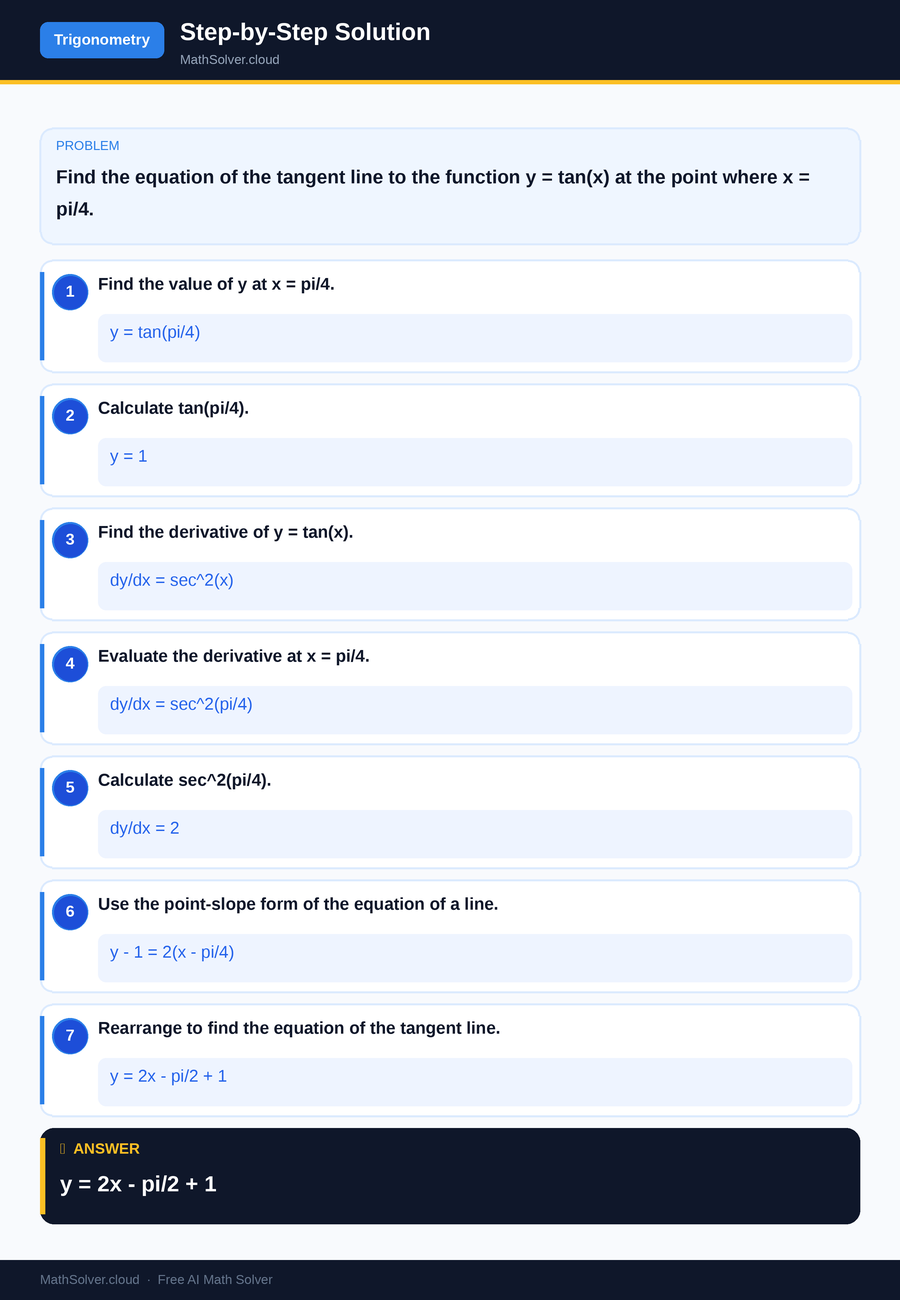
MathSolver Chrome extension solving this problem step-by-step
Example 2
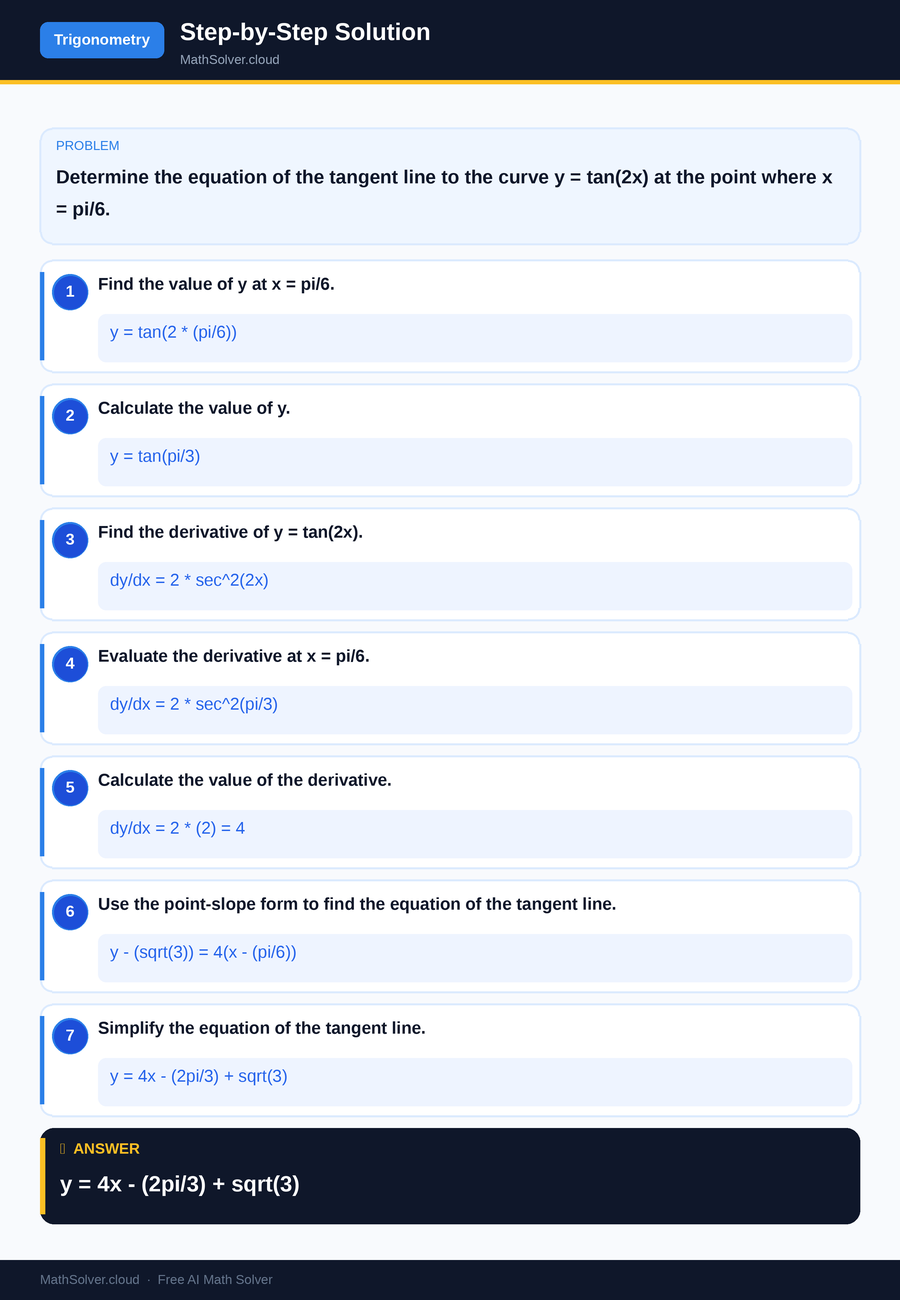
MathSolver Chrome extension solving this problem step-by-step
Common Mistakes to Avoid
One common mistake students make is miscalculating the derivative, especially when dealing with trigonometric functions. Remember, each function has specific rules for differentiation, and overlooking these can lead to errors. Always double-check your differentiation steps, especially when functions are nested or involve compositions like tan(2x).
Another frequent error is failing to simplify the final tangent equation correctly. After using the point-slope form, take care to perform algebraic manipulations accurately. Missteps here can lead to incorrect or overly complicated equations. Practice ensuring each step is precise and review each calculation to avoid these pitfalls.
Real-World Applications
Tangent equations have numerous applications in real-world scenarios. For example, in engineering, they help in determining the slope of a curve at a specific point, which is crucial for understanding stress and strain in materials. Similarly, in physics, they are used to find instantaneous rates of change, such as velocity and acceleration.
In economics, the tangent equation is employed to analyze cost functions and optimize profit. By understanding the slope of the tangent line, economists can make predictions about how small changes in one variable can affect another, providing insights into maximizing efficiency and reducing costs.
Frequently Asked Questions
❓ What is a tangent equation and why is it important?
❓ How do I find the tangent equation of a curve?
❓ How can AI help with the tangent equation?
❓ Can tangent equations be used for all types of functions?
❓ What's the difference between a tangent equation and a cotangent equation?
🚀 Solve any math problem instantly
2,000+ students use MathSolver every day — join them for free
📥 Add to Chrome — It's Free