Mastering the Tangent Plane Equation
📋 In this guide
The tangent plane equation is a fundamental concept in calculus, especially when dealing with multivariable functions. When students first encounter the tangent plane equation, they often find it challenging because it requires an understanding of partial derivatives and how they combine to describe the slope of a surface at a given point. For many, the difficulty lies in visualizing how a flat plane can approximate a curved surface near a particular point.
In this guide, we'll break down the concept of the tangent plane equation and provide a clear, step-by-step approach to finding it. Whether you're a high school student tackling calculus for the first time or a college student in an advanced math course, you'll learn how to find the tangent plane equation and how it applies to real-world situations. Along the way, we'll also touch on related areas of mathematics, such as algebra equations and quadratic equations, to give you a comprehensive understanding of the topic.
By the end of this article, you'll not only be confident in solving problems involving the tangent plane equation but also in understanding its significance in fields ranging from physics, where it relates to kinematic equations, to biology, where similar mathematical principles can describe processes like the photosynthesis equation. Let's dive in and explore the fascinating world of tangent planes!
Step-by-Step: How to Solve Tangent Plane Equation
Step 1: Understand the Problem
Before you can find the tangent plane equation, it's crucial to understand the problem at hand. Identify the surface equation, z = f(x, y), and the point at which you need to find the tangent plane. This point will often be given in the form (x0, y0, z0). For example, if you're given z = 3x^2 + 2y^2 and the point (1, 2, 14), your task is to find the equation of the tangent plane at this specific point.
Step 2: Calculate Partial Derivatives
The next step is to find the partial derivatives, fx and fy. These derivatives represent the rate of change of the function with respect to x and y, respectively. To find fx, differentiate the function with respect to x, treating y as a constant. Similarly, to find fy, differentiate the function with respect to y, treating x as a constant. These derivatives are essential as they give us the slope of the tangent plane in the x and y directions.
Step 3: Evaluate the Derivatives at the Given Point
Once you have fx and fy, the next step is to evaluate these partial derivatives at the given point (x0, y0). This involves substituting the x and y coordinates of the point into the partial derivatives you've calculated. This step gives you the specific values of the slopes at the point of tangency, which are crucial for constructing the tangent plane equation.
Step 4: Construct the Tangent Plane Equation
Finally, substitute the values obtained from the previous steps into the tangent plane formula: z = f(x0, y0) + fx(x0, y0)(x - x0) + fy(x0, y0)(y - y0). This equation represents the plane that just touches the surface at the given point and provides an approximation of the surface near that point. Ensure all calculations are accurate, as errors here can lead to incorrect results.
🤖 Stuck on a math problem?
Take a screenshot and let our AI solve it step-by-step in seconds
⚡ Try MathSolver Free →Worked Examples
Example 1
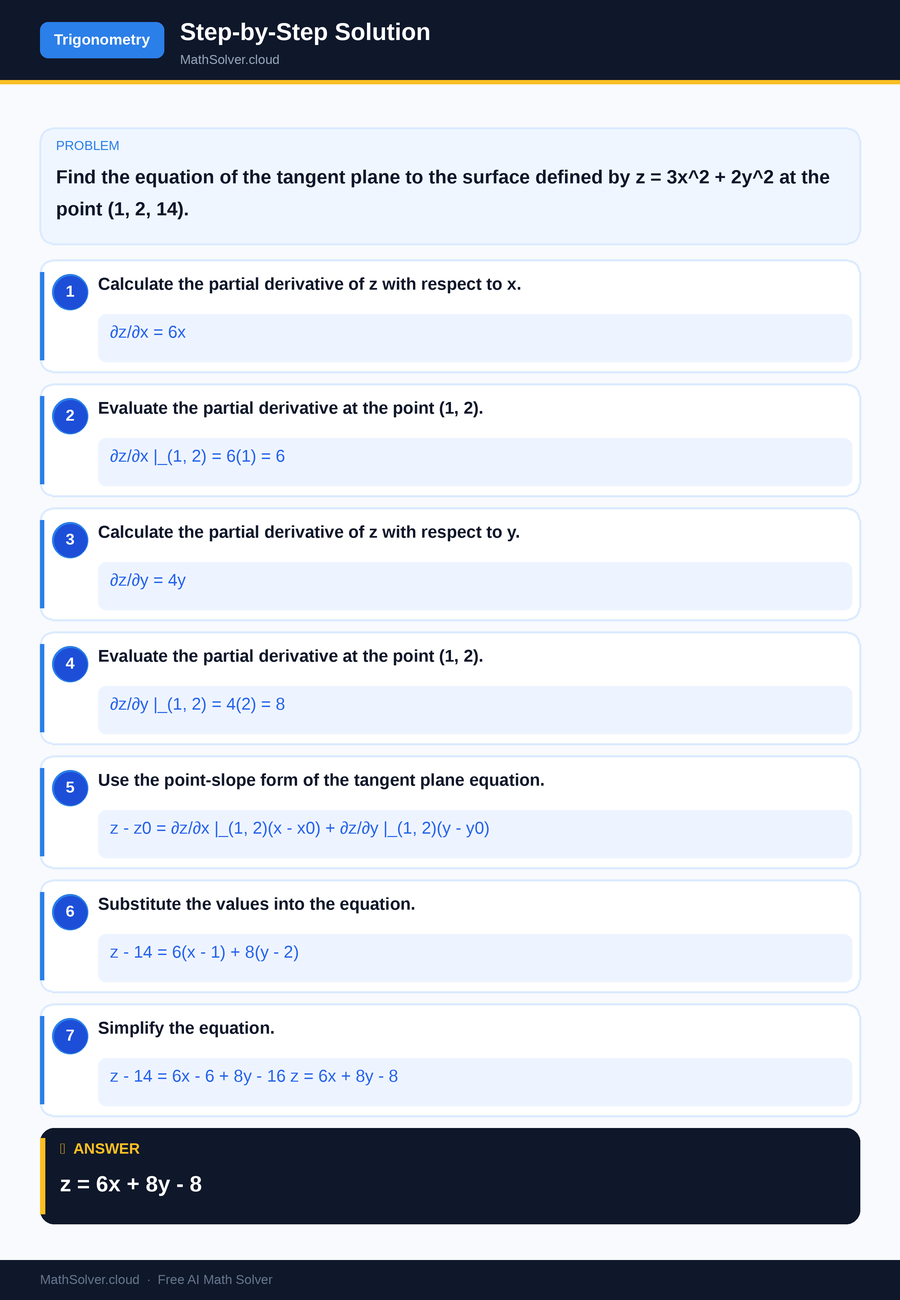
MathSolver Chrome extension solving this problem step-by-step
Example 2
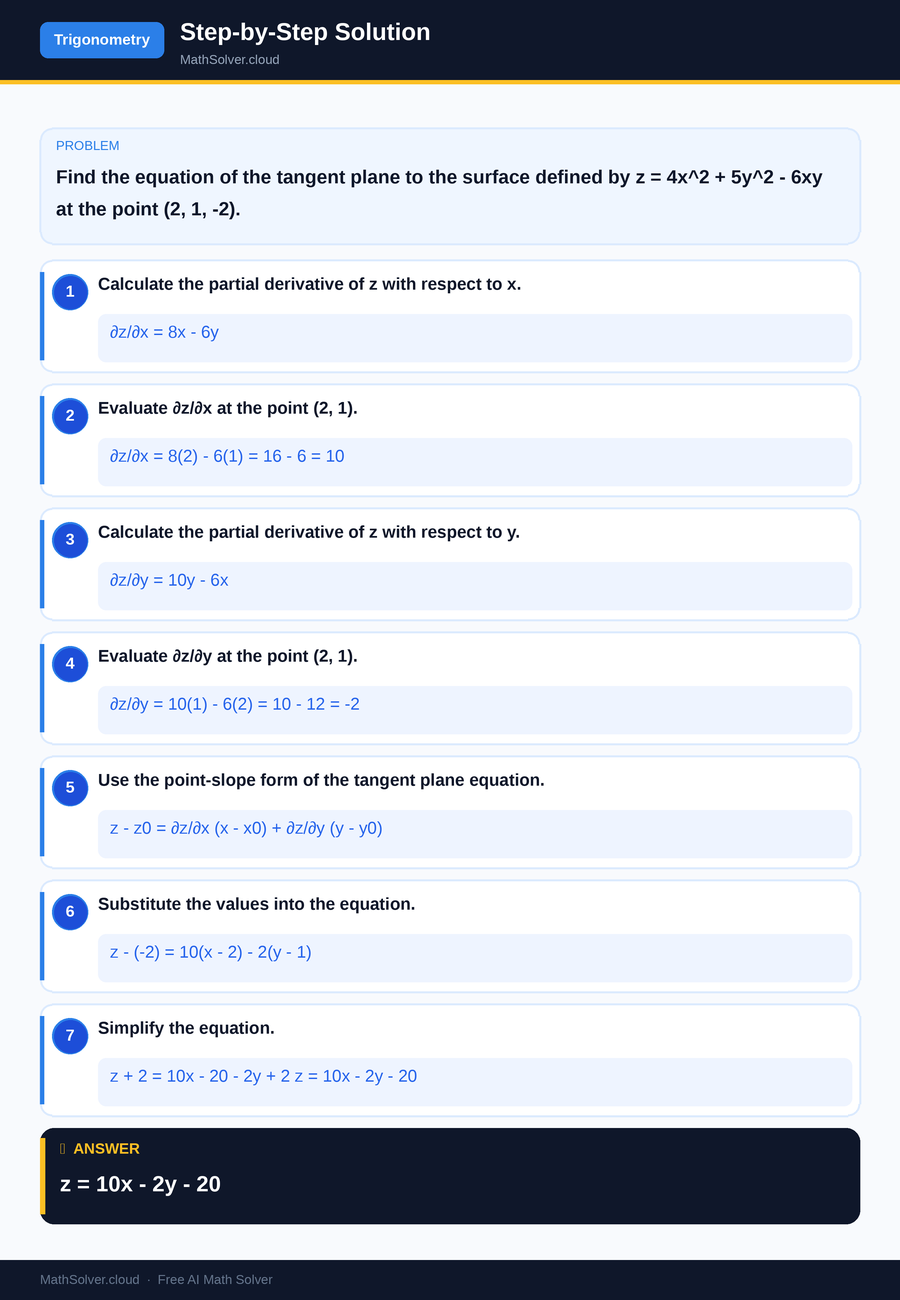
MathSolver Chrome extension solving this problem step-by-step
Common Mistakes to Avoid
One common mistake is failing to correctly compute the partial derivatives. This error often arises from neglecting to treat one variable as a constant when differentiating with respect to the other. To avoid this, always double-check your differentiation steps.
Another mistake is miscalculating the evaluation of derivatives at the given point, which can lead to an incorrect tangent plane equation. Students should carefully substitute the point's coordinates into the derivatives and ensure their arithmetic is accurate.
Additionally, forgetting to substitute the z-coordinate of the point into the tangent plane equation is a frequent oversight. Remember, the tangent plane equation should account for the surface's elevation at the point of tangency. Keeping track of all components and performing a final review of your calculations can help prevent these errors.
Real-World Applications
The tangent plane equation has numerous real-world applications, particularly in engineering and physics. In computer graphics, for instance, tangent planes are used to approximate the surfaces of 3D models, aiding in rendering realistic images.
Another application is in optimization problems, where tangent planes can help identify the maximum or minimum values of a function, crucial for efficient resource allocation.
In the field of physics, tangent planes are integral to analyzing motion and forces in kinematic equations. For instance, when studying the trajectory of an object, the tangent plane can provide insights into its instantaneous velocity and acceleration. These applications underscore the importance of understanding the tangent plane equation beyond theoretical exercises.
Frequently Asked Questions
❓ What is the tangent plane equation, and why is it important?
❓ How do you find a tangent plane equation?
❓ How can AI help with tangent plane equations?
❓ Why do students often confuse tangent plane equations with other types of equations?
❓ Are tangent plane equations used in biology?
🚀 Solve any math problem instantly
2,000+ students use MathSolver every day — join them for free
📥 Add to Chrome — It's Free