Understanding and Solving Trig Equations
📋 In this guide
Trig equations, or trigonometric equations, are mathematical expressions that involve trigonometric functions such as sine, cosine, tangent, and their inverses. These equations often present a challenge for students due to their complex nature and the variety of methods available for solving them. Understanding trig equations is crucial because they form the backbone of many advanced topics in mathematics and are widely applicable in various scientific fields.
Students often struggle with trig equations because they require not only an understanding of basic trigonometric functions but also the ability to manipulate these functions in equation form. The periodic properties of trigonometric functions add an extra layer of complexity, as solutions may involve multiple angles within a given range. In this article, we will explore the essential concepts and strategies for solving trig equations, providing clarity and confidence to tackle these mathematical challenges.
By the end of this guide, you will have a solid grasp of the techniques involved in solving trig equations. We will cover key formulas, provide a step-by-step guide, and work through detailed examples. Whether you're preparing for an exam or simply seeking to strengthen your understanding, this article will equip you with the tools and insights needed to master trig equations.
Step-by-Step: How to Solve Trig Equations
Step 1: Identify the Trigonometric Function
The first step in solving trig equations is to identify the trigonometric function involved. Determine whether the equation includes sine, cosine, tangent, or any of their inverses. This identification will guide you in applying the appropriate identities and inverse functions. For instance, if the equation is 2sin(x) = 1, you know you are dealing with the sine function, and you can proceed by isolating sin(x).
Step 2: Simplify the Equation
Once you have identified the trigonometric function, simplify the equation as much as possible. This might involve factoring, combining like terms, or using trigonometric identities to rewrite the equation in a more manageable form. For example, if you have 2cos^2(x) - 1 = 0, you can use the identity cos^2(x) = (1 + cos(2x))/2 to simplify the expression further.
Step 3: Solve for the Trigonometric Function
With a simplified equation, the next step is to solve for the trigonometric function itself. This often involves isolating the function on one side of the equation. If you have an equation like tan(x) = sqrt(3), you would use the inverse tangent function, or arctan, to find the angle x. Be mindful of the function's periodicity, which may result in multiple solutions within a given interval.
Step 4: Find All Possible Solutions
Finally, find all possible solutions for the variable within the specified domain. Trigonometric functions are periodic, meaning they repeat their values in regular intervals. Therefore, you must consider all angles that satisfy the equation within the specified range. For example, if solving for x in the interval 0 <= x <= 360 degrees, remember to account for each instance the function value occurs within this range.
🤖 Stuck on a math problem?
Take a screenshot and let our AI solve it step-by-step in seconds
⚡ Try MathSolver Free →Worked Examples
Example 1

MathSolver Chrome extension solving this problem step-by-step
Example 2
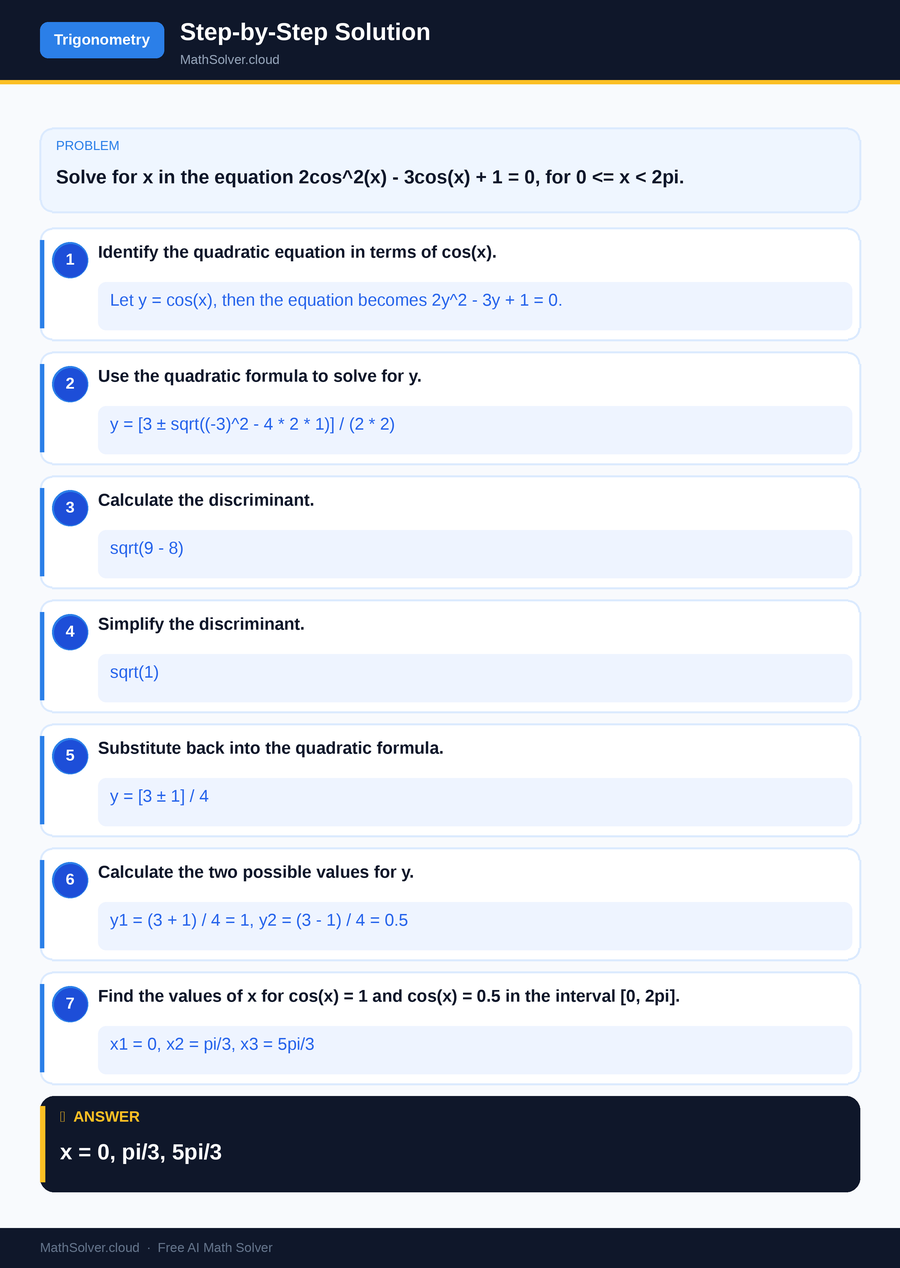
MathSolver Chrome extension solving this problem step-by-step
Common Mistakes to Avoid
A common mistake when solving trig equations is forgetting the periodic nature of trigonometric functions, which can lead to missing solutions. Always consider the complete set of solutions within the specified interval by adding the appropriate periodicity, such as 360 degrees for sine and cosine or pi for tangent. Another frequent error is neglecting to check solutions against the original equation, especially after using identities or inverse functions, which might introduce extraneous solutions.
Additionally, students often overlook the importance of understanding the domain of the trigonometric functions involved. This oversight can lead to incorrect solutions or misinterpretation of the problem. Pay careful attention to the domain and range of inverse trigonometric functions and consider the implications when determining the final solutions.
Real-World Applications
Trig equations are not just theoretical constructs; they have numerous practical applications. One of the most common uses is in engineering, where trig equations help model periodic phenomena such as sound waves, light waves, and alternating current circuits. Engineers use these equations to design and analyze systems that rely on wave behavior, such as radio transmission or structural engineering that involves vibrations.
In the field of geography and navigation, trig equations are used to calculate distances and angles between points on the Earth's surface. For instance, the equation for diagonal to the right sine curve can help determine the shortest path between two geographical points. Trig equations also play a crucial role in computer graphics, where they are used to simulate natural motion, create realistic lighting, and model complex surfaces, such as the equation of a tangent plane.
Frequently Asked Questions
❓ What are trig equations?
❓ Why do students struggle with solving trig equations?
❓ How can AI help with trig equations?
❓ What is a tangent equation, and how is it used?
❓ Where can I find resources to practice solving trig equations?
🚀 Solve any math problem instantly
2,000+ students use MathSolver every day — join them for free
📥 Add to Chrome — It's Free