Mastering the Tangent Line Equation
📋 In this guide
The tangent line equation is a fundamental concept in calculus that describes a line which just touches a curve at a specific point. This mathematical tool is crucial for understanding how functions behave at any given point by examining their slopes. Many students find the tangent line equation challenging because it involves concepts such as derivatives and slopes, which can seem abstract at first. However, mastering this topic is vital for solving complex mathematical problems and for applications in physics, engineering, and economics.
In this article, we will demystify the process of finding the tangent line equation. You'll learn about the key formula and the steps involved in deriving the equation. By breaking down the process into manageable parts, you'll gain the confidence to tackle these problems on your own. Whether you're a student trying to find the slope of the tangent line equation or a professional looking to understand its applications, this guide is for you.
You'll also find worked examples that illustrate how to find the tangent line equation for different functions. By the end of this article, you will be equipped with the knowledge to approach any problem involving tangent lines. We'll also discuss common mistakes to avoid, real-world applications, and answer frequently asked questions to ensure that you have a well-rounded understanding of this important concept.
Step-by-Step: How to Solve Tangent Line Equation
Step 1: Identify the Function and Point of Tangency
The first step in finding the tangent line equation is to clearly identify the function and the specific point where the tangent line touches the curve. This point is usually given in the problem as (x1, y1). For example, if you are asked to find the tangent line to the function y = f(x) at x = a, then your point of tangency is (a, f(a)).
Step 2: Calculate the Derivative
Once you have the function and the point of tangency, the next step is to calculate the derivative of the function. The derivative, often denoted as f'(x), represents the slope of the function at any point x. It is crucial because it gives you the slope of the tangent line at the point of tangency. Use standard differentiation rules to find this derivative.
Step 3: Evaluate the Derivative at the Point of Tangency
After finding the derivative, evaluate it at the x-coordinate of the point of tangency. This means you substitute x1 into f'(x) to find the slope of the tangent line, m. For example, if your derivative is f'(x) = 2x and your point of tangency is x = 3, then m = 2(3) = 6.
Step 4: Use the Point-Slope Formula to Find the Tangent Line Equation
Finally, substitute the slope from Step 3 and the point of tangency into the point-slope formula y - y1 = m(x - x1). Solve for y to express the tangent line equation in slope-intercept form, y = mx + b, if needed. This equation represents the linear approximation of the function at the point of tangency.
🤖 Stuck on a math problem?
Take a screenshot and let our AI solve it step-by-step in seconds
⚡ Try MathSolver Free →Worked Examples
Example 1
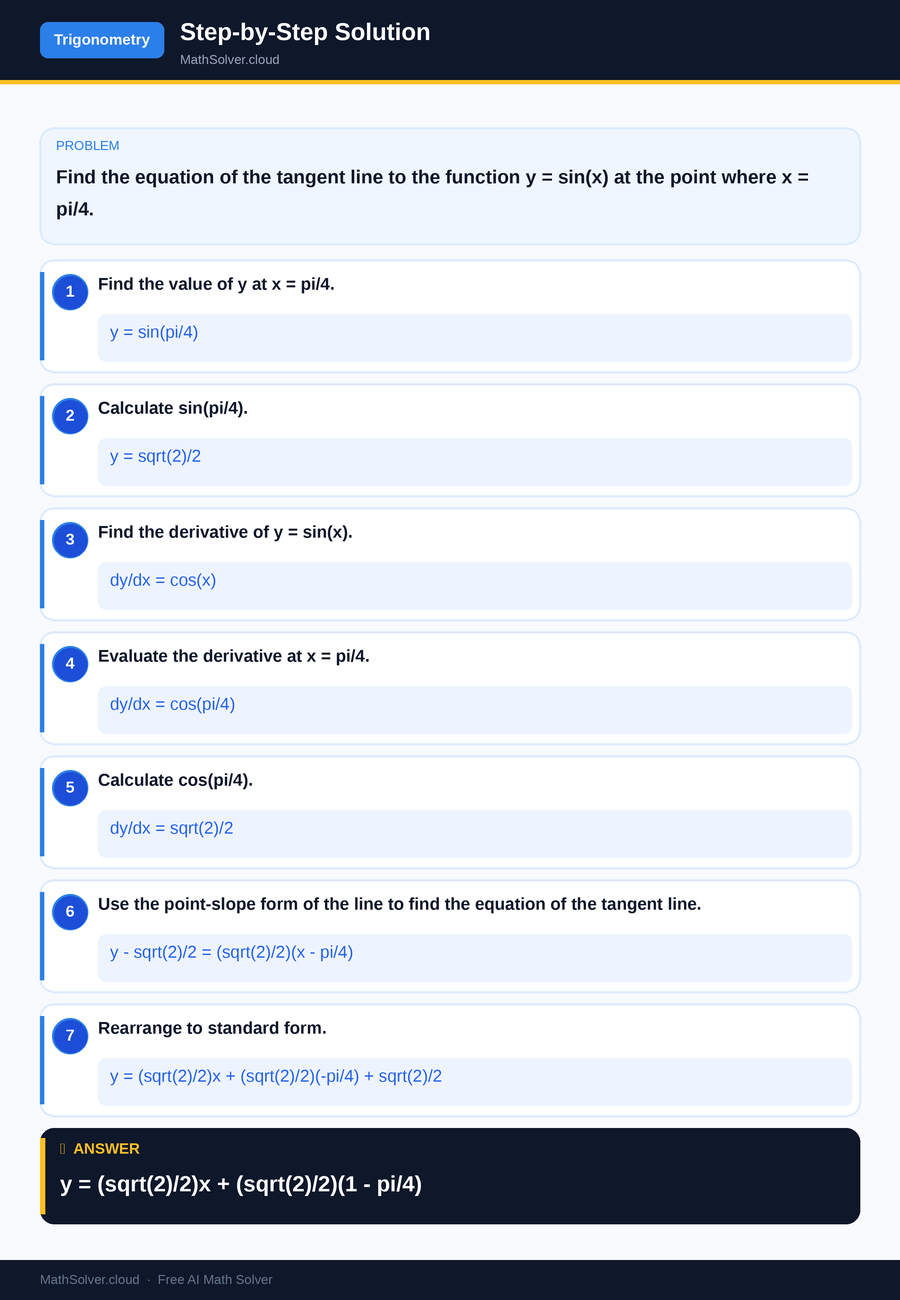
MathSolver Chrome extension solving this problem step-by-step
Example 2
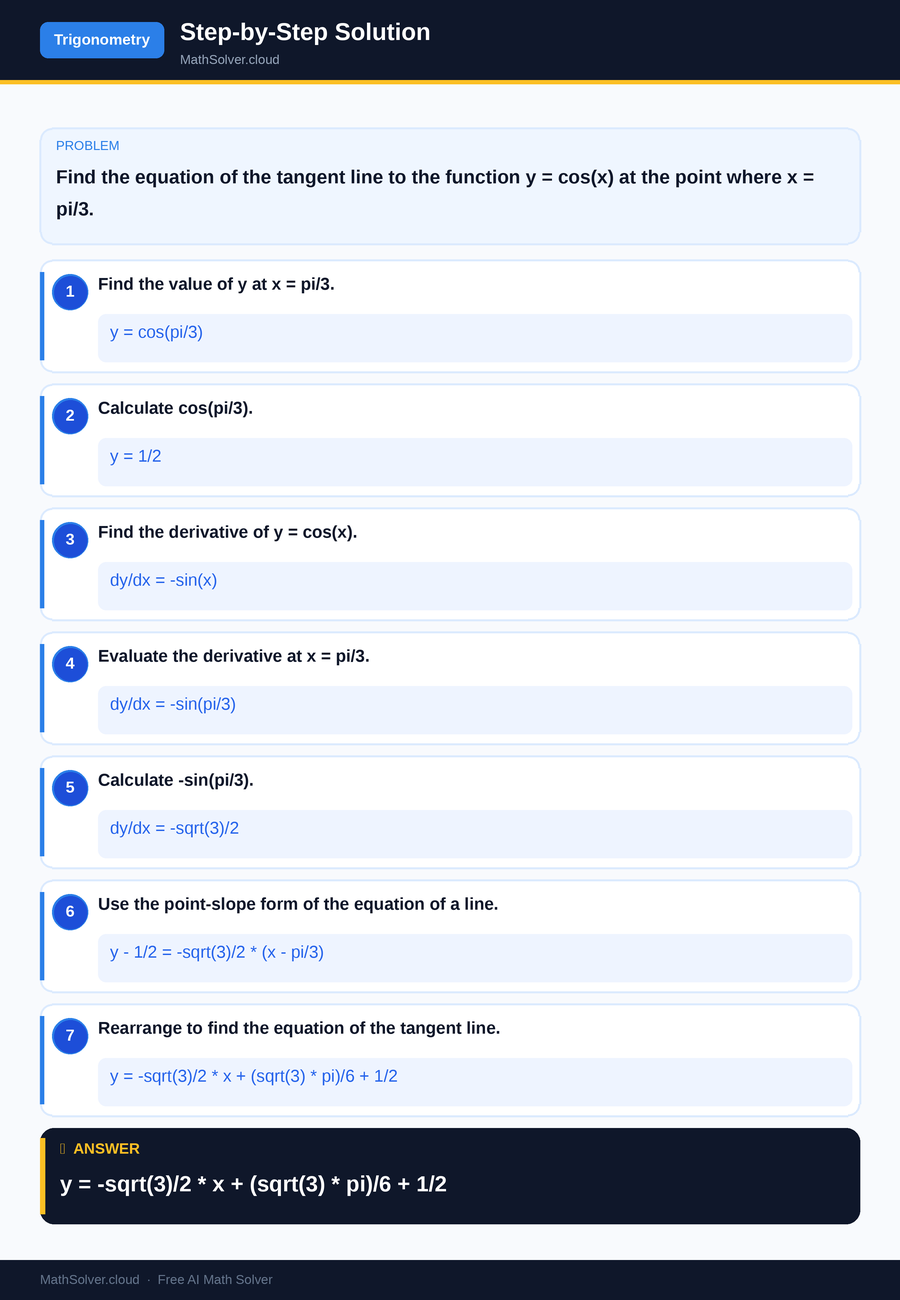
MathSolver Chrome extension solving this problem step-by-step
Common Mistakes to Avoid
One common mistake students make is forgetting to evaluate the derivative at the specific point of tangency. This leads to an incorrect slope and, consequently, an incorrect tangent line equation. Always double-check that you substitute the point correctly into the derivative.
Another frequent error is misapplying the point-slope formula by confusing x1 and y1. Make sure you correctly identify the coordinates of the point of tangency and substitute them into the formula accurately to avoid errors.
Real-World Applications
The tangent line equation has numerous real-world applications. In engineering, it's used to approximate the behavior of materials under stress by examining the slope of stress-strain curves. This helps in designing safer and more efficient structures.
In economics, tangent lines help in determining the marginal cost or revenue by analyzing the slope of cost or revenue functions. This allows businesses to make informed decisions about production levels and pricing strategies.
Frequently Asked Questions
❓ What is a tangent line equation?
❓ Why is finding the tangent line equation important?
❓ How can AI help with tangent line equation problems?
❓ Can tangent lines be used to approximate functions?
❓ How do tangent line equations relate to tangent plane equations?
🚀 Solve any math problem instantly
2,000+ students use MathSolver every day — join them for free
📥 Add to Chrome — It's Free